China's highest-altitude ultra-supercritical coal-fired power unit starts operations, set to bolster grid stability
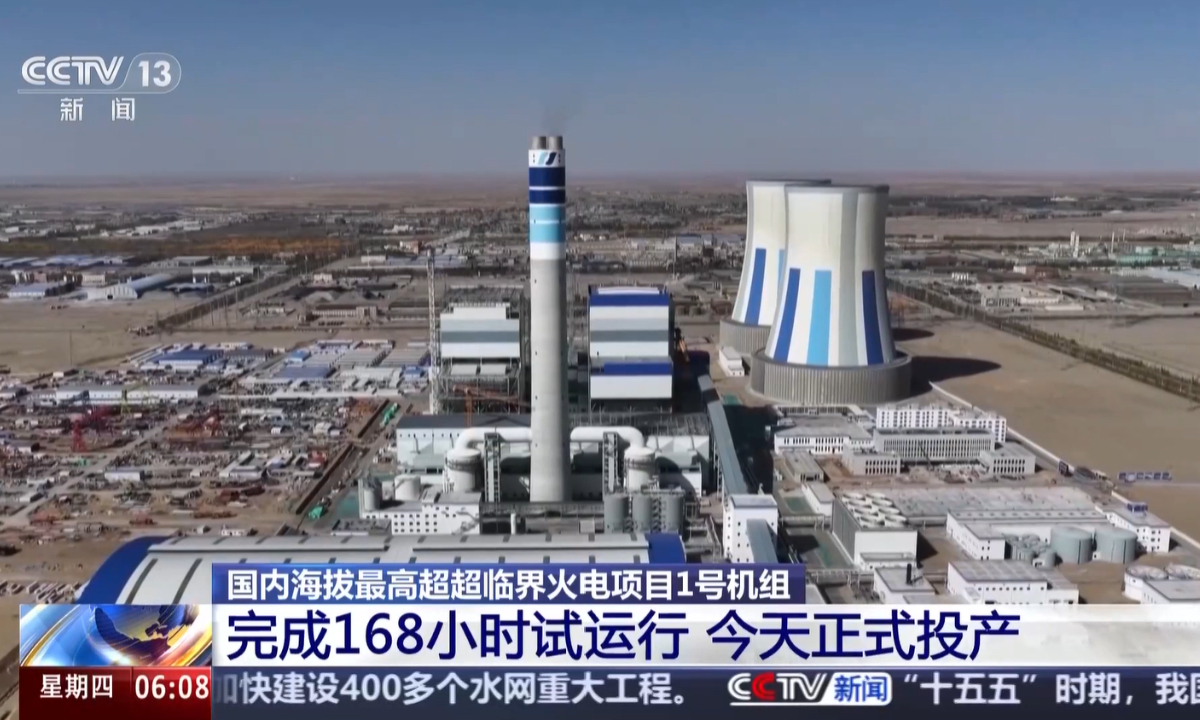
An aerial view of China's highest-altitude ultra-supercritical coal-fired power project in Golmud, Northwest China's Qinghai Province, whose first unit began commercial operations on November 5, 2026. Photo: Screenshot from CCTV
China's highest-altitude ultra-supercritical coal-fired electricity project began commercial operations on Thursday after its first generating unit completed a 168-hour trial run, marking a breakthrough in coal power generation under challenging high-altitude conditions, state broadcaster CCTV News reported.
Located in Golmud, Northwest China's Qinghai Province, at an average altitude of about 2,850 meters, the power project comprises two 660-megawatt ultra-supercritical generating units. It is designed to provide reliable electricity supplies while helping balance fluctuations in renewable energy generation.
Once both units are operational, the project is expected to generate 6 billion kilowatt-hours of electricity annually, enough to meet the yearly electricity needs of approximately 6.6 million residents, Zhao Falin, the project's chief manager at Huadian Golmud Co, said.
He added that the project would strengthen the stability and reliability of Qinghai's power grid while providing flexible back-up capacity to support the large-scale integration of renewable energy.
It’s not easy to build a coal-fired power plant at such an altitude. Low oxygen levels and atmospheric pressure make it harder for coal to burn efficiently, while the high alkali content of the fuel can cause slagging and ash buildup in boilers.
To overcome these challenges, the project introduced oxygen-assisted startup and combustion-stabilization technologies for ultra-low-load operations. The customized boiler system enables the plant to burn high-alkali coal while flexibly adjusting its output to match changing electricity demand, addressing key technical hurdles in high-altitude coal power generation and filling a gap in the industry, according to the report.
Ultra-supercritical technology allows coal-fired power plants to generate electricity using steam at exceptionally high temperatures and pressures, typically above 580 C and 24 megapascals. By extracting more energy from the same amount of coal, the technology improves efficiency, reduces fuel consumption and helps lower emissions.
The Golmud plant's coal consumption per unit of electricity supplied is better than China's national benchmark, the CCTV News report said.
The project incorporates water-saving and waste-management technologies. By treating and reusing reclaimed municipal wastewater from Golmud, the plant has established a closed-loop water management system that achieves zero wastewater discharge. It also reports a 100 percent comprehensive utilization rate for solid waste.
Preparations are now underway for the second unit's full-system startup, with the project aiming to bring both units into commercial operation by the end of the year, according to the report.
Global Times
RELATED ARTICLES