Takaichi’s remarks on Shodo’s UNESCO bid spark renewed discussion over its Chinese roots
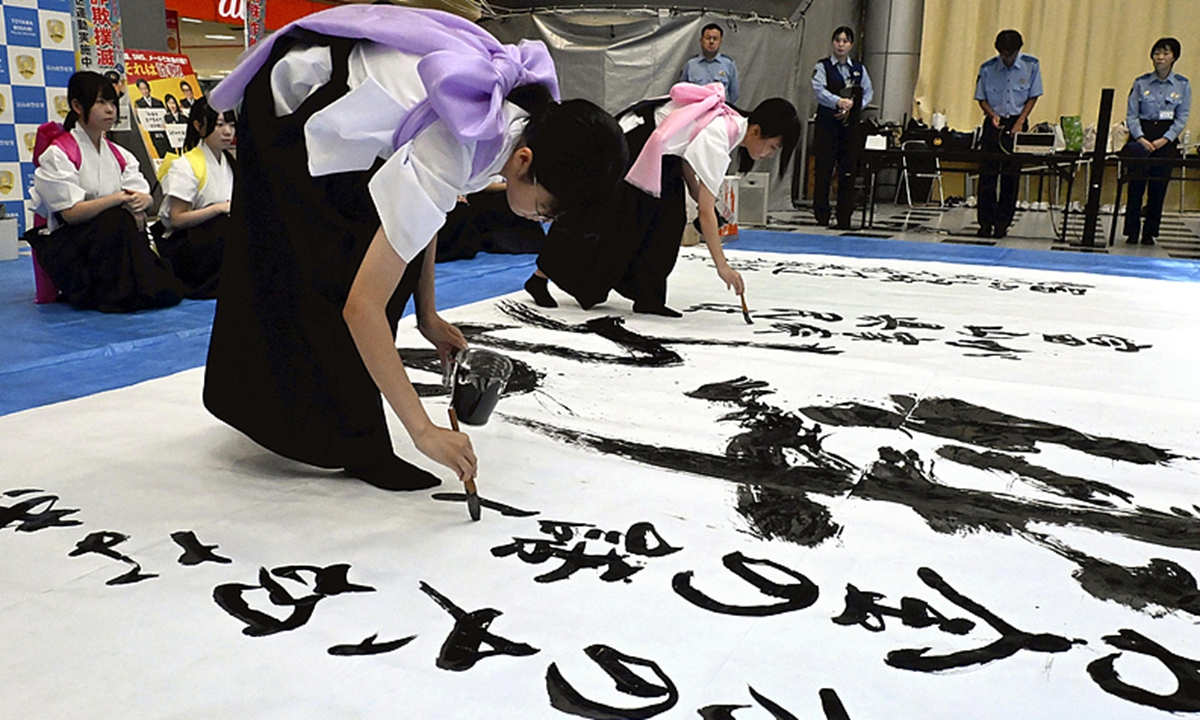
Students perform calligraphy in Toyama City, Japan, on August 24, 2026. Photo: VCG
An advisory body of the United Nations Educational, Scientific and Cultural Organization has recommended adding Japanese calligraphy, known as "Shodo", to its Intangible Cultural Heritage list, according to Japanese media outlets. However, Japanese Prime Minister Sanae Takaichi has been criticized for obscuring Shodo's Chinese origins.A decision on whether to inscribe it is expected to be made at a session of UNESCO's intergovernmental committee in Xiamen, East China's Fujian Province, to be held from November 30 to December 5.
According to Japan's Agency for Cultural Affairs, Shodo is a traditional art form that employs kanji and kana characters. It claimed that Japan has developed its own styles since the introduction of Chinese characters.
Chinese calligraphy was inscribed on UNESCO's Representative List of the Intangible Cultural Heritage of Humanity in 2009.
Takaichi called it a "precious Japanese cultural practice" that expresses characters through traditional brush techniques and methods using tools such as brushes, ink, inkstones and paper, in her X post on Thursday.
Her remarks, however, drew criticism from some Chinese netizens. A Chinese netizen wrote on social media platform Weibo that Takaichi's remarks failed to highlight what makes "Shodo" distinctive, instead invoking features rooted in Chinese tradition to embellish Japan's UNESCO bid.
Zhang Heqing, former cultural counselor at the Chinese Embassy in Pakistan, said that Chinese calligraphy was inscribed on the UNESCO list of Intangible Cultural Heritage as early as 2009. Shodo is a derivative branch of calligraphy, not an independently originating art.
"It can be inherited and developed, but it should not obscure its origins. In the mutual appreciation of civilizations, the foremost baseline is acknowledging where the roots truly lie," he said in an X post.
Learning from China and then innovating through localization - this has always been a moving chapter in the cultural exchanges of East Asia. The source and flow cannot be inverted, Zhang emphasized.
Some Japanese netizens also questioned Takaichi's remarks. One wrote: "'Calligraphy' originated in China, didn't it? One thing I dislike is people misleading others. Takaichi's post was worded in a way that made it seem as though Japanese calligraphy itself had been recognized as a cultural heritage."
One Japanese netizen also asked, "Didn't calligraphy originate in China?" The netizen also expressed confusion over what makes Japanese calligraphy unique if Chinese calligraphy was already inscribed.
Zhang said in another response that "there's absolutely no problem with applying for regional variants of intangible cultural heritage, but don't package arts that were introduced from abroad and then localized as if they were original native culture. Art can take root in foreign lands and grow, but the historical origins and lineage shouldn't be downplayed."
Global Times
RELATED ARTICLES