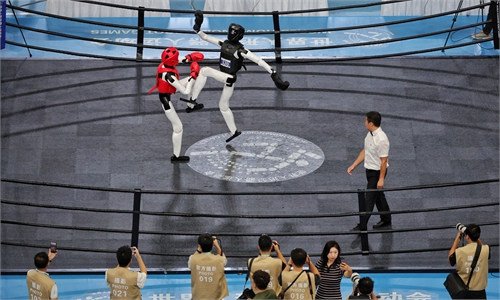
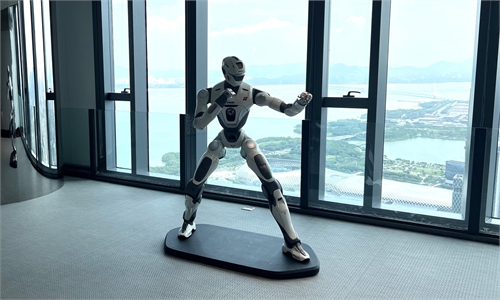
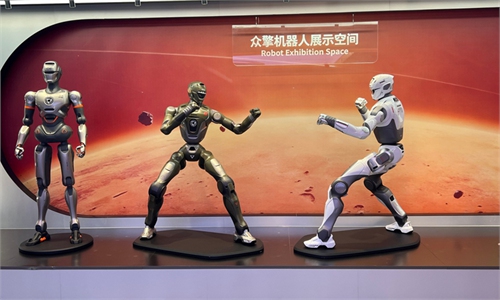
Two Unitree humanoid robots fight at the 2026 Consumer Electronics Show (CES), in Las Vegas on January 7, 2026. Photo: VCG
Humanoid robot fighting demonstrations have become less entertaining than in 2025, as the machines have grown more stable, Wang Xingxing, founder and CEO of Chinese robotics firm Unitree Robotics, said on Thursday.Speaking at a sub-forum on humanoid robots and embodied intelligence at the 9th Hongqiao International Economic Forum, Wang said robots can now remain upright even after taking heavy blows, reducing the number of dramatic knockdowns and falls that once made the performances more compelling.
"Robot autonomous fighting was a concept Unitree proposed in 2025, and more than a year has passed since then," Wang said. "Interestingly, the spectacle is now less entertaining than it was last year."
The improvement reflects advances in autonomous capability.
Wang noted that Unitree has achieved fully autonomous robot fighting using an end-to-end world model that processes visual input in real time and makes decisions directly through the model.
This is a result we completed over the past one or two months, Wang said.
"Two robots have achieved fully autonomous fighting," he said, adding that they can perform a dozen to about 20 actions. In theory, after training, they could "load hundreds or even thousands of actions for free combinations."
Wang also highlighted Unitree's push to build a self-evolving AI feedback loop for robots, saying such systems could accelerate development and deployment.
In the robotics industry, including Unitree, progress on automated self-improvement has been slower than in large AI models, where systems can automatically collect and label data, train, generate metrics and optimize themselves with less human intervention, he said.
"For Unitree, deploying 10,000 robots for testing and evaluation is entirely manageable in terms of cost and technology," Wang said. "The automated loop will accelerate like a snowball, providing support for large-scale robot deployment in the future."
Unitree recently unveiled its latest H2-X humanoid robot Kung Fu Legend Guardian, which the company says has been trained in martial arts and can operate for about eight hours on a single charge while performing a range of dynamic movements.
Robot fighting is also moving from niche performances into commercialization.
On July 16, the inaugural freestyle combat tournament for full-sized humanoid robots was launched by Shenzhen-based robotics firm EngineAI in South China's Guangdong Province. Organizers described it as the world's first commercially operated full-size humanoid robot fighting league.
According to the organizers, more than 200 teams from around the world registered for the competition, and 32 teams from China, the US, Poland, Singapore, and other countries advanced to the main event.
Corporate information platform Tianyancha shows that currently China has over 1.165 million active robot-related companies. Among them, approximately 144,000 newly registered related companies have been added so far in 2026.
Industry analysts said the shift from robots being easily knocked down to remaining upright despite heavy strikes, while subtle, underscores rapid progress in core technologies.
Analysts added that embodied intelligence products stand at a critical juncture, shifting from small-batch trials toward broader adoption. The sector is still working through scenario adaptation challenges and is expected to expand into healthcare, public services and other fields, bringing robots out of labs and into wider industrial and consumer applications.
RELATED ARTICLES