Chinese Industry Close-up: Globalmarkets embrace Chinese high-tech robots, as they bring innovation, efficiency, new way of life
By , Chen Zishuai and Yu Jiayin in Shenzhen Published: Aug 13, 2026 10:01 PM

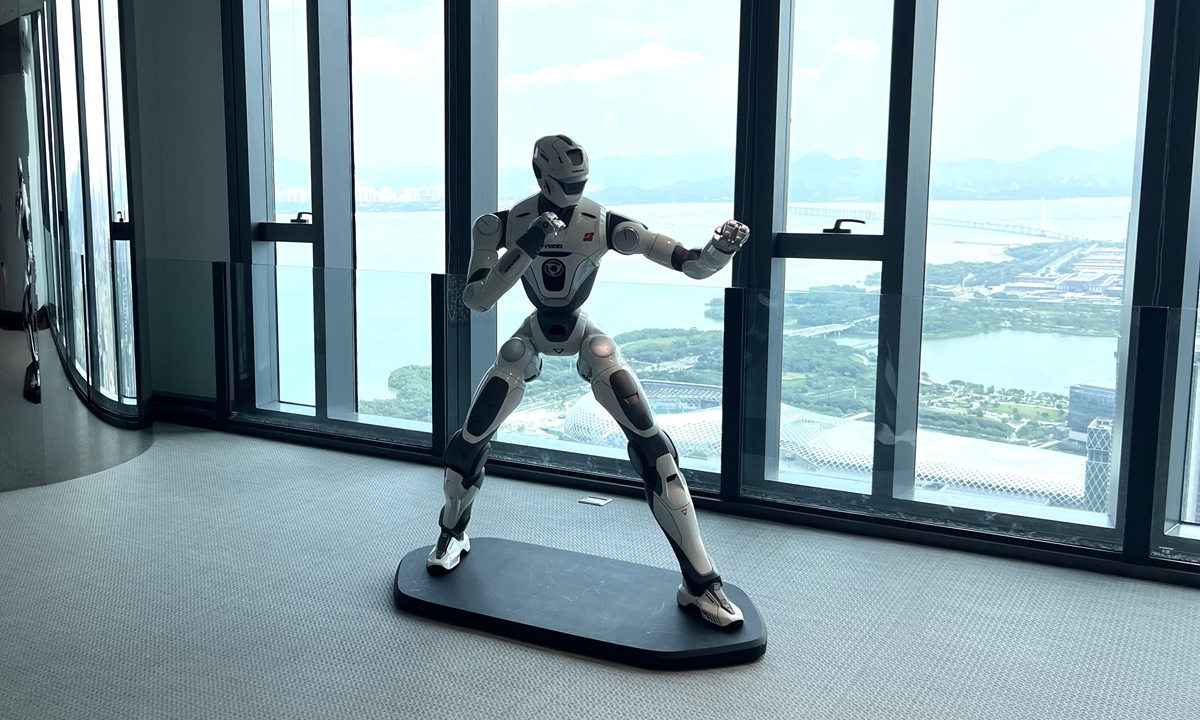
A display of a humanoid fighting robot at robotics firm EngineAI's intelligent manufacturing base in Robot Valley in Shenzhen, South China's Guangdong Province, on August 5, 2026. Photo: Li Xuanmin/GT
Editor's Note:
The outline of the 15th Five-Year Plan (2026-30) calls for building a modern industrial system, consolidating the foundation of the real economy, and accelerating high-level technological self-reliance and self-strength to lead the development of new quality productive forces. These goals have provided clear direction for industrial transformation and upgrading across various sectors, while injecting strong momentum into high-quality development. The Global Times has launched a new column titled "Chinese Industry Close-up." Focusing on the creation of a new development pattern, the column will delve deeply into vivid examples of industrial transformation and upgrading across various sectors, aiming to showcase China's innovation-driven and high-quality development. This is the second half of the second installment of the series.
Three months after her high-risk surgery in late May, a 73-year-old Brazilian woman is walking on her own again - something she feared that she might never do.
Back then, under the cold glare of surgical lights in a hospital operating room in Jau, São Paulo state, she lay tense on the table, waiting nervously for her left knee replacement. It is one of the most demanding orthopedic procedures, as even a few millimeters of deviation in the lower-limb alignment can alter the patient's gait for the rest of her life.
The surgery was successfully done with the assistance of a "Made-in-China" orthopedic surgical robot named Kunwu, with the lead surgeon standing beside the operating table and guiding the robotic arm with remote controls. The robot was imported from Yuanhua Robotics, a medical robotics company based in Shenzhen, South China's Guangdong Province.
On the other side of the planet, in a shopping mall in Dubai, the United Arab Emirates (UAE), a robotic arm made by Shenzhen-based robotics firm Dobot produces a cup of latte art in just 45 seconds, drawing long lines of customers while reducing labor cost by 70 percent. Nearby, an AI-powered floor-cleaning robot from Chinese company NARWAL, engineered specifically to address the unique challenges of sandy and dusty desert environments, has also become a popular cleaning solution among local households.
And in a courtyard in Bavaria, Germany, a robotic lawn mower from Chinese robot company Mammotion navigates the grass, skillfully weaving around garden furniture and pets.
This growing presence in the world highlights the rising and irreplaceable role that Chinese robots are playing worldwide. They are no longer merely exported products; instead, they help transform daily lives overseas - stepping into operating rooms, commercial spaces and private homes, while delivering precision, reliability and localized solutions that are reshaping how people work, live and recover.
The momentum is evident in the Robot Valley in Shenzhen, which accounts for one fourth of China's robot export value, with its products sold to more than 100 countries and regions.
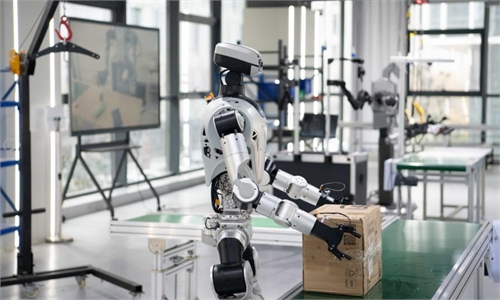
Driving across the valley, a 28-square-kilometer area which is home to manufacturing a full stream of robot components, one can feel the pulse of China's homegrown innovations. This trend, which is gaining further traction amid China's industrial upgrading, highlights the core competitiveness of China's robot industry, which cannot be reversed by blockades imposed by certain Western countries, industry insiders said.
'Knocking on the door'
When visiting Yuanhua Robotics in Shenzhen last week, a staff member was demonstrating how the orthopedic surgical robot Kunwu could play the triple role of serving as the "arms, brain and eyes" of a surgeon. The dexterous robotic arm of Kunwu can precisely locate the pre-planned osteotomy position, and the surgeon only needs to press a button to operate it, with the margin of error controlled at the sub-millimeter level.
"The surgery was very successful and took only 45 minutes, compared with the typical 1.5 to 2 hours," Xu Hanting, the company's sales manager, told the Global Times. He noted that beyond speed, what matters more is the precision and standardization, which enable patients to recover faster and walk normally again.
The efficiency of Chinese robots has impressed the local hospital in Brazil, and as a result, the hospital will schedule 16 surgeries in just one week in late August - all with the assistance of Kunwu. It is also in talks with the company to purchase more, Li Aili, founder and chairman of Yuanhua, told the Global Times.
Li said that in the field of surgical robots, Chinese companies were late-comers compared with European and US conglomerates. Yet what helps Chinese players stand out is their "ability to adapt".
"If hospitals purchase robots made by European and US companies, they are locked into a closed platform and have to use those companies' expensive, designated prosthetic implants. Whereas with Chinese robots, we can accommodate a variety of prosthetic implants made by Brazilian companies, whose prices are more affordable," Li said.
This same ability to adapt is also evident in the consumer cleaning robotics sector, where Chinese robotic vacuum cleaner brands swept the world.
"It is of vital importance to tailor our technology and products based on the demands of overseas markets," Bin Ye, global brand director of Shenzhen-based cleaning robot-maker NARWAL, told the Global Times.
For example, in Europe and the US, many households have wall-to-wall carpeting, prompting the company to develop specialized deep carpet cleaning technologies designed to effectively remove embedded dust and debris from carpet fibers. In Dubai, where fine sand and dust are abundant, NARWAL addressed this challenge by developing an advanced mopping solution with continuous water spraying and real-time self-cleaning capabilities to prevent dirt accumulation and maintain cleaning efficiency in desert environments. In Japan, consumers place high importance on quiet operation, leading the company to optimize key structural components, including motor design, airflow channels, and air outlet systems, to reduce operational noise and enhance the user experience, according to Bin.
Representatives of Chinese robotics companies believe that the underlying logic behind this strong adaption lies in the speed of China's industrial chain - covering everything from mass production and product upgrades to after-sales service.
This industrial chain advantage has made Chinese robots almost irreplaceable - a "must-have" choice in global markets. "Most countries lack the technology to produce robots, while those that do possess the technology rarely have a supply chain as complete and efficient as China's," Liu Shaoshan, director of the Embodied Intelligence Center at the Shenzhen Institute of Artificial Intelligence and Robotics for Society, told the Global Times.
Wang Ziyi, the product director of PaXini AI robot technology, pointed out that overseas clients, especially high-end manufacturers in Japan, South Korea, Europe and the US, place great emphasis on a supplier's response efficiency and long-term maintenance capability when choosing partners.
The combination of product quality and full-lifecycle support is translating into lasting partnerships, making China's robots long-term "employees" that overseas clients are eager to hire - a shift that reflects the broader picture of China's manufacturing upgrade, industry insiders said.
"Once a company chooses a Chinese robot, it will continue to make repeat purchases," said Liu Zhufu, deputy general manager of Shenzhen-based Dobot Robotics. He highlighted the growing trend of renowned foreign manufacturers adopting Chinese industrial robots on a large scale, with Dobot's collaborative robots now deployed on the core production lines of foreign automakers including Porsche, Mercedes-Benz, Toyota and Volkswagen.
Global market openness
The US in July included two new categories of devices - "advanced robotic devices" and "connected power inverters" onto its so-called "Covered List." But China's exceptional responsiveness of the supply chain, the rapid iteration of hardware, and the continuous refinement of application scenarios together form the underlying capabilities of Chinese robots that are difficult for any bans to sever, analysts said.
The institute Liu works for has received numerous foreign business delegates in recent months, including from South Korea, Europe and Southeast Asia. According to him, although the US attempts to promote a binary bloc confrontation, the vast majority of countries in Europe and elsewhere are eager to establish deep scientific research and industrial cooperation with Chinese universities and enterprises in the field of robot and AI, in order to "ensure the security of their own supply chains."
"China is sharing its robotic technology with the world - just like China's intelligent meteorological early-warning system 'Mazu,' which is widely adopted worldwide. It is fair to say Chinese robots have established a foundation of trust globally," Liu said.
The center is developing an open-source embodied intelligence system called AIRSEAI, with the goal of advancing global foundational infrastructure for embodied AI. To date, research institutions and enterprises from Russia, Italy, Egypt and Brazil are using the open-source technology base.
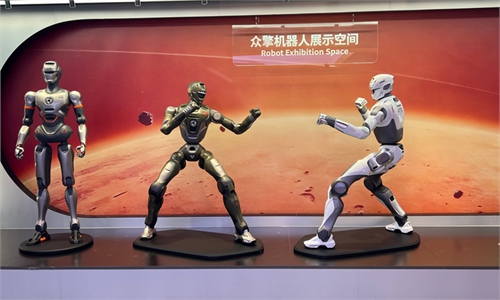
Currently, Chinese robots lead the global market share in a variety of robotics categories including robotic vacuum cleaners, lawn mowers and drones, data showed. And, in emerging sectors such as humanoid and quadruped robots, Chinese manufacturers are gaining foothold in Europe and South America.
China's humanoid robot makers commanded more than 97 percent of global shipments in the first half of 2026, Bloomberg reported, citing data from California-based research firm Smart Analytics Global.
During the Global Times' week-long visit to a number of humanoid robot companies across Shenzhen's Robot Valley, almost all were actively in talks with potential foreign partners, with some also considering the set-up of overseas offices to better support the global expansion.
Industry insiders envisioned that there is "substantial room" for China's robots to further expand in the global market. "The story of Made-in-China robot is only beginning to reach its climax," Liu said.
Pang Bo, co-founder of robotics company LimX Dynamics, told the Global Times that for countries facing challenges of population aging and rising labor costs, robots are no longer a "showpiece" product, but an increasingly practical tool of experience, service, and productivity. LimX Dynamics so far has secured thousands of customer orders across different product lines, with more than half of which coming from overseas.
"For example, South Korea's entertainment industry is highly developed, and it has introduced Chinese robots for dancing and performances. Southeast Asia hopes Chinese robots can help with labor-intensive work, while European enterprises look to robots as a means of boosting productivity," Pang said, stressing that such advanced productive forces will be highly welcomed by overseas users.
RELATED ARTICLES