Unitree sells robots starting at around 10,000 yuan at its first directly operated offline store in downtown Beijing
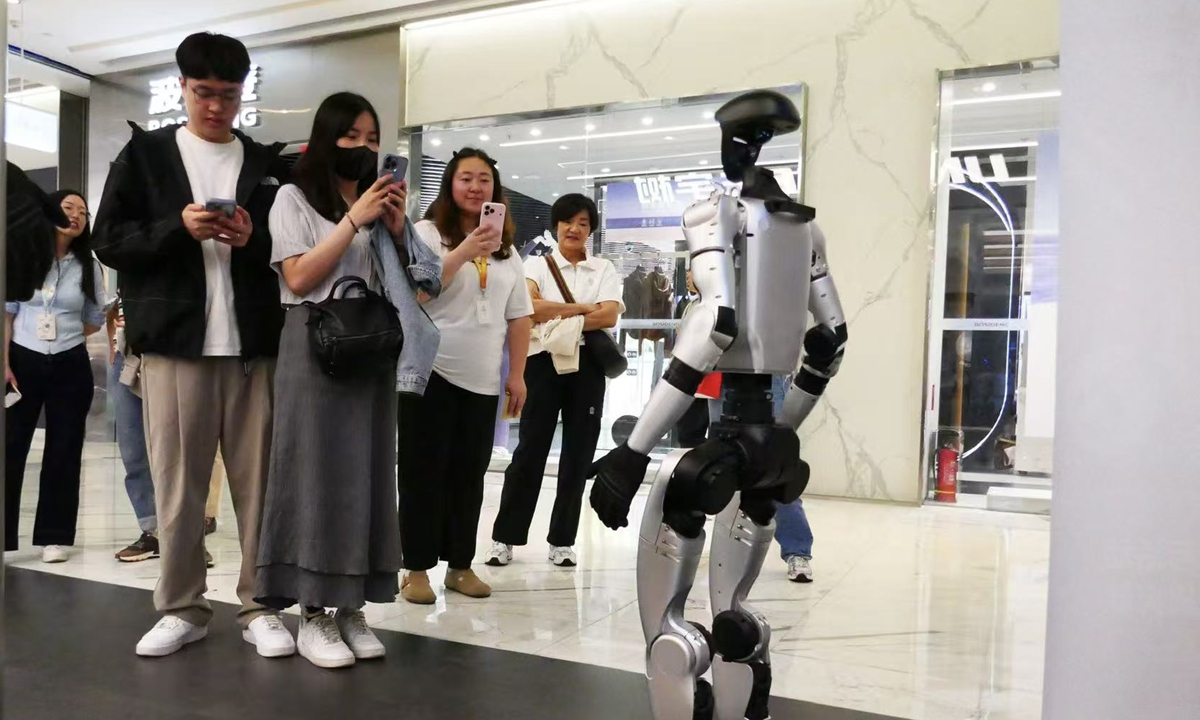
People take photos of the G1 humanoid robot at the Unitree offline store in Beijing on April 30, 2026. Photo: Tao Mingyang/GT
Chinese robotics firm Unitree Robotics opened its first directly operated store nationwide on Thursday in a shopping mall on Wangfujing pedestrian street in downtown Beijing. The outlet prominently showcases and sells customer products, including the G1 humanoid robot and GO2 robotic dog, providing consumers with an offline space to experience and purchase embodied intelligence products firsthand.
Despite it being the last working day before the upcoming five-day May Day holidays, the Global Times observed on site that the robotic dogs and humanoid robots in the store attracted a large number of consumers and tourists, including many foreign visitors. Customers consulted staff about product details, children interacted with the robots and robotic dogs, and many visitors operated the robots themselves under staff guidance using remote controllers.
Sun Baoyan, a representative of the store, told the Global Times that under purely organic traffic conditions — with only promotional posters released in advance on Wednesday and no full-scale media coverage — both the foot traffic and attention the store received far exceeded expectations on the opening day.
All products in the store are in stock, allowing consumers to take delivery immediately after placing orders on-site. The offerings are divided into two main categories: the GO2 robotic dog series and the G1 humanoid robot, with prices ranging from just over 10,000 yuan ($1,462.36) to more than 130,000 yuan, meeting diverse consumer needs, Sun said.
Ding Liandong, whose child has shown great interest in robotic dogs, told the Global Times that she and her families have been following many Chinese robot brands including Unitree.
"When we first started paying attention to robot dogs, prices ranged from 60,000 to 80,000 yuan, but now entry-level models have dropped to just over 10,000 yuan, making them more acceptable," she said, adding that she is considering purchasing a robotic dog for her child.
Giacomo Galli, a tourist from Italy, said it was his first time seeing a shop dedicated to robots. "The humanoid one is very impressive, especially the movement and speed," he said, adding that such robots could be useful in daily life. "Maybe one like a human could accompany my grandfather or something like that."
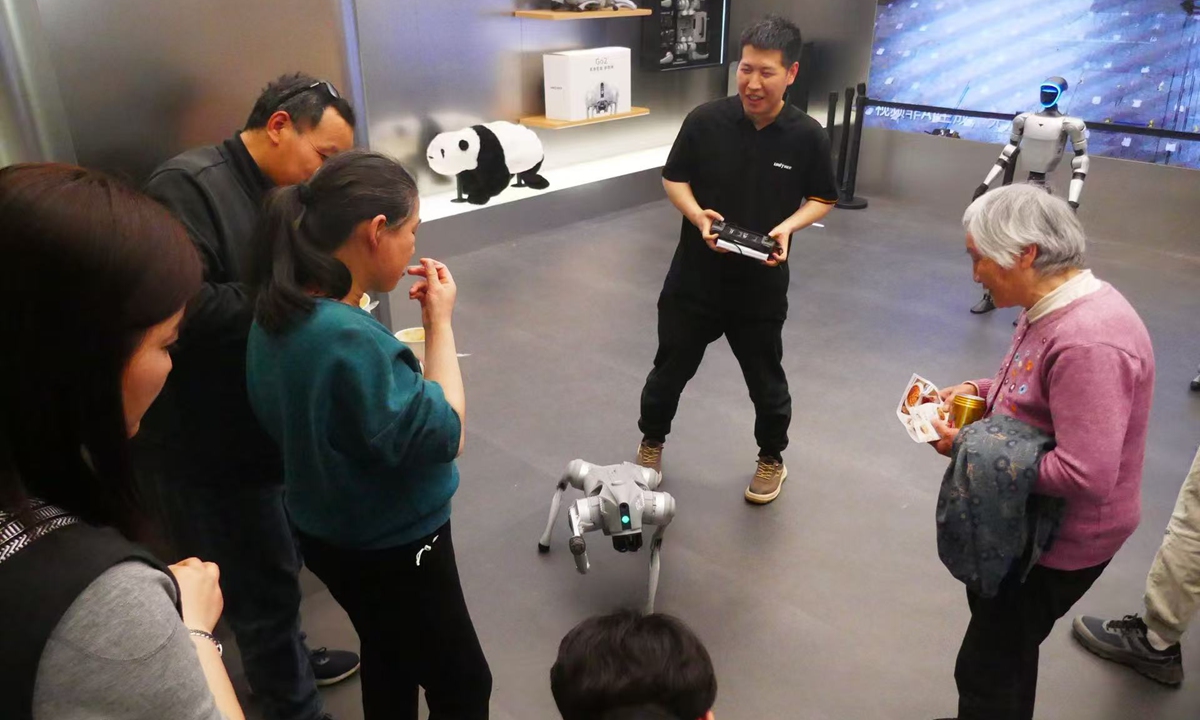
People interact with a GO2 robot dog at the Unitree offline store in Beijing on April 30, 2026. Photo: Tao Mingyang/GT
In 2025, the number of Chinese humanoid robot manufacturers exceeded 140, with shipments reaching about 14,400 units, accounting for 84.7 percent of the global total. The market size reached 1.55 billion yuan, representing about 53.8 percent of the global share, according to industrial data. Analysts believe that China's wide range of application scenarios have helped sustain rapid growth in the robotics sector.
Other robotics firms are also ramping up real-world applications of robots. Xinhua News Agency reported on April 21 that in Shenzhen, South China's Guangdong Province, cleaning staff can already collaborate with robots developed by X Square Robot to complete various cleaning tasks. A quadruped robot developed by a Chinese navigation platform has achieved fully autonomous functions such as guiding the visually impaired and avoiding obstacles.
At the recently held Second Humanoid Robot Half-Marathon, charging through the 21-kilometer route in southern Beijing's E-Town, the Robotics D1 humanoid robot — developed by Chinese smartphone maker HONOR and nicknamed "Lightning" — won the championship with a time of 50 minutes and 26 seconds.
Its research and development team said after the race that liquid-cooling equipment in the robot's joints was one of the key factors behind the victory. Analysts believe that advanced technologies used by humanoid robots in long-distance running are likely to be transferred to household robots in the future.
Ding and her family have long followed the Humanoid Half-Marathon since its inaugural event. She said the strong performance of robot runners this year reflects the rapid pace of technological progress, which is underpinned by a large pool of national talent and manufacturing and industrial chain strength far exceeding that of the past.
Stephan Kondratenko, a chip industry practitioner from the Czech Republic, told the Global Times that the robotics industry has enormous potential and that China's robotics sector, like its drone industry, is developing rapidly. "China's robots have progressed quite quickly in a very short time compared with Western companies, and are being sold at relatively accessible prices for industrial and business use," he said.
The opening of the directly operated store marks an important attempt by Unitree Robotics to bring robot products into everyday life scenarios, according to the company. Sun noted that customers visiting the store can interact closely with robots from a consumer perspective, something that was previously not possible at exhibitions.
Sun said that the store team is in high spirits, as the smooth opening of the store and widespread customer interest have validated the feasibility of the offline direct-sales model. "It has also enabled the brand to better understand real consumer demand for consumer-grade robots, which will help inform future product development," he noted.
RELATED ARTICLES