China adopts cross-border anti-corruption law, a governance milestone with global insights: experts
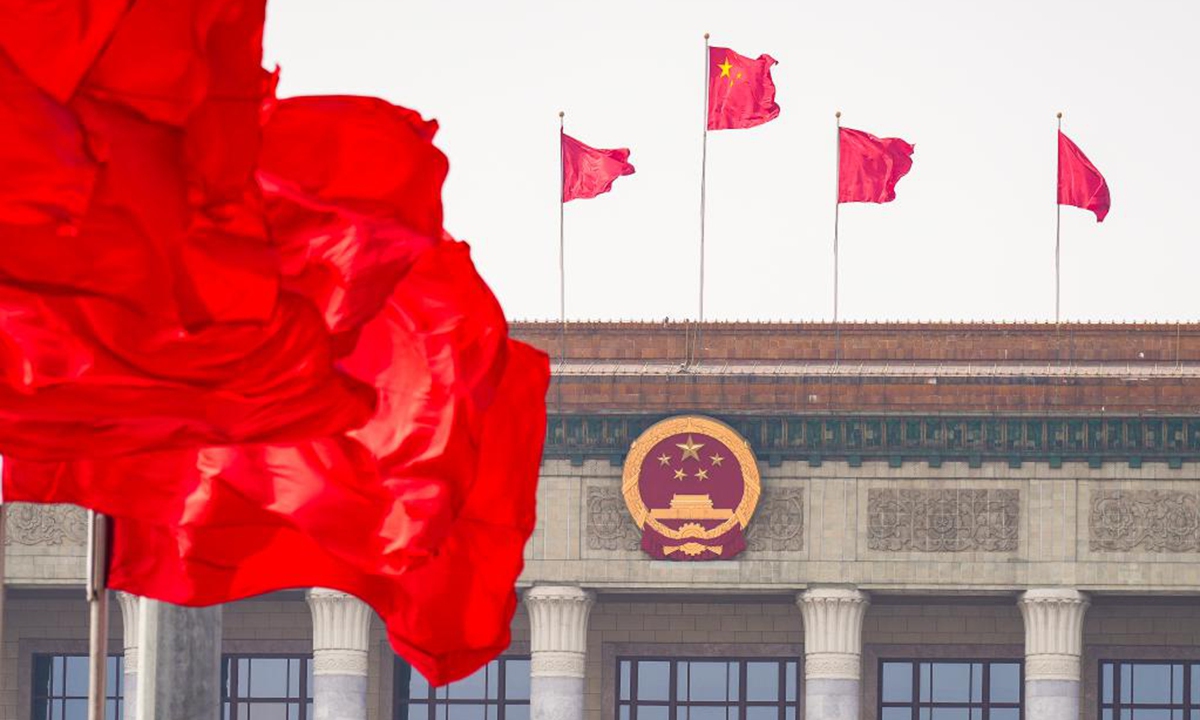
This photo taken on March 12, 2026 shows the Great Hall of the People ahead of the closing meeting of the fourth session of the 14th National People's Congress (NPC) in Beijing, capital of China. (Xinhua)
China's top legislature on Friday adopted a law to combat cross-border corruption at a legislative session of the Standing Committee of the National People's Congress. The law, which takes effect upon promulgation, provides strong legal support for investigating cross-border corruption cases, the Xinhua News Agency reported.
The law aims to prevent and punish cross-border corruption, deepen international anti-corruption cooperation, safeguard China's sovereignty, security and development interests, and promote the building of a fair and equitable global anti-corruption governance system, per Xinhua.
Chinese analysts said that this law is not only a milestone in advancing the modernization of China's anti-corruption governance system and governance capacity, but also contributes Chinese solutions to the global fight against cross-border corruption.
Filling gaps with Chinese solutions
Containing 47 articles in six chapters, the law covers mechanisms and responsibilities, case handling and international cooperation, integrity and compliance, and legal liability, among other areas.
The law states that efforts to combat cross-border corruption should leave no area beyond oversight, leave no ground uncovered and show zero tolerance for corruption. It also stipulates that such efforts must be conducted in strict accordance with the Constitution and laws, follow statutory procedures, and respect and protect human rights.
Integrating prevention, enforcement and countermeasure functions, this law represents a major legislative achievement aligning domestic and foreign-related rule of law and fills the gap in specialized cross-border anti-corruption legislation, Huo Zhengxin, a professor at the China University of Political Science and Law, told the Global Times on Friday.
As corruption takes on growing cross-border and foreign-related features, Huo said this law arrives in good time to address new demands and emerging anti-corruption challenges.
The law says efforts against cross-border corruption should provide equal protection for the legitimate rights and interests of all types of business entities, uphold order in cross-border business activities, and foster a world-class business environment aligned with market principles, the rule of law and international standards.
During its second reading, the draft law requires Chinese companies operating across borders to set up integrity and compliance departments or appoint dedicated staff, based on their size, business scope and risk prevention and control.
An article in the Legal Daily noted that defining integrity and compliance duties for cross-border operators guides Chinese outbound enterprises to conduct lawful, compliant and clean operations. Integrity can thus become a core competitive edge, supporting the development of a cordial and clean government-business relationship and a fair global business environment, according to the report.
While conveying the Communist Party of China (CPC)'s resolve and will on anti-corruption to the international community, the law sends a warning that corrupt fugitives will be tracked down and held legally accountable wherever they flee, Zhang Xixian, a professor at the Party School of the CPC Central Committee, told the Global Times.
It also offers Chinese solutions for global cross-border anti-corruption governance, providing a reference for countries to work together through international collaboration to stop corrupt fugitives from evading punishment overseas and jointly tackle corruption challenges, he added.
An unwavering pursuit
China has steadily pushed forward its anti-corruption campaign in recent years. At the fifth plenary session of the 20th CPC Central Commission for Discipline Inspection (CCDI), held in January, the disciplinary body of the CPC called for reinforced anti-corruption efforts during the 15th Five-Year Plan period (2026-30), Xinhua reported.
At the recently concluded fifth plenary session of the 20th Central Committee of the CPC, four areas of focus for steadfastly following a distinctive Chinese path to combating corruption were adopted in a resolution.
The four areas are: maintaining a tough stance against corruption, strengthening checks on and oversight over the exercise of power, fortifying the cultural-ethical foundations for championing integrity and disdaining corruption, and enhancing coordinated efforts to prevent corruption by rooting out audacity, opportunity, and desire.
In the first half of 2026, China's disciplinary inspection and supervision authorities filed 538,000 cases and imposed sanctions on 412,000 people, including 74 officials at or above the provincial-ministerial level, Xinhua reported.
The country has stepped up international cooperation in combating corruption in recent years. In 2025, China deepened international anti-corruption cooperation and investigated 505 cross-border corruption cases. A total of 963 fugitives were repatriated to the country in 2025, per Xinhua.
In July of that year, Liang Jinwen, one of China's most wanted graft fugitives, returned to China and turned himself in after 28 years at large overseas. Born in February 1954, Liang was formerly a general manager of an automobile brake company in Zhuhai, South China's Guangdong Province. He was suspected of seizing property by taking advantage of his position before fleeing abroad in November 1996.
Since the launch of Operation Sky Net in 2015, China had brought back 14,048 fugitives from more than 120 countries and regions and recovered 66.62 billion yuan ($9.92 billion) in illicit assets by the end of 2024, according to official data.
RELATED ARTICLES