Xinjiang's Kelameili gas field tops 1 billion cubic meters in output, eyes record annual production
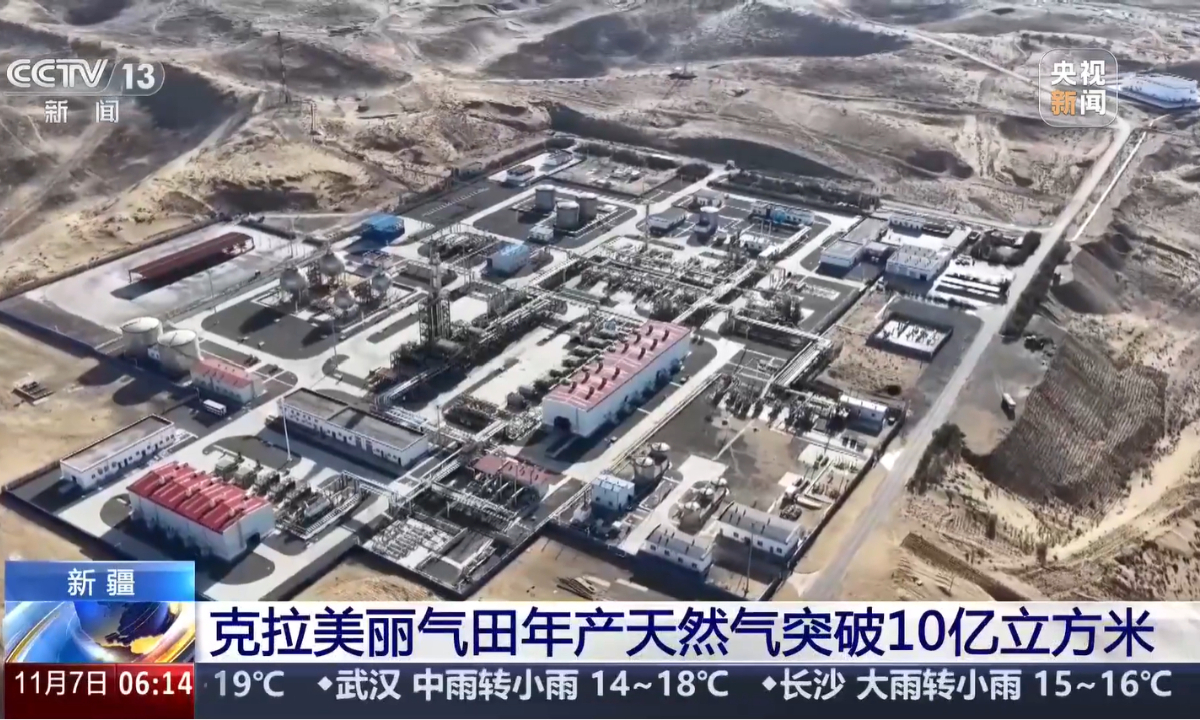
An aerial view of the Kelameili gas field in the Junggar Basin, Northwest China's Xinjiang Uygur Autonomous Region. Photo: Screenshot from CCTV News
China's Kelameili gas field in Northwest China's Xinjiang Uygur Autonomous Region saw its natural gas output exceed 1 billion cubic meters as of Saturday, with full-year production expected to set a new record since the field began operations, CCTV News reported. The increase in output is helping bolster residential and industrial gas supplies in northern China during the winter heating season.
Located in the heart of the Junggar Basin, Kelameili is the first large-scale complex the volcanic-rock condensate gas field developed at mid-to-deep depths western China, with proven natural gas reserves exceeding 100 billion cubic meters.
Since the start of this year, the gas field has brought seven new production wells online in efforts to slow output declines and improve gas recovery. Daily production has exceeded 4 million cubic meters, pushing annual commercial gas output to its highest level since the gas production plant was established, according to the report.
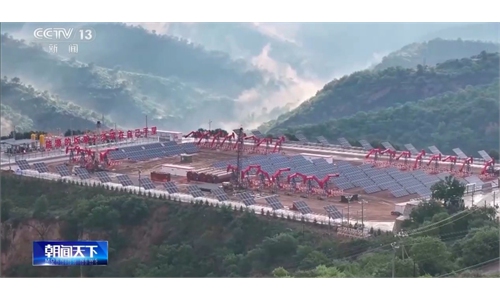
Peng Wanli, deputy manager of the Kelameili gas production operations area under Xinjiang Oilfield's No. 1 Gas Production Plant, said the field has added nearly 400 million cubic meters of economically recoverable reserves and introduced intelligent operation and maintenance systems for its photovoltaic power station.
Peng said the field's annual natural gas production is expected to exceed 1.3 billion cubic meters by the end of 2026, setting a new record since it began operations.
Technological advances have also supported the field's production growth. Du Guo, director of the geological research institute at Xinjiang Oilfield's No. 1 Gas Production Plant, said high-resolution 3D seismic technology has been used to accurately identify volcanic rock formations and map high-quality reservoirs and the distribution of remaining gas reserves.
The field has also undertaken infill drilling and well-pattern adjustments, measures to control water encroachment and other targeted development work, while strengthening operating cost controls, Du said.
With the heating season underway, the field has maintained high daily production levels to help ensure gas supplies for households and industries.
The production increase comes as China accelerates oil and gas exploration and development in major basins, tapping both conventional and unconventional resources to expand domestic natural gas reserves and output.
In the first eight months of 2026, China added 610 billion cubic meters of recoverable natural gas reserves, more than twice the country's total natural gas production in 2025, according to CCTV News.
Turning those reserves into actual output depends on expanding production capacity. China's natural gas production reached 196.7 billion cubic meters in the first three quarters of 2026, a record high for the period.
For the current winter heating season, China has secured more than 200 billion cubic meters of natural gas resources, with peak daily supply capacity exceeding 1.75 billion cubic meters, nearly 70 million cubic meters above the peak level recorded during the previous heating season, CCTV News reported.
China's 15th Five-Year Plan (2026-2030) for oil and gas development sets a target of 440 million tons of oil equivalent in domestic oil and gas supplies by 2030, while seeking to further improve the natural gas reserve replacement ratio.
The plan calls for accelerating the development of strategic oil and gas supply bases in major basins, including Ordos, Bohai Bay, Sichuan-Chongqing, Tarim, Songliao, Junggar and Qaidam, while aiming to keep China's natural gas self-sufficiency rate above 50 percent.
Global Times
RELATED ARTICLES