IN-DEPTH / IN-DEPTH
From blank history to visual epic: How painter Shen Yaoyi walks 25,000 li to make the Long March visible
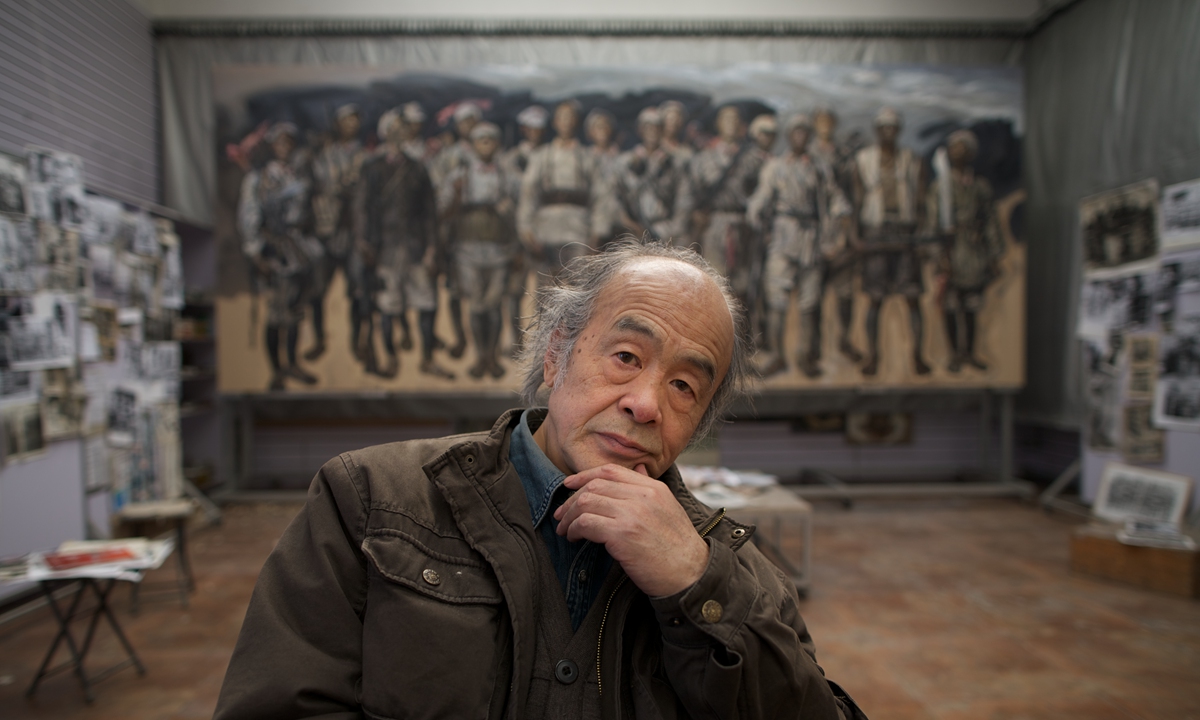
ShenYaoyi Photo: Courtesy of Shen
This year marks the 90th anniversary of the victory of the Long March of the Chinese Workers' and Peasants' Red Army. Recently in Beijing, three Long March-themed exhibitions of works by painter Shen Yaoyi are meeting audiences. The National Museum of China's exhibition integrates original oil paintings, prints and picture-story books with digital art, creating a three-dimensional, vivid and tangible "visible Long March." The National Centre for the Performing Arts' exhibition selects oil paintings (high-definition replicas) of key moments of the Long March, capturing with rich colors those earth-shaking and heart-stirring historical instants. The Beijing Art Center's exhibition displays nearly 80 black-and-white picture-story book works that, frame by frame, unfold the long, blood-soaked expedition. Together the three exhibitions form a three-dimensional visual epic of the Long March.
In an exclusive interview with the Global Times, Shen said: "The underlying tone of the Long March is heavy — blood and fire, life and death. It is the weight of history."
'Not doing it would feel like failing history'
In Songzhuang, Beijing's Tongzhou district, an inconspicuous path leads to an unremarkable gate. Inside, the hawthorns in the small courtyard orchard have turned red and kiwifruits still hang on the vines. Few would imagine that deep in this almost rustic compound lies a visual "archive" of the Long March — the studio of painter Shen Yaoyi.
Stepping into the studio, the space opens up. Paintings of all sizes cover the four walls — oil paintings and prints layered one upon another, resembling a small art museum. Shen led Global Times reporters toward the innermost room. On the walls, blackboards and beside the easels were pasted photographs of Red Army soldiers in various expressions and real-scene images of snow mountains and grasslands. The work he was creating still stood on the easel, with paints and brushes scattered nearby.
During the interview, the word Shen mentioned most frequently was "authenticity." Authenticity is precisely the original aspiration with which he has conveyed the Long March spirit to the world through his brush. Behind it, lies the painter's long quest of measuring the Long March route with his feet and touching the temperature of history with his heart.
Born in 1943, Shen, now in his eighties, still maintains the most "primitive" method of creation: the room is full of photographs, all printed out one by one and pasted up by hand so that he can look at them every day and ponder them repeatedly. "I'm not very good with those electronic things," Shen admitted. "Only when they are printed out and stuck right in front of me can the forms of each figure take root in my heart."
This almost clumsy earnestness has run through most of Shen's life spent with Long March subjects. From 1988 to 2018, Shen completed the "Long March Trilogy," totaling more than 2,200 works that fully present the history of the Long March. The first part, The Red Ribbon of the Earth, mainly depicts the Central Red Army's arduous journey from the bloody battle of the Xiangjiang River to reaching Hadapu in Gansu. The text was adapted from the novel of the same name by renowned writer Wei Wei. After its publication, the work won multiple major awards and became an indispensable banner in Chinese revolutionary historical theme art creation. The second part, The Long March · 1936, and the third part, Sparks on the Journey, were both written and illustrated by Shen himself — painting first, then writing the text.
In the 1980s, the picture-story book industry as a whole entered a low tide. The market shrank, creators switched professions one after another, and creating long-form picture-story books was widely regarded as a laborious task. It was against this backdrop that Shen accepted the commission for The Red Ribbon of the Earth.
"Many people asked me why I took it on. Actually, there weren't that many reasons," Shen recalled. "Visual materials left from the Long March are extremely scarce; that period of history was blank in visual terms. Filling in this history was the unshirkable responsibility of art workers trained by New China."
From 1988 to 1993, Shen spent six years completing The Red Ribbon of the Earth with 926 picture-story book frames, bringing the literary classic by Wei Wei to life on paper frame by frame. When asked whether, in six years of painting 926 frames, he had ever thought of giving up, he smiled and replied: "No, because you know the thing is worth doing. Not doing it would feel like failing history."
Where does this sense of mission come from? Shen's answer was simple: "Our generation was trained by New China. We have a natural affinity for the Long March and revolutionary history. Artists have the responsibility to restore the historical facts of the Long March with their brushes. This is not a slogan; it is a matter of conscience."
When creating The Red Ribbon of the Earth, the greatest difficulty in moving from text to image was that there was "nothing to rely on." Wei Wei's novel provided the literary skeleton, yet transforming the words into credible visual images — without photographs, without film footage, without ready visual references — meant starting almost from zero. Shen chose the clumsiest yet most solid path: retracing the Long March route.
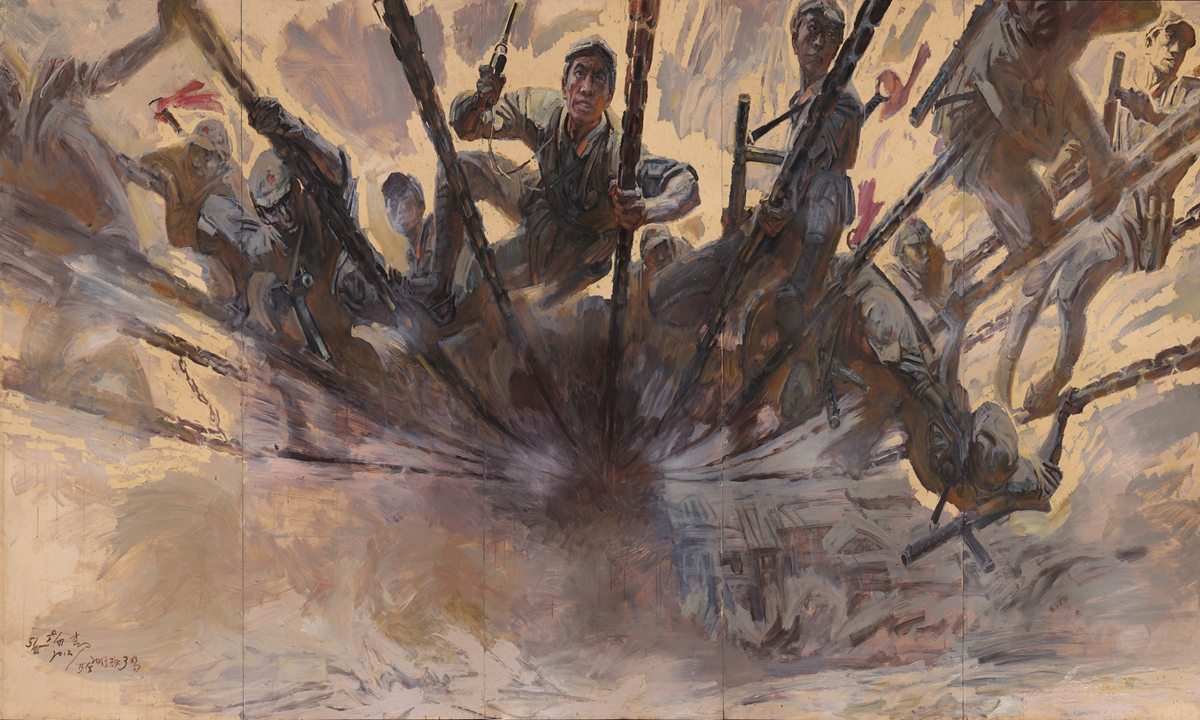
Shen Yaoyi's work on the Long March Photo: Courtesy of Shen Yaoyi
Authenticity carries immense weight
For The Red Ribbon of the Earth, Shen made multiple field sketching trips along the complete route of the Red Army's Long March and interviewed veteran Red Army soldiers and historical experts. "If you don't go to the sites, you cannot paint that genuine sense of exhaustion and tenacity," Shen told the Global Times. "The Long March in books is a concept; the Long March under your feet on that land is concrete."
One work in the exhibitions depicts the Red Army crossing snow mountains: soldiers wrapped in thin clothing, faces purple from the cold, frost on their eyelashes, some leaning on wooden sticks, others supporting one another. The painting does not deliberately heighten tragedy, yet holds the viewer's gaze for a long time. Shen said that before creating this work he specially climbed a snow mountain to personally experience the piercing cold and the suffocating sensation of oxygen deficiency. The higher he went, the more frequently he had to stop; the entire ascent took a full eight hours. "Only by experiencing it for yourself can you appreciate the hardships of the Red Army soldiers of those years."
During the interview, the reporters looked around the studio and saw old photographs of Long March figures in different poses pasted on the walls. "For real historical figures, every expression and appearance must match because if they don't, you fail them and you fail history," Shen said.
On the painting table, a pair of straw sandals caught the reporters' attention. Shen said they were physical objects he had specially obtained for reference sketching. He repeatedly observed and copied the weaving texture, wear marks and the way the ties were fastened.
It was precisely this obsessive attention to detail and stubborn pursuit of "authenticity" that made every scene in Shen's works stand up to scrutiny: from the way Red Army soldiers tied their straw sandals, to how troops carried their rifles on the march, to the distinctive vegetation of different terrains. Shen would repeatedly verify and revise them.
In The Red Ribbon of the Earth, Shen depicted both grand battle panoramas and numerous delicate close-ups of ordinary soldiers: one mending a torn straw sandal during a brief rest on the march; another writing a letter by the light of a campfire; still another pressing his last mouthful of dry rations into a comrade's hand on a snow-capped mountain. These seemingly minor moments form the most moving warmth of the entire work. "History is created by the people, and the Long March was walked by countless ordinary soldiers. If you do not paint them, you cannot paint a true Long March."
Shen told the Global Times that he has walked the Long March road with both "left foot and right foot": the "left foot" being picture-story books, the "right foot" oil paintings. "Oil painting seeks the eternity of a single moment; one painting must carry the full weight of a historical instant. Picture-story books seek the power of continuity, unfolding frame by frame so that readers follow the images through the entire journey. The two are irreplaceable."
In his view, the picture-story book form is especially suited to narrating an epic like the Long March: "It can break grand history down into tangible, perceptible scenes, allowing readers to step into history page by page."
In the later stages of creation, Shen felt the history of the Long March to be increasingly sacred and developed a creative complex for an "image epic." "As you paint, you feel you are not painting but conversing with history," he said. "The stories of the Red Army soldiers strike you one after another. That spiritual shock reshapes a person's values."
'When the people are painted, they come alive'
After traversing the Long March route and depicting its events, what impressed Shen most deeply was "the tenacity of ordinary soldiers, their gritted-teeth perseverance every single day and every single step."
Today, The Red Ribbon of the Earth has become a classic of revolutionary-themed picture-story books in the history of Chinese sequential art. Facing the younger generation, Shen's expectation is simple and sincere: "The core of the Long March spirit is never bowing one's head in the face of difficulties. Young people today need not climb snow mountains or cross grasslands, yet each has his or her own Long March. I hope what they draw from this history is that tenacity of gritted-teeth perseverance and that belief in the future."
As a veteran artist who has devoted his life to revolutionary subjects, Shen also has his own thoughts on future creation of revolutionary art: "Authenticity comes first. Do not conceptualize; do not take things for granted. Go and walk, go and see, paint the genuine historical feeling, and only then can readers feel the power."
"And paint people — ordinary people, their joys and sorrows. History is the history of people. When the people are painted, they come alive, and history comes alive," he stressed.
As the interview ended, the reporters once again looked around Shen's studio. The straw sandals on the table remained rough and real; the unfinished work on the easel still awaited the next stroke. Shen stood in the center of the studio, his lean figure elongated by the light, resembling the marchers on the Long March road in his own paintings — neither hurried nor slow, step by step measuring the 25,000-li journey with his brush, filling a history that was almost blank in visual terms into a tangible image epic.
Shen told the Global Times that the Long March can never be fully painted. "Every time I retrace the route, every time I repaint, there are new feelings. Today, I am still creating. This road, I will keep walking."
As the reporters left the studio, Shen's words still echoed: "Authenticity is the life of art. A history as magnificent as the Long March deserves to be presented in the most authentic way." This is perhaps an artist's deepest tribute to that history — neither embellished nor simplified — fixing stroke by stroke a journey that winds like a red ribbon across China, forever fixed on paper and in people's hearts.
RELATED ARTICLES