Photo:Liu Xiangya/Global Times
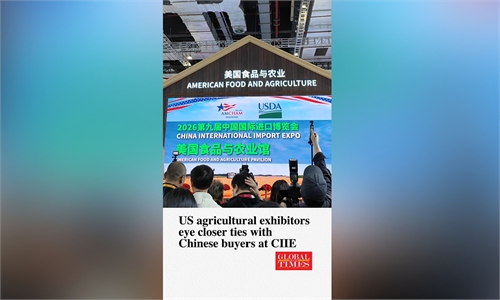
"Want some chicken feet?" US exhibitor Jared Thomas Turner held up a replica chicken foot model and greeted visitors fluently in Chinese at the US Food and Agriculture Pavilion at "Four Leaf Clover" - the main venue of the ongoing 9th China International Import Expo (CIIE). The models were props he brought to the booth, hoping to draw attention to American chicken feet.
After earning his MBA at a US college, Turner came to China with his family. After working in China for eight years, he returned to the US where he continued working in corporate consulting and international trade, helping American suppliers connect with overseas buyers.
A Chinese friend once asked him to help import American chicken feet. Turner initially thought the deal would be easy, but once he took it on, he found that size, processing chemicals and many other details all mattered - everything had to meet the requirements of the Chinese market.
In his view, having a product is not enough to enter the Chinese market; what matters is to get to know the true demands of 1.4 billion Chinese consumers. Foreign companies only stand a chance of taking root if they are willing to adjust their products to the needs of Chinese consumers.
This is exactly what the CIIE, the world's largest import expo, offers global businesses. During this year's expo, the Export-to-China Capacity Development Report, an important part of the "Export to China" initiative, was launched for the first time.
The report analyzed China's import market from multiple perspectives, including import structure, trading entities, market demand and policy frameworks. The report also examined the compatibility of trading partners' products with the Chinese market, offering recommendations to help them build their capacity to export to China and unlock their export potential.
According to the report, China's imports of high-end technological products as well as primary commodities have helped expand China's vast market, creating new demand for advanced manufacturing while opening up opportunities for global resource products and specialty agricultural goods.
The publication of the report represents an effort to see things from China's trading partners' perspective, helping them find the golden keys that can unlock the huge Chinese market, which is a vivid practice of implementing the China-proposed Global Development Initiative.
Turner's chicken feet would be the most micro-level footnote to that report. American suppliers do not lack production capacity; what they lack is "translation ability" - translating an American factory's process into the standards of Chinese hot pot, braised-snack and late-night-food options.
Interestingly, while businesses inside the "Four Leaf Clover" were seriously negotiating chicken-foot specifications, some in the West kept repeating another script.
On one side, labels like "China threat," "overcapacity" and "risks of dependence on China" are getting thicker and denser. On the other side, 4,142 overseas enterprises are moving samples, contracts and localization plans into Shanghai. Foreign businesses such as Turner vote with their feet: they are not blind to political winds, but they trust more the votes cast by consumers with their chopsticks.
Nevertheless, China's expanding imports are not a generous show of "buying the world." What the trend goes is a fairer kind of international public good - taking the mega-market and breaking it into accessible channels, learnable rules, and replicable capacity. For developing countries, it means a small farmer's avocado can reach a supermarket in the Yangtze River Delta. For US small and medium-sized enterprises, it means chicken feet can find a savvy importer.
Those who talk down "China driving the world's growth" ignore one fact: In recent years, as trade protectionism spread and unilateralism resurged, China's import growth kept outpacing its export growth. In the first three quarters of this year, imports grew 22.3 percent year-on-year to 16.7 trillion yuan ($2.5 trillion), with import growth outpacing export growth by 5.9 percentage points. In September alone, imports surpassed 2 trillion yuan for the first time.
Openness is not simply a manifesto. It is someone willing to hold up a slightly awkward chicken foot model and ask you sincerely - "Look, can this be sold?" And a report, an expo, and a mega-market answer: "Yes. We can help you align with local standards."
The author is a reporter with Global Times. bizopinion@globaltimes.com.cn
RELATED ARTICLES