Cooperation Illustration: Liu Rui/GT
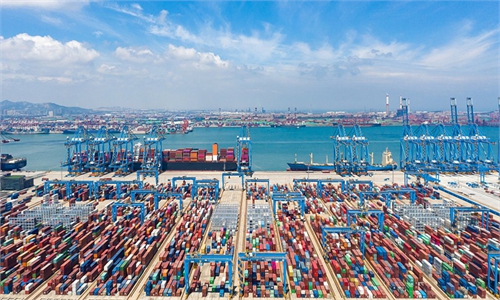
China is welcoming the world to the 9th China International Import Expo (CIIE), which opened in Shanghai on Thursday. For developing economies, the event offers a gateway to China's vast market and opportunities to diversify exports, upgrade industries and move up global value chains.
At a time of geopolitical tensions and fragmented supply chains, access to a large, predictable market matters. China's continued opening-up helps preserve the conditions on which international commerce depends: reliable demand, competitive supply, efficient logistics and long-term investment. Such stability is particularly valuable for emerging economies seeking to attract productive investment and build more resilient trade ties.
The CIIE gives this commitment a practical form. It connects foreign producers from multinationals to small businesses with Chinese buyers, distributors, e-commerce platforms and potential partners. It also helps suppliers understand consumer preferences, regulatory requirements and quality standards, identify niche market opportunities and build lasting commercial relationships beyond one-off transactions.
By linking Chinese demand with global supply, the expo helps developing economies diversify their exports and reduce their reliance on a handful of developed markets.
But finding buyers is only the beginning. For developing economies, the greater challenge is to meet Chinese market demand while delivering the required quality, cost competitiveness and reliability. Exporters must meet certification, food safety, traceability, packaging, logistics and after-sales requirements.
The first Export-to-China Capacity Development Report, scheduled for release at this year's CIIE, can help governments and businesses better understand market requirements and strengthen their export capabilities.
To make the most of these opportunities, developing economies should focus on higher-value agricultural and food products, industrial inputs suited to Chinese manufacturing, and services linked to digital trade and logistics. Better cold chains, certification systems and local processing facilities would help turn market access into lasting export gains.
China's market offers developing economies opportunities on both the demand and supply sides. Its increasingly sophisticated consumers create a market for premium foods, wellness goods, cosmetics and cultural products. Its industrial ecosystem, meanwhile, offers access to machinery, automation, digital platforms, renewable-energy technologies and advanced manufacturing capabilities. Together, these opportunities can help developing economies upgrade local industries and move into higher-value production.
The most promising approach for developing economies is to focus on niche sectors where they have natural advantages, whether in biodiversity, cultural heritage, design or strategic resources. These include processed foods, bioeconomy products, specialty coffee and cocoa, sustainable textiles, lithium and copper processing, renewable-energy components and electric mobility supply chains.
China's opening-up can help drive this transformation through technology transfer, joint ventures, local manufacturing, collaboration in research and development (R&D) and workforce training. The goal is to generate more local value, create skilled jobs and strengthen industrial capabilities, rather than simply export raw materials.
In this way, South-South cooperation can move beyond trade to become a broader development partnership. By combining China's scale, technology and capital with the resources, talent and growth potential of developing economies, such cooperation can foster more balanced and sustainable industrial integration.
Latin America shows how these opportunities can translate into deeper economic cooperation. China's trade with Latin America grew 14.5 percent year-on-year in the first eight months of 2026, according to data from the General Administration of Customs. Building on this momentum, the next stage of cooperation should focus on higher-value trade, stronger local industrial capacity and deeper integration across supply chains.
The strongest prospects lie in renewable energy, electric vehicles, batteries, critical minerals, digital infrastructure, smart agriculture, logistics and financial services. Latin America has the resources essential to the green transition. China brings scale, technology, manufacturing capacity and capital. The next step is to turn this complementarity into shared industrial value chains, moving beyond the traditional exchange of raw materials and manufactured goods.
Realizing this potential will require more Chinese investment in local processing, component manufacturing, R&D centers, technical training and distribution networks. Latin American countries, in turn, need to strengthen their capacity to absorb technology and investment, improve infrastructure and regulatory standards, and develop workforce skills and export capabilities.
The CIIE can serve as a catalyst for this next stage of cooperation. By bringing together Latin American producers, Chinese investors and technology partners, it can help promote higher-value exports and joint projects in green industries, the digital economy and sustainable agriculture. Such cooperation can become a stronger driver of inclusive growth and South-South industrial development.
Brazil offers a compelling example of this potential. Its priorities in reindustrialization, the green transition and regional integration align closely with China's strengths in manufacturing, renewable energy, electric mobility, digital infrastructure and development finance. This alignment creates opportunities for joint value creation in batteries and electric vehicles, renewable energy and smart grids, critical minerals processing, sustainable agriculture, artificial intelligence and satellite technology.
A deeper China-Brazil partnership can demonstrate the practical benefits of South-South cooperation: building green industries, strengthening technological capabilities and supporting a more balanced and stable international economic order.
The author is a professor at Tsinghua University and former acting minister of Development, Industry and Foreign Trade of Brazil. bizopinion@globaltimes.com.cn
RELATED ARTICLES