ARTS / CULTURE & LEISURE
Digital reconstruction reveals face of possible son of China's first emperor
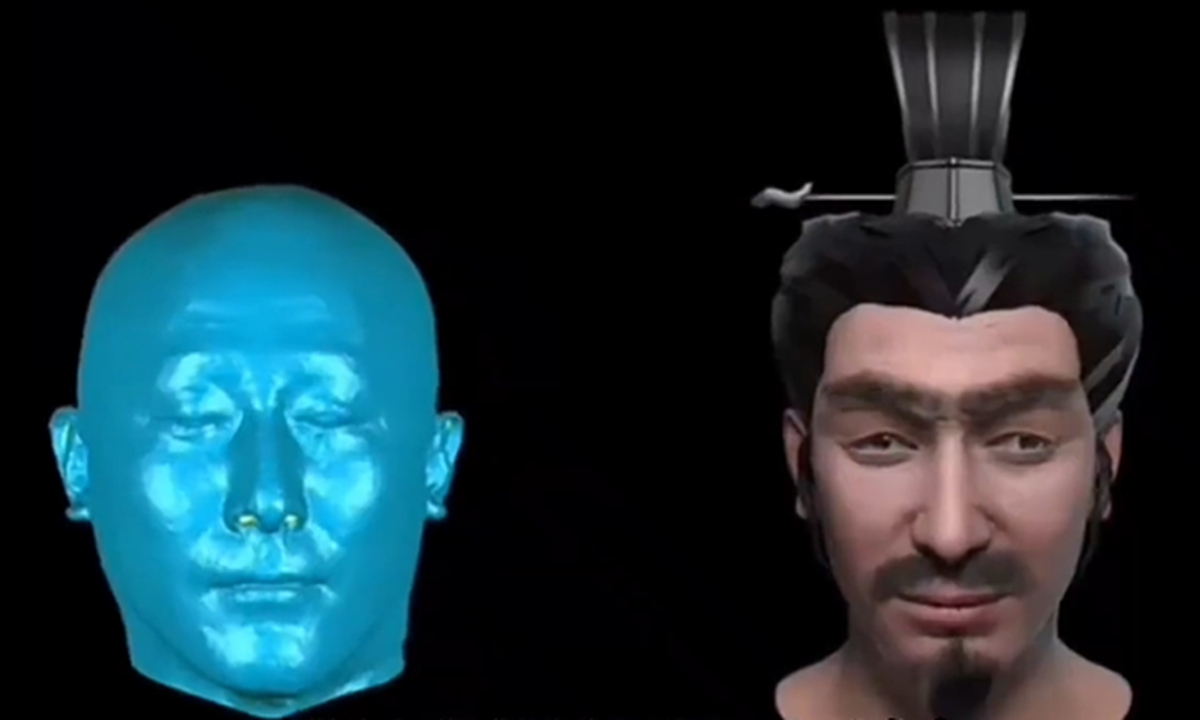
Photo: Screenshot of Shaanxi TV report
The facial reconstruction of a young man believed to have been a son of Qinshihuang, China's first emperor, has drawn widespread attention on Chinese social media, offering a glimpse into the lives of members of the Qin imperial family more than 2,000 years ago.The reconstruction was produced by a research team at Northwest University in Xi'an, Northwest China's Shaanxi Province, using craniofacial reconstruction technology to recreate the appearance of a man whose remains were discovered in a burial site in Shangjiao village, east of the Mausoleum of Qinshihuang, Shaanxi TV reported.
Experts believe the man was likely one of Qinshihuang's sons who was killed during a purge of the imperial family ordered by his younger brother, Qinershi, who succeeded their father as emperor, according to the report.
The man was estimated to have been around 30 years old at the time of his death. A bronze arrowhead was found embedded in the right temporal bone of his skull, while his head and limbs had been severed from his torso and placed inside the coffin.
The reconstructed face features elongated, almond-shaped eyes and a prominent nose. Researchers noted similarities between the facial features and the description of Qinshihuang in the Shiji, or Records of the Grand Historian, which describes the emperor as having a prominent nose and long eyes.
The burial site also contained high-status funerary objects, including gold, silver and bronze items, as well as bronze swords, providing further clues to the elevated social status and possible connection to the imperial family of the deceased.
According to a report published by Northwest University in October 2024, archaeologists identified 17 accompanying tombs in Shangjiao, within the outer enclosure of the mausoleum.
The university's researchers said the tombs were believed to belong to princes and princesses of the Qin Dynasty (221BC-206BC) who were killed after Qinershi took the throne.
One of the skulls recovered from the site had a bronze arrowhead embedded in its right temporal bone, and researchers considered its owner likely to have been a prince.
Historical records also describe the killing of members of the Qin imperial family following Qinshihuang's death in 210 BC.
The Records of the Grand Historian recounts that 12 princes were executed in Xianyang and 10 princesses were killed in the area of Du, reflecting the violent struggle for power during the early years of Qinershi's reign.
The facial reconstruction was made possible by the university team's digital craniofacial reconstruction research. According to the university, its researchers have developed a database containing facial and cranial data from more than 3,000 modern individuals.
By digitally scanning an ancient skull and applying statistical models of facial soft tissue, researchers can estimate the person's appearance during their lifetime.
However, the reconstruction provides an approximation rather than an exact portrait of the individual. While the skull can offer important information about facial structure, some features cannot be definitively established from skeletal remains alone.
RELATED ARTICLES