ARTS / CULTURE & LEISURE
Technology helps restore identities of unknown heroes
Giving a face to the fallen
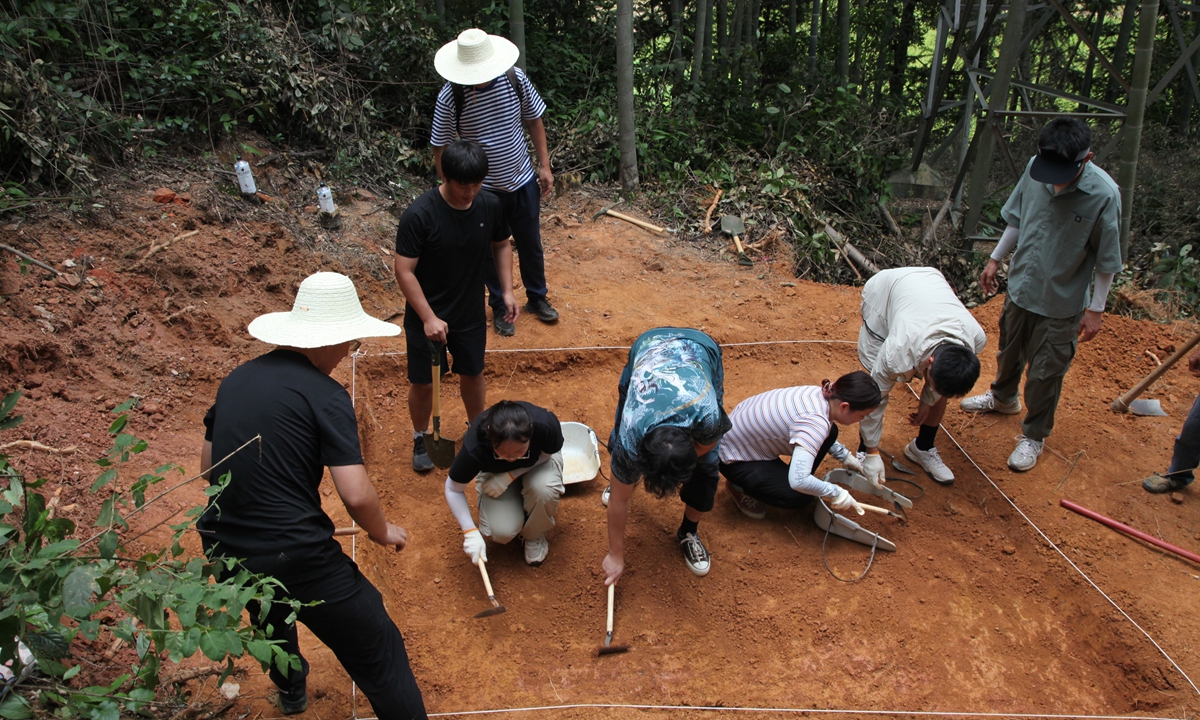
Researchers excavate the Majitang site in Taojiang county, Central China's Hunan Province. Photo: Courtesy of the Institute of Forensic Science of Fudan University
At Fudan University, a group of research teams has spent years using cutting-edge technology to restore the faces of China's fallen soldiers. After successfully reconstructing the appearances of 10 martyrs who sacrificed their lives during the Chinese People's War of Resistance Against Japanese Aggression (1931-45), they have now achieved another breakthrough: recreating the face of an unidentified Chinese People's Liberation Army (PLA) soldier who sacrificed his life decades ago.Using DNA analysis, digital archaeology and facial reconstruction technology, a team has restored the appearance of one of the unidentified soldiers whose remains were unearthed from the battlefield.
By restoring the faces of unknown martyrs, researchers aim to allow the public to see them not as abstract figures in history, but as real individuals who lived through extraordinary hardship and made profound sacrifices, Huang Ping, vice dean of the Institute of Forensic Science of Fudan University, told the Global Times.
Tracing the unidentified
Decades ago, more than 300 PLA troops died in fierce fighting at Majitang in Taojiang county, Central China's Hunan Province.
Many of the soldiers had come from Northeast China and had marched south with the advancing army following the Liaoshen Campaign.
The battle successfully pinned down enemy forces and helped create favorable conditions for the subsequent Hengbao Campaign, a decisive operation that accelerated the liberation of Hunan.
After the fighting ended, local residents buried the fallen soldiers near the battlefield, leaving behind a number of anonymous graves that would remain unidentified for more than 70 years.
In August 2024, China's National Martyrs' Remains Search Team launched an archaeological excavation at the Majitang battlefield.
The excavation brought together more than 20 faculty members and students from Fudan University and Wuhan University. Specialists were divided into teams responsible for excavation, cleaning, anthropological analysis, three-dimensional modeling, sample collection and remains preservation, according to CCTV News.
The remains had been buried outdoors for more than 75 years, leaving them exposed to moisture, soil erosion and environmental degradation. Extracting usable DNA from such fragile material was far from guaranteed.
"Exhumation is an extremely serious matter. We cannot take all samples back with us; DNA collection must be completed quickly on site, and we only have one chance to choose," said Huang.
In theory, teeth are the first choice, followed by dense bone. However, most of the remains recovered from Majitang had no teeth, and intact skulls were extremely rare, with most consisting only of fragments.
"We can only rely on experience and try to select the densest structures possible," she said.
A total of 57 human remains were recovered during the excavation, and forensic analysis indicates they belong to at least nine martyrs. Among the nine sets of remains, one skull was relatively well preserved.
According to Huang, a clear bullet hole was visible on the surface of the skull. After 3D reconstruction, researchers were able to trace the path of a bullet that penetrated the top of the cranium, which they determined to be the fatal injury.
Based on comparisons with skeletal development models in their database, the researchers estimated that the soldier was around 20 years old at the time of his death.
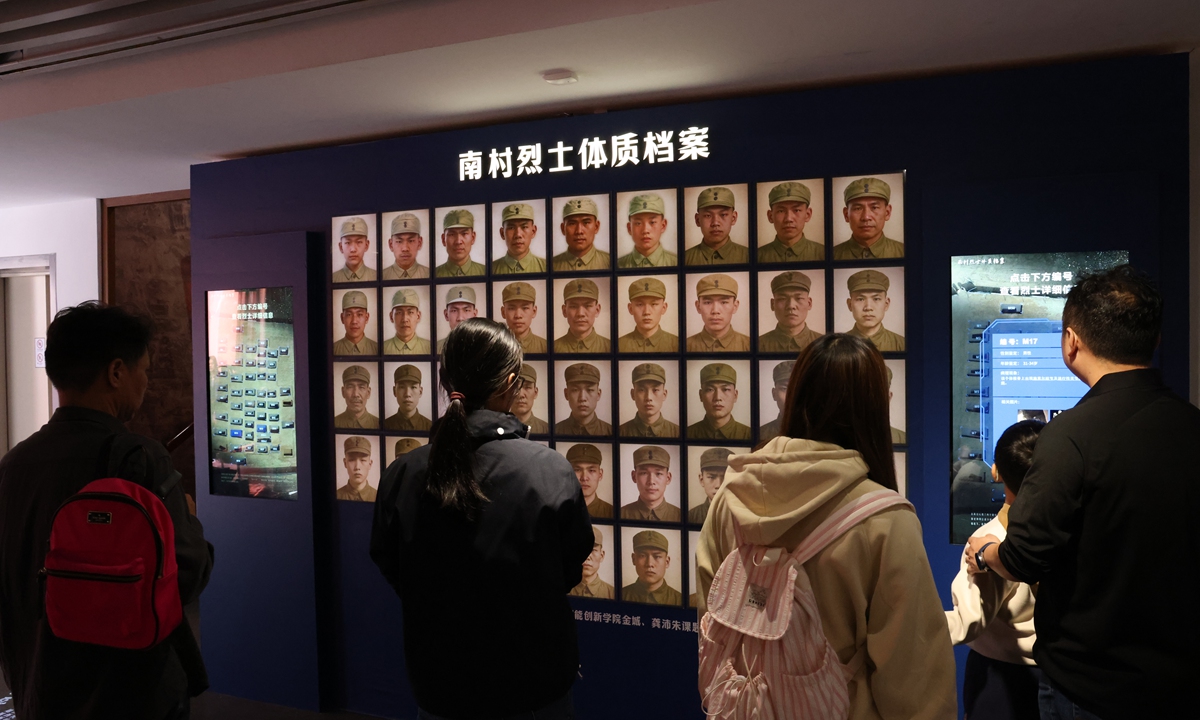
Visitors look at a board showing the portraits of martyrs at an exhibition in Shanghai. Photo: VCG
Science meets remembrance
After multiple rounds of optimization, researchers were able to extract DNA from the recovered remains, with 24 samples ultimately yielding DNA libraries suitable for further analysis.
Researchers first conducted anthropological examinations to determine basic biological characteristics, including sex, age and physical features, providing a precise anatomical foundation for facial reconstruction.
Based on the 3D model, they applied artificial intelligence algorithms to extract key cranial features and gradually reconstruct facial structures.
"The facial reconstruction we use is a generative model that analyzes the biological contours of different individuals' skulls to reconstruct the appearance of remains, rather than producing a standardized or 'face-like' template," Huang told the Global Times.
"Building on reconstruction based on cranial morphology, we also incorporate supplementary DNA molecular information to refine individualized facial features, such as eyebrow shape and ear structure," noted Huang.
For the first time in decades, the young soldier's appearance could be seen again. He has sharp features, a high nose bridge and single eyelids. According to the research team, the reconstruction achieved an estimated accuracy of up to 90 percent.
Searching for a name
Restoring a face is only one step toward restoring an identity.
The next stage involves locating surviving relatives and comparing their DNA with the recovered genetic material.
Authorities have publicly appealed for information and are encouraging anyone with relevant family histories or records to come forward.
For Huang and his colleagues, identifying the soldier would represent more than a scientific achievement.
As many of the soldiers who died in the Majitang battlefield were from Northeast China, the veterans affairs departments in Hunan and Jilin provinces jointly conducted a review to support efforts to locate their families.
They have compiled a list of 40 martyrs and released contact information to collect leads, seeking public assistance in identifying relatives of the young men who died far from home 77 years ago.
The most important thing is the joint effort of government authorities and society as a whole to find leads, Huang said.
Once potential clues are identified, researchers can then trace possible descendants and compare their DNA with the samples collected today to see whether a match can be made.
"That is what we are working on now," he said.
RELATED ARTICLES