ARTS / CULTURE & LEISURE
DNA study on remains from 11,000 years ago unveils how humans adapted to era change
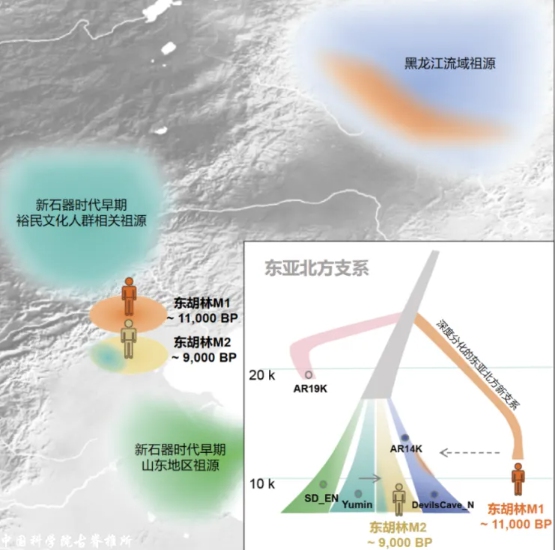
Photo: Institute of Vertebrate Paleontology and Paleoanthropology, Chinese Academy of Sciences
By studying DNA from three ancient human skeletal remains dating to around 11,000 years ago, a Chinese research team has discovered more about the lives of ancient humans who lived in northern East Asia during the shift from the Paleolithic to Neolithic period. The discoveries include ancient human's genetic roots, survival strategies, as well as the wisdom of their craftsmanship.The ancient humans of northern East Asia refer to the populations that "lived north of the Qinling-Huaihe line," Zhang Ganyu, a key member of the paleontology project, told the Global Times. Their range covered a vast territory, including the North China Plain with locations such as Beijing and Hebei Province; the Northeast Plain encompassing today's provinces of Liaoning and Heilongjiang, as well as areas surrounding the Jiaodong Peninsula such featuring Shandong Province.
Zhang told the Global Times that these areas as a whole represent "one of the most important core regions in the world" for understanding the Paleolithic-to-Neolithic transition. Meanwhile, revealing the mysteries of this transition is "crucial for studying human genetic evolution" and has become one of the most compelling topics in contemporary archaeology.
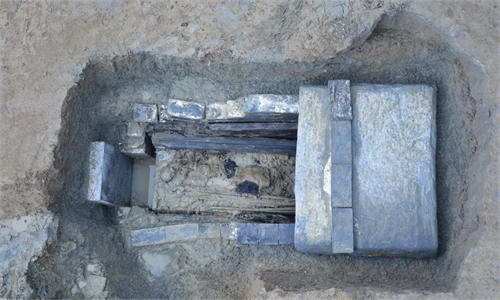
To uncover secrets related to ancient human genetics, the team turned its attention to the Donghulin site in Beijing's Mentougou district. It is the most iconic site for the Paleolithic-to-Neolithic transition in northern East Asia.
There, the team discovered three human skeletal remains dating back between 9,000 and 11,000 years ago. By conducting repeated sampling from different parts of the three remains, they constructed over 30 DNA profiles. Combined with analytical methods such as mitochondrial genome and Y-chromosome analysis, the team was able to determine details including the sex and migration patterns of these three ancient human specimens.
Unearthed from the lower layer of the Donghulin site's tomb, the skeletal remains labeled M1 were found to belong to a female individual. The team's ancient DNA research revealed that this female represents a previously unidentified, deeply differentiated northern East Asian human lineage. Although the woman's skeletal remains date back only 11,000 years, DNA analysis has revealed that her lineage shares deep similarities with the currently oldest known northern East Asian population - the AR19K people from the Amur River Basin, who lived approximately 19,000 years ago.
"This discovery directly indicates that some deeply differentiated northern East Asian ancient human lineages from the Late Pleistocene successfully survived the ice age and began to gain Neolithic characteristics," Zhao remarked.
Beyond this, the research team has also identified another male individual found at the Donghulin site as M2. The 9,000-year-old M2 remains exhibit a shift in genetic composition compared to M1. From this, the researchers found that a population replacement occurred at the Donghulin site, and that the cause of this replacement was the continuous warming during the Early Holocene.
The warming conditions "posed survival challenges" for the ancient humans at the site, but combined with the plant remains discovered there, Zhang said that it is clear to see "these ancient people found ways to survive under adversity, for example, by domesticating foxtail millet.
"Survival pressure forced populations to explore new resource utilization strategies, and this may have been one of the driving forces behind the Paleolithic-to-Neolithic transition process in northern East Asia," Fu Qiaomei, the lead of the project, told the Global Times.
Ancient DNA research on M2 has also allowed Fu's team to establish a genetic link between his ancient lineage and the early Neolithic Yumin culture population that originated in North China's Inner Mongolia Autonomous Region around 8400 years ago. This provides evidence that ancient humans were engaged in migration and interaction with outside groups during the Paleolithic-to-Neolithic transition.
RELATED ARTICLES