ARTS / CULTURE & LEISURE
Inner Mongolia Great Wall sites provide new material for ancient defensive strategies
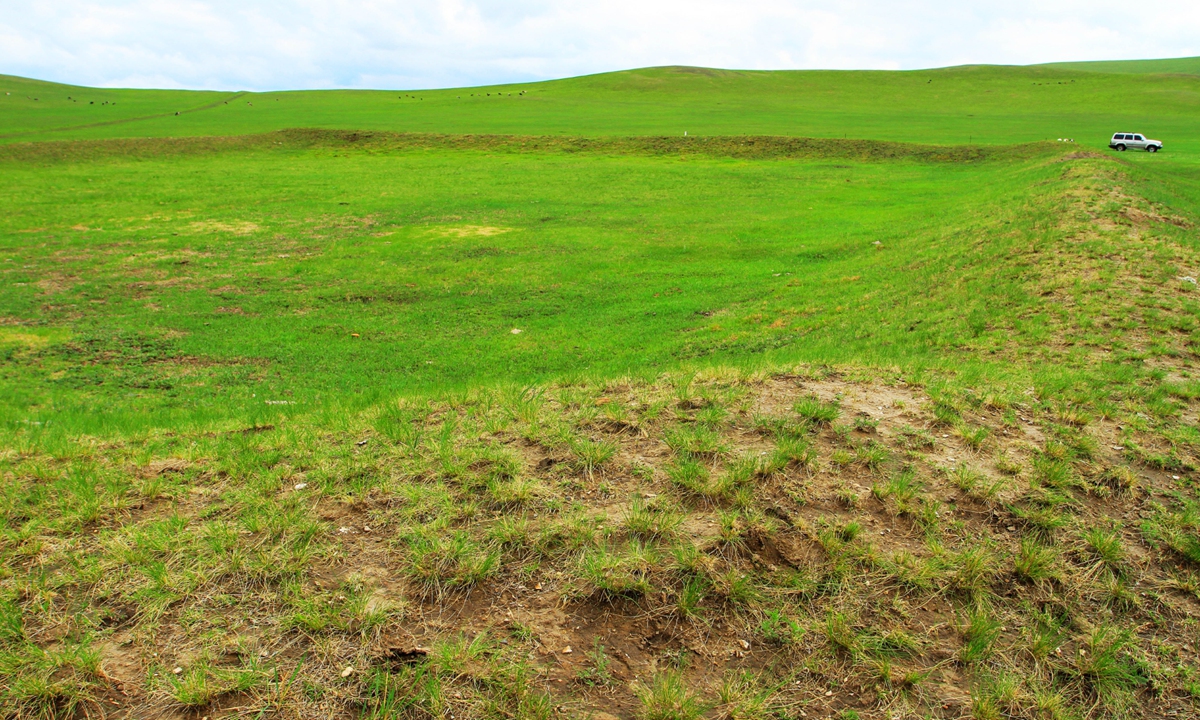
The Jinjiehao, or Jin Great Wall, in North China's Inner Mongolia Autonomous Region Photo: VCG
Chinese archaeologists have uncovered 20 previously undocumented sections of the Jin Dynasty (1115-1234) border trench wall, known as the Jinjiehao, or Jin Great Wall, in North China's Inner Mongolia Autonomous Region, providing significant new material for understanding the defensive strategies of the ancient regime.The discoveries were made during a 2025 archaeological survey of the Jin Great Wall remains in the Hexigten Banner, the city of Chifeng, according to the Inner Mongolia Institute of Cultural Relics and Archaeology on Sunday.
The newly identified remains include 17 sections of the wall, one mamian (a projecting bastion-like structure), and two border forts. Together, they offer fresh evidence for reconstructing the layout, construction techniques, and military logic of the Jin Dynasty's frontier defense system.
Dandar, head of the project, told the Global Times that the 17 trench wall remains oriented roughly north to south stretches for about 92 kilometers, although nine segments have completely disappeared due to natural erosion and human activity.
Unlike the better-known Great Walls of the Qin Dynasty (221BC-206BC), Han Dynasty (206BC-AD220), or Ming Dynasty (1368-1644), the Jin Great Wall was characterized by a distinctive defensive concept: "digging deep trenches and using them in place of high walls," Dandar explained. Defensive strength was achieved through a coordinated system combining earthen walls with deep ditches, rather than relying solely on towering masonry.
In terms of site selection, the Jin Great Wall avoided steep and rugged mountain terrain. Instead, it was typically laid out along gentle mountain slopes, river valleys, or plains, areas more suitable for construction, troop deployment, and supply transport. In more complex landscapes, natural barriers were incorporated into the defense line to reduce construction workload while enhancing protection.
Liu Zheng, a member of the Chinese Society of Cultural Relics, told the Global Times that the survey highlights the remarkable military-geographical insight of Jin Dynasty builders. "Such choices not only facilitated construction and logistics, but also allowed cavalry to maneuver effectively," Liu said. "At the same time, deep trenches could significantly impede the charge of enemy horses."
Structurally, the Jin Great Wall evolved over time. Early phases were dominated by simple ditches, but as military demands intensified, the system gradually developed into a more complex configuration combining outer trenches, main walls, inner trenches, and subsidiary walls, Liu noted, calling it "Jin's principle of adapting to local conditions and using locally available materials."
The defensive structure was first constructed in 1123 and reached its final form around 1198, following more than 70 years of building. Its scale was vast, and its defensive capacity increased steadily as construction techniques matured.
The latest survey shows that construction methods in the Dongsheng section varied according to local terrain and available materials. Identified techniques include rammed-earth walls, mixed earth-and-stone walls, and walls formed by piling earth excavated from adjacent trenches.
Well-preserved sections measure roughly 4 to 8 meters in width at the base, narrowing to 0.5 to 5 meters at the top, with remaining heights ranging from 0.6 to 4 meters. Trenches are typically 4.5 to 6 meters wide at the opening, 1.2 to 3 meters at the bottom, and up to 2 meters deep. In flatter areas, many remains have eroded into low earthen ridges, while trenches have often been filled or leveled by farming and other human activities, resulting in generally poor preservation.
The newly discovered mamian is located in Section 10 of the Dongsheng Jin Wall, on the crest of a ridge. Built of stone along the outer side of the inner wall, it survives in only fair condition. The two border forts once served as key strong points for troop deployment and supply storage, though both are now badly preserved.
Within China, the Jin Great Wall remains are distributed across Inner Mongolia Autonomous Region, and Hebei, Jilin, and Heilongjiang provinces. Inner Mongolia alone is home to 3,326.97 kilometers, taking up about 83 percent of the total. Of the region's 7,259.72-kilometer-long Great Wall remains from all dynasties, the Jin Great Wall accounts for nearly 46 percent, underscoring its central place in the history of China's northern frontiers.
RELATED ARTICLES