From salmon to kiwifruit, how China's logistics puts ‘global freshness’ on Chinese tables
By in Shanghai Published: Nov 09, 2026 07:58 PM


People queue up to buy Zespri kiwifruit at the brand's booth at the CIIE in Shanghai on November 9, 2026. Photo: Tu Lei/Global Times
Of all the halls at the 9th China International Import Expo (CIIE) held in Shanghai, the food and agricultural products halls are always the busiest.
Fruits from all over the world are laid out in tidy rows, each display drawing crowds of visitors who line up for a taste, packed shoulder to shoulder. The smell of grilled meat hangs in the air, mingling with the smell of coffee — it feels less like an exhibition hall than a fairground.
Behind that aroma is a supply chain few visitors see — one that moves fresh food from farm and fishing boat to the expo floor with barely a pause.
At the CIIE, China Eastern Airlines' logistics subsidiary once again served up a "gourmet deal," signing a salmon supply agreement with Denmark's Skagen Salmon.
During this November, China Eastern will open a cargo route linking Shanghai with Copenhagen, adding another efficient air artery between China and northern Europe.
Salmon is not alone. From kiwifruit to blueberries and avocados, this responsiveness in China's logistics rests on steadily expanding cargo flying routes and improving services — explaining why more foreign goods reach Chinese tables faster and with greater ease.
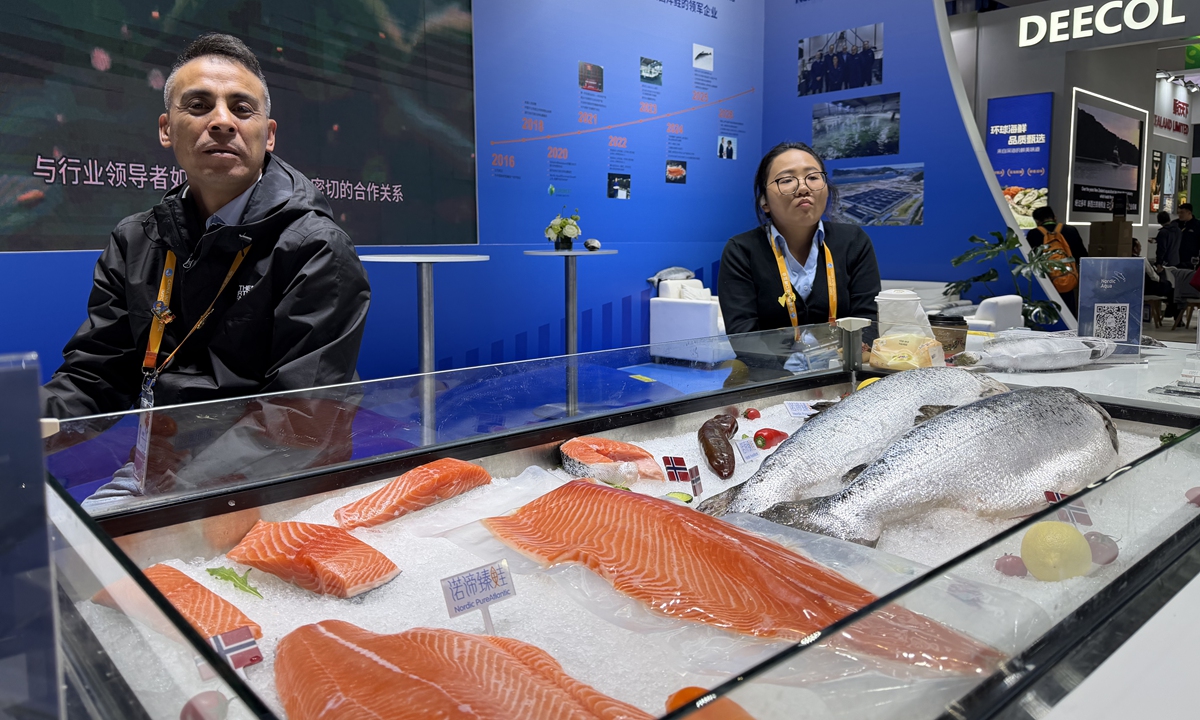
Fresh Atlantic salmon on display at a CIIE booth in Shanghai on November 9, 2026 Photo: Tu Lei/Global Times
Higher efficiency
With China's demand for imported salmon rising, the cold chain logistics firm under China Eastern went looking for suppliers in Denmark, where its route capacity could meet premium European supply. Talks with Skagen Salmon found alignment on origin resources, air freight and Chinese market channels, and the CIIE provided the platform that sealed the partnership, according to the information China Eastern shared with the Global Times.
Keeping a "fresh" chain that spans thousands of miles running smoothly would take more than speed in the air: it depends on refined, digitally enabled quality control.
The cold chain logistics firm worked closely with Skagen to clear each bottleneck in turn, and has built a one-stop cross-border supply chain solution. The chain now runs without a break: origin transport, port customs clearance, cold storage and end-to-end temperature tracking, then processing at the company's fresh-food hubs, and final delivery to supermarkets and livestream e-commerce channels, China Eastern said.
For example, the logistics firm has built its own in-pack temperature logger, which tracks conditions along the entire journey and yields a full temperature curve — giving the company a record to trace where any anomaly began.
And, at the Zespri booth at CIIE, kiwifruit from New Zealand sat in neat, orderly rows.
Michael Jiang, president of Zespri China and APAC South, told the Global Times that, on March 17, the Panama-flagged vessel Kowhai, carrying more than 4,750 tons of the new-season fruit, sailed from New Zealand's Port of Tauranga and arrived in Shanghai 12 days later. The first batch of more than 3,000 boxes arrived at an agricultural products trading center in Shanghai on April 2 and sold out on its first day on the market.
"We will keep innovating, sustain our steadfast partnerships in China, and keep Zespri at the forefront of the kiwifruit category here," Jiang said.
Over the past nine years, Zespri has both witnessed and benefited from China's widening opening-up. For the 2026/27 season, the company expects global sales of 260 million standard retail trays and revenue of NZ$6.3 billion ($3.5 billion). Sales in China are projected to reach NZ$1.4 billion, with an annual volume of more than 1.5 billion kiwifruit reaching 34.37 million Chinese households. Its retail footprint has expanded from 35 Chinese cities in 2019 to 82 cities in 2026, according to the data the company shared with the Global Times.
Expanding routes
Widening routes are not about a single corridor or a single market. New cargo services, direct sailings and intermediate feeder networks are shortening the distance between overseas producers and Chinese consumers — and the change is reaching markets well beyond Asia.
Wang Bin, general manager of COSCO SHIPPING Ports Chancay Peru, told the Global Times on Monday that freight volumes have grown very rapidly in the two years since Chancay Port began operations in November 2024.
The company's overall operating capacity at the port is 1 million twenty-foot equivalent units (TEUs), and this year's throughput is expected to approach half that capacity. It has opened five feeder routes serving neighboring countries, consolidating cargo from around South America at Chancay for shipment to China and other destinations in the Asia-Pacific.
Chancay Port, in operation since November 2024, is one of China's most representative BRI investment projects in South America. It has established a direct shipping corridor linking China with South America's west coast, helping bring products such as avocados and blueberries from Peru to China.
The direct sailing time from Chancay to Shanghai has been cut to just 23 days now, reducing logistics costs by more than 20 percent.
From January to September of this year, 62 percent of Peru's agricultural exports to China were shipped via the Chancay Port, generating sales of about $210 million. The port provides an efficient route for Peruvian specialty products to access the Chinese market, according to the official website of the State-owned Assets Supervision and Administration Commission of the State Council (SASAC).
More and more overseas agricultural products are using the CIIE as a platform and China's mature cross-border cold chain network to travel from fishing boats, farms and ranches straight to exhibition booths and supermarket shelves — a vivid illustration of how China's logistics services have become so cost-efficient. For overseas exporters behind those shipments, the CIIE is less a once-a-year showcase than a standing invitation from 1.4-billion-consumer giant market: ship your fine goods to China.
RELATED ARTICLES