China's NEV exports surge 144.7% in Oct, growth expected to moderate as overseas markets mature
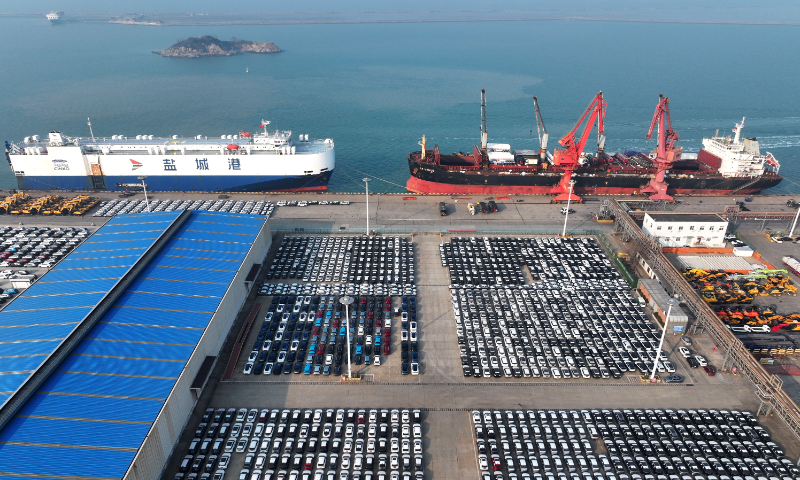
A large number of new-energy vehicles waiting to be exported are parked at Lianyungang Port, East China's Jiangsu Province. Photo: VCG
China's new-energy vehicle (NEV) exports surged 144.7 percent year-on-year in October, industry data showed on Monday, underscoring strong overseas demand even as domestic sales weakened. Industry analysts said that exports are likely to maintain robust momentum in the near term, although growth is likely to moderate as overseas markets mature and competition intensifies.
Chinese producers exported 582,000 passenger NEVs in October, up 3.9 percent from September, according to data released by the China Passenger Car Association (CPCA). Meanwhile, domestic NEV retail sales fell 13.7 percent year-on-year to 1.109 million units, although they rose 2.3 percent month-on-month.
Cui Dongshu, secretary-general of the CPCA, told the Global Times on Monday that China's automobile exports are expected to shift from rapid growth this year to a more moderate pace in 2027.
Cui forecast that overall vehicle export growth could slow to about 10 percent next year as shipments to Russia stabilize and exports to the EU face mounting pressure. The Middle East region could provide additional growth, although prospects remain uncertain, he said.
Passenger NEV exports reached 4.472 million units in the first 10 months of 2026, up 139.7 percent year-on-year, according to the CPCA.
These figures also point to a changing export structure. NEVs accounted for 62.8 percent of China's passenger vehicle exports in October, up 20 percentage points from a year earlier. Battery electric vehicles represented 61.7 percent of NEV shipments, while conventional plug-in hybrids accounted for 33.7 percent.
Leading Chinese automakers recorded substantial overseas shipments. BYD exported 165,194 passenger NEVs in October, followed by Chery with 83,843 and Geely with 80,119, CPCA figures showed. Tesla China's exports reached 59,012 units.
Zhang Xiang, a researcher at the Automotive Industry Innovation Research Center of North China University of Technology, told the Global Times on Monday that Chinese automakers have established a competitive edge in the global NEV market through technological advances, mature supply chains and increasingly competitive products.
He said that he expects overseas demand to remain strong in the coming months, supporting continued export growth. However, as NEV adoption expands and initial demand is gradually absorbed, export growth is likely to return to a more sustainable pace over the longer term.
The expansion comes amid a changing international trade environment. The EU has imposed additional countervailing duties on China-made battery electric vehicles, while Chinese manufacturers are increasingly exploring emerging markets to diversify their overseas sales.
According to the International Energy Agency, sales of Chinese-made electric cars last year grew by 130 percent in Southeast Asia, 60 percent in the Middle East and 55 percent in Latin America, highlighting growing demand beyond traditional markets.
Zhang said that maintaining growth in these markets would require Chinese automakers to move beyond simply exporting vehicles and strengthen their local operations. Manufacturers should develop models tailored to local consumer preferences and regulatory requirements rather than directly introducing vehicles designed for China's domestic market, he said.
He also stressed the importance of expanding dealership networks, improving after-sales services and establishing local spare-parts facilities. In markets with sufficient demand, automakers could consider local manufacturing and supply-chain partnerships to reduce costs and better meet local requirements.
Zhang said that Chinese automakers could draw lessons from Japanese and South Korean brands' international expansion, placing greater emphasis on product quality, brand reputation and long-term investment in local markets.
As overseas demand continues to expand, the challenge for Chinese automakers will be to translate rapid export growth into a more durable international presence, supported by localized production, stronger distribution networks and reliable services.
RELATED ARTICLES