ARTS / CULTURE & LEISURE
Chinese actress thanks ‘Peaceful China’ after winning Best Actress for film on Japanese war crimes
Peaceful China gives me confidence to chase my dreams: best actress
By Published: Nov 10, 2026 11:53 PM

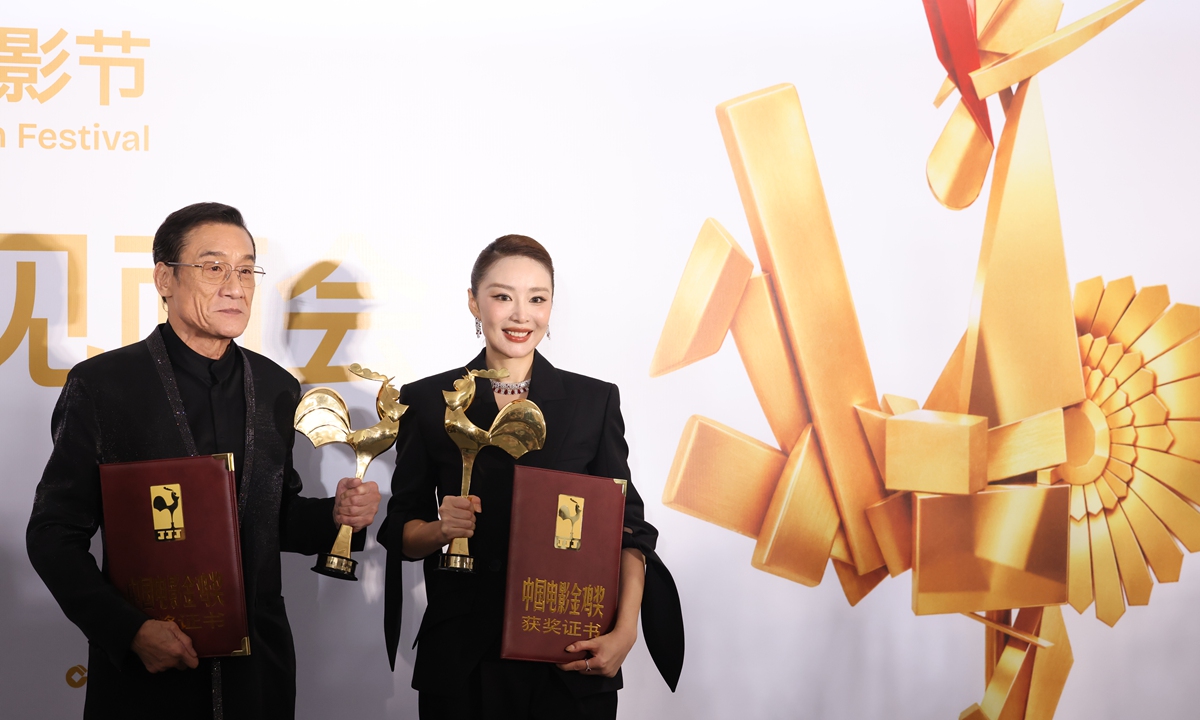
Best actor and best actress winners Tony Leung Ka-fai (left) and Gao Ye pose for a photo at the 2026 China Golden Rooster and Hundred Flowers Film Festival in Xiamen, East China's Fujian Province on November 10, 2026. Photo: VCG
Chinese actress Gao Ye won the Best Actress award at the 39th China Film Golden Rooster Awards on Tuesday evening in Xiamen, East China's Fujian Province, for her portrayal of Lin Yuxiu in Dead to Rights, a historical drama based on war crimes committed by the Japanese military during the Nanjing Massacre in 1937.The film, directed by Shen Ao, also won Best Feature, the highlight of the 2026 China Golden Rooster and Hundred Flowers Film Festival.
Standing on the stage, Gao Ye said that she had felt "what it feels like a dream come true."
Marking 20 years since she entered the Beijing Film Academy in 2006, she said she was "deeply grateful to have been born on peaceful Chinese soil and have grown up in this land of magnificent rivers and mountains," which gave her the confidence to pursue her dream. She also thanked audiences for their tolerance and affection.
The jury praised her performance as full-bodied and expressive, noting that she precisely "captured the character's trajectory from living in illusion to sudden awakening and navigated the enormous emotional gulf between the two states."
At the nominee ceremony on Monday, Gao said she believed "it was the audience who saw Lin Yuxiu." "Because you saw her, these 137 minutes became exceptionally heavy with meaning, and that stretch of history had a chance to be seen, and to be remembered," she said, her voice breaking.
She added that it had taken her a long time to reach this point, and several times she thought she might never get there. "Today I can stand here. I want to thank every single time I was seen, and I also want to thank those people who never give up." She then offered to share her luck with fellow dreamers: "Go after your dreams. The road is long, but those who set out will arrive, and passion will always find an echo."
Dead to Rights, from a screenplay by Xu Luoyang, Zhang Ke and Shen, stars Liu Haoran, Wang Chuanjun and Gao. Released nationwide on July 25, 2025, the film, which has an 8.7/10 rating on review site Douban, grossed 3.017 billion yuan ($452 million), making it the top grosser of the 2025 summer season. It drew seven nominations at this year's ceremony, winning two, and was selected as China's submission for best international feature at the 98th Academy Awards.
The jury said the film "uses the small photo studio as its narrative vehicle, meticulously depicts the historical environment, and reproduces the human choices and national responsibility of people in turbulent times," adding that "in the blending of individual destiny and national memory, it restores the essence of history, and provides a rich, deep and heartfelt artistic paradigm for the creation of historical films."
Shen accepted the award and certificate from renowned Chinese director Zhang Yimou. "We have the prosperous society of today, we have the Chinese cinema of today," he said. "It is a great honor to be able to create more and better works in this peaceful era. At the same time, I would like to take this opportunity to say sorry to our audiences. My previous works always left you with a sense of pain, or indignation, whichever. From now on I will devote myself to making works that leave you feeling satisfied, joyful and warm," Shen said.
Chaoshan-region themed film Dear You received the special jury award and also won Best Screenplay. Directed by Lan Hongchun and shot largely in the Teochew dialect with a mostly non-professional cast, the film cost just 14 million yuan to make, but grossed 2 billion yuan, with 58.82 million tickets sold and earning a 9.3/10 Douban score. Its narrative thread is qiaopi, the letters and remittance documents sent home by overseas Chinese, now inscribed on UNESCO's Memory of the World Register. The film was screened at the Venice Film Festival in September.
Veteran Hong Kong actor Tony Leung Ka-fai took the Best Actor award for his portrayal of crime boss Fu Longsheng in The Shadow's Edge, making him the third Hong Kong actor to win the honor, following Jackie Chan and Tony Leung Chiu-wai. This was his first Golden Rooster win in a career spanning more than four decades.
"This is the first time I was nominated for a Golden Rooster. Now that I have the trophy in my hands, it is a really wonderful feeling," he said. At Monday's ceremony, he described himself as simply "a film actor." "Being seen is a kind of luck," he said, noting that many of his colleagues in front of and behind the camera "don't seem to have many chances to be seen," while the Golden Rooster stage allows both familiar and unfamiliar faces to share the limelight. "That is what makes us happy as film workers."
Footage of Leung, 68, traveling to Xiamen alone by high-speed train to attend the ceremony drew warm comments online. He now holds five Hong Kong Film Awards, one Golden Horse and one Golden Rooster, completing a rare "triple crown" in Chinese-language cinema.
Director Zheng Dasheng won Best Director for Hideaway: The Dossiers, a Shanghai Film Group production about the underground struggle to guard Communist Party files in occupied Shanghai in 1942. The jury said he "chose a small entry point to address major red-history facts," building tension through the abnormal within the everyday, and made a "new exploration in the red spy genre."
Other honors went to Lan Xiya for Best Supporting Actress in Sound of Silence, and Usher Sailai for Best Supporting Actor in Wan Tong Shu, which follows the preservation of the Uygur Twelve Muqam. Wan Li was awarded Best New Director, Nobody took Best Animated Feature, Shanghai Wonton won Best Low-to-Medium Budget Feature Film, while Sentimental Value from Norway won Best Foreign Language Film.
The Golden Rooster, China's highest professional film honor, has rewarded the domestic industry since 1981. This year's winners reflect a maturing slate: a record-breaking historical drama built on archival footage, a 14 million yuan sleeper hit in the Teochew dialect that drew nearly 59 million moviegoers, and a realist work from first-time directors.
RELATED ARTICLES