ARTS / CULTURE & LEISURE
2,000-year-old palace site discovered along ancient road in Shaanxi
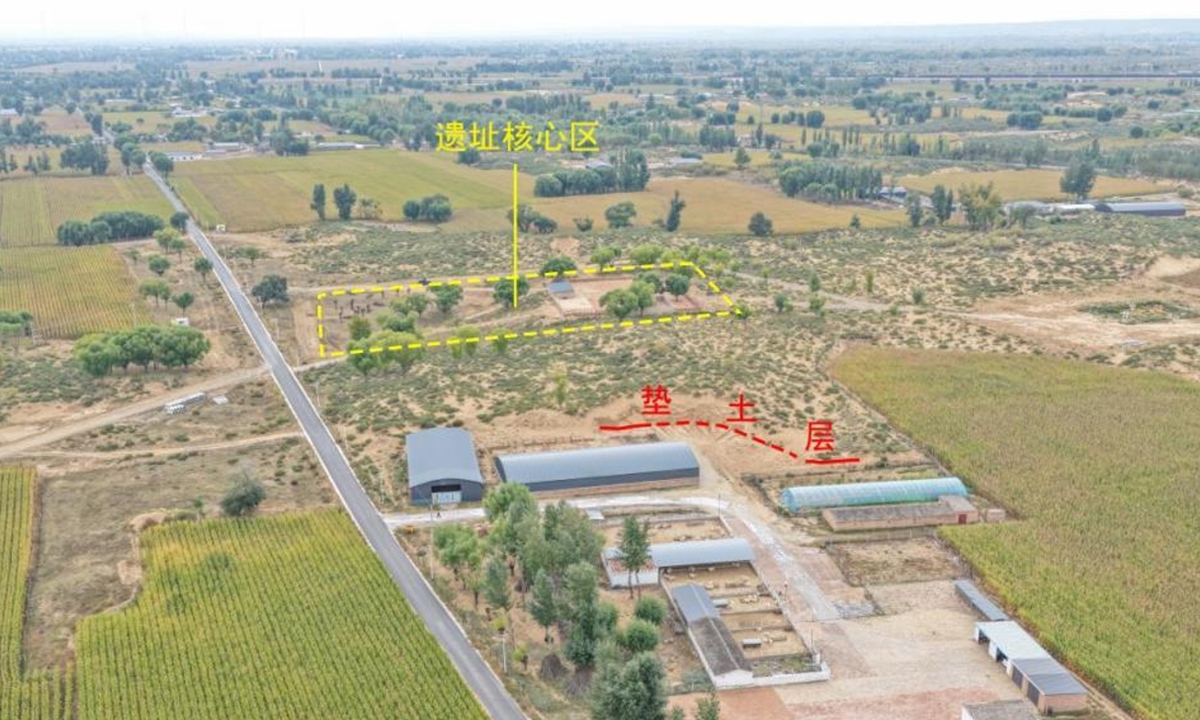
The Huangtuliang site in Yulin, Northwest China's Shaanxi Province Photo: Courtesy of the Yulin Institute of Cultural Relics and Archaeology
Archaeologists have discovered a Qin Dynasty (221BC-206BC) site in Yulin, Northwest China's Shaanxi Province, which they preliminarily believe was an auxiliary palace along the Qin Straight Road, an ancient transportation route stretching more than 700 kilometers that served as a major artery for trade, migration and cultural exchange in ancient China.
The site, known as the Huangtuliang site, was discovered in Huangtuliang village, Yulin, during an archaeological survey of the route the Qin Straight Road took through the Mu Us Desert. The Yulin Institute of Cultural Relics and Archaeology first started the investigation in August.
Based on the architectural materials found on the surface, archaeologists have preliminarily identified the site as a palace from the Qin Dynasty.
The core area of the site covers nearly 10,000 square meters, while scattered archaeological remains extend across approximately 150,000 square meters, according to the institute.
Large quantities of architectural materials, particularly bricks and roof tiles, have been found on the ground, alongside a small number of pottery fragments.
The bricks include hollow bricks and square bricks, some decorated with geometric patterns, including meander motifs and raised studs arranged in square or diamond shapes.
Archaeologists said the architectural materials provide important clues to the site's date and status. Most of the bricks and tiles are typical of the Qin Dynasty, while large kui-patterned roof-end tiles have so far been found only in buildings of the highest architectural rank from that period. Kui was a mythological dragon-like creature whose image was often incorporated into objects as a decorative pattern.
Further evidence comes from the remains of construction foundations and infrastructure. Local information and preliminary probing have indicated the presence of rammed-earth platforms beneath the sand in the site's central area.
Earlier soil excavation in the area also reportedly uncovered drainage facilities and wells. The drainage system included round ceramic pipes and right-angle pipe fittings, suggesting that the complex had an organized water supply and drainage system.
The architectural materials and infrastructure are comparable to those found at other known palace sites along the Qin Straight Road.
Archaeologists said these similarities further support the identification of the Huangtuliang site as a palace site associated with the ancient roadway.
The Qin Straight Road was built during the Qin Dynasty under the orders of Emperor Qinshihuang, who unified China in 221BC. The construction of the road facilitated transportation between the Central Plains and the Hetao region, becoming a major artery connecting China's heartland with its northern frontier. It had a far-reaching impact on the region's economic, cultural and political development and remains an important resource for research into ancient Chinese transportation and Qin Dynasty history. In May 2006, the Qin Straight Road ruins were designated a Major Historical and Cultural Site Protected at the National Level as part of China's sixth batch of such sites.
The latest survey has also yielded potential clues to the road's route through the desert.
About 7.5 kilometers southwest of Huangtuliang, archaeologists identified extensive traces of what may be an ancient roadbed along a previously predicted section of the Qin Straight Road.
The traces form a discontinuous north-northeast-oriented line extending for nearly 800 meters. The deposits consist mainly of yellow earth and reddish clay, with a small number of pottery fragments found on the surface dating to the Qin and Han (206BC-AD220) dynasties. A small Qin- and Han-era archaeological site, covering approximately 10,000 square meters, was also identified in the sandy area near the northern end of the deposits.
They therefore preliminarily suggested that the deposits may represent surviving sections of the Qin Straight Road itself.
A more comprehensive understanding of this section of the ancient route will require additional archaeological work, according to the institute.
RELATED ARTICLES