Meteorite fragments from Hebei fireball event fetch varying asking prices online, raising authenticity concerns
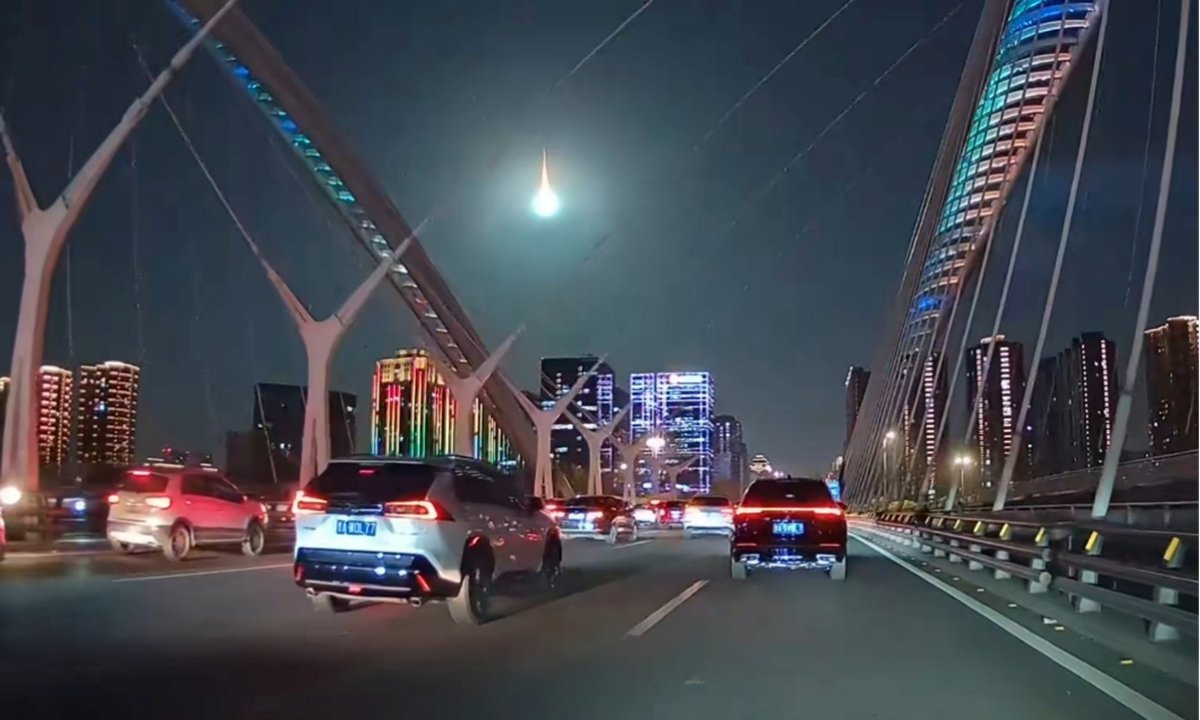
A fireball streaks across the sky over North China on the evening of November 6, 2026. Photo: Screenshot of CCTV News report
Following the fireball event in North China's Hebei Province, meteorite fragments have begun appearing on secondhand trading platforms, according to media reports.
A search on Xianyu, a Chinese secondhand marketplace, by the Global Times reporter showed that two sellers who listed Shijiazhuang, the provincial capital, as their location were offering meteorite fragments purportedly linked to the fireball event for 1,999 yuan ($299.68) and 666 yuan, respectively, with free delivery.
These are asking prices set by the sellers, not confirmed transaction prices.
The Beijing News reported on Wednesday that actual market prices for such meteorites currently range from approximately 20 yuan to 100 yuan per gram.
Researchers at the Institute of Geochemistry under the Chinese Academy of Sciences (CAS) have preliminarily identified meteorite samples recovered in the Shijiazhuang area, North China's Hebei Province, as L6 ordinary chondrites, following a bright fireball sighting on November 6, according to a release from the institute on Tuesday.
On the Chinese social media platform Sina Weibo, users have expressed differing views on the prices and collectible value of the meteorites. Some argued that the meteorites from this event belong to the ordinary chondrite category and are not particularly rare. Small fragments of such meteorites typically sell for several dozen yuan per gram, they said, while larger, more intact specimens are relatively uncommon.
Others said that prices of 30 to 50 yuan per gram for some fragments were reasonable, cautioning against viewing the meteorites as an investment offering easy profits.
Other users argued that the meteorites have a documented fall event, giving them scientific significant that should not be reduced to their market prices.
The trading activity has also raised questions about the relationship between scientific classification and value in the collectors' market. According to CNR, Chen Hongyi, a professor at Guilin University of Technology and deputy director of its Geological Museum, said that preliminary identification suggests the meteorites are not particularly valuable to collectors.
However, Wang Kechao, deputy director of the science popularization center at the Purple Mountain Observatory of the Chinese Academy of Sciences, noted that meteorites whose falls have been directly observed have a documented fall history, and relatively fresh samples. Compared with meteorites whose fall locations and circumstances cannot be traced, such specimens may have distinct scientific value and command a premium in the collectors' market, he said.
Beyond price differences, meteorite trading also faces challenges involving authenticity verification and the tracing the origins of sample. CNR quoted Chen as warning that ordinary buyers often have difficulty distinguishing genuine meteorites from fakes. He urged the public to be particularly cautious about sellers passing off meteorites from other sources as fragments from the recent fireball event.
Wang added that meteorite identification requires expensive, sophisticated scientific instruments and specialized personnel. Commercial authentication services currently available on the market remain underdeveloped, while relevant identification standards and procedures still need to be improved.
Global Times
RELATED ARTICLES