ARTS / CULTURE & LEISURE
Micro-dramas turn overseas viewers into on-screen stars as Chinese culture crosses borders
Stepping into the spotlight

Poster for a duanju shoot experience Photo: Courtesy of Zhang Jinquan
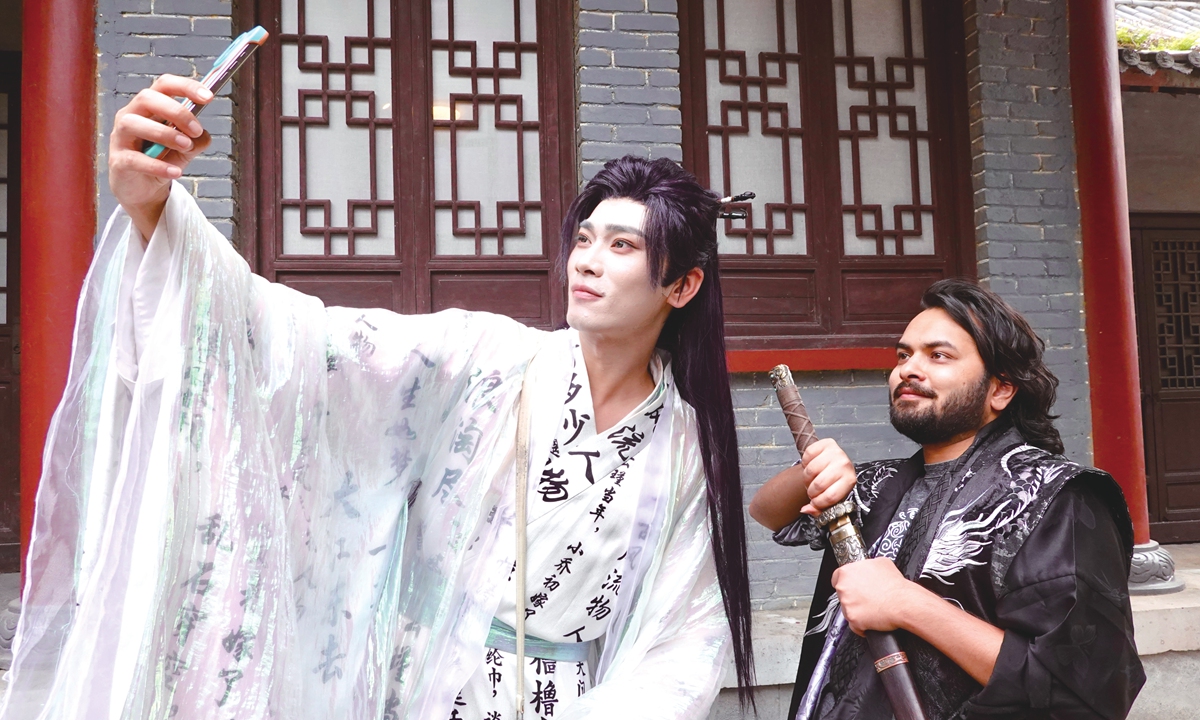
A character actor (left) poses with a visitor from Nepal at Hengdian Film Studio in Dongyang, Zhejiang Province, on October 3, 2026. Photo: VCG
The Chinese pinyin term "Duanju," referring to micro-dramas, has made its way onto Wikipedia, where the English entry has seen a rise in page views. The growing visibility of the term reflects the expanding international reach of Chinese micro-dramas, which are attracting audiences beyond China's borders.
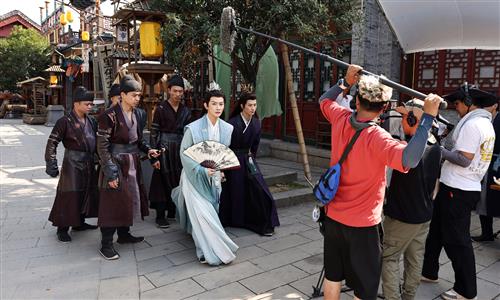
Patel, a 35-year-old woman from London, the UK, traveled all the way to Hengdian, East China's Zhejiang Province, where she donned a red traditional Chinese costume and stepped in front of the camera to experience acting in a duanju.
Having first discovered Chinese micro-dramas online, Patel decided to go beyond watching them on screen and take part in a production herself.
Her experience reflects a growing trend among international visitors. As Chinese duanju gain popularity overseas, some viewers are traveling to film bases across China to try on traditional costumes, learn to act and even come up with their own scripts.
"Since our team launched the short-drama film experience for tourists in August, it has attracted a large number of domestic visitors, followed by international participants from countries including Japan, South Korea and the US," Zhang Jinquan, chief director of the short-drama project "Hengdian Micro Film," told the Global Times.
Some visitors have even traveled to China specifically to film a short drama, Zhang said, adding that the opportunity to take part in a complete production for just a few hundred yuan offers tourists a novel and appealing experience.
Different tastes, shared fascination
International visitors have brought not only new customers to the project but also revealed differences in viewing preferences across cultures.
According to Zhang, many US visitors tend to favor fast-paced stories featuring dramatic twists and underdog characters who rise to success, such as tales about a "dragon king's return" or a wealthy man offering the female romantic interest money to leave his son. Japanese visitors, by contrast, tend to favor costume romances and visually elegant action scenes. Some have requested handsome male leads and sword-fighting sequences to create a romantic atmosphere.
"For some visitors, putting on traditional Chinese costumes is only part of the appeal. They want to experience firsthand the dramatic twists and role reversals they have enjoyed while watching short dramas," Zhang said.
Some participants even pay extra for photos and behind-the-scenes videos after filming, so they can keep a record of their first experience acting on a Chinese film set, he added.
The experience does not require professional acting skills. Zhang said a standard short-drama session costs only 498 yuan ($70) for one person, or 388 yuan per person for two participants. The package includes directing, camera work and costume and makeup services, with filming taking about 30 to 40 minutes.
Visitors can choose from existing scripts or discuss customized productions in advance. More elaborate projects involving multiple actors, fight scenes or wire-assisted stunts usually require additional script development or production planning.
Zhang's team began producing duanju for visitors in 2011 and gradually developed customized services at different levels. In August, a video showcasing the team's short-drama experience unexpectedly went viral online, prompting more people to sign up. Chinese micro-dramas' appeal to viewers well beyond the filming experience itself. Their popularity among audiences from different backgrounds is also evident in how people watch and discuss them in their daily lives.
Hengdian is not the only film production base exploring this model. In Wuxi, East China's Jiangsu Province, the Wuxi National Digital Film Industrial Park launched its first micro-drama filming experience for tourists in October. Participants can choose a script, dress up in costumes and perform in a professional studio, with directors guiding them through the scenes. The 599-yuan-per-person package includes filming and a finished video lasting one to two minutes. The project attracted more than 10 bookings within two days of its announcement, local media reported. The park is also preparing to introduce virtual-scene filming, giving visitors more options for creating their own short dramas.
Shared stories
At present, about 10 Chinese companies have built out duanju platforms for overseas markets, and more than a dozen Chinese short-drama apps going global have launched dedicated channels for AI-generated animated duanju. The combined active user base for AI-animated micro-dramas in overseas markets has surpassed 150 million. Among the top ten paid short-drama apps overseas, Chinese developers hold nine of the ten slots.
Wang Deyan, director of the Chinese Department at the School of Humanities and Law and director of the Center for Research on Chinese Classics Education at North China University of Technology, said one reason behind duanju's appeal lies in their focus on relatable characters and emotional relationships, rather than on requiring viewers to first grasp unfamiliar cultural elements. "An international viewer may know little about China's ancient social systems or the cultural meanings behind traditional clothing, but they can understand love, family ties, perseverance, dignity and destiny," Wang told the Global Times. "They first become interested in what happens to the characters, and then may grow interested in the cultural environment in which those characters live." As a story unfolds, traditional clothing, etiquette, architecture and ways of life cease to be isolated visual symbols. Instead, they become part of the characters' choices and experiences, allowing viewers to develop a more tangible understanding of Chinese culture as they follow the story.
"Effective cultural communication is not simply about presenting Chinese elements to international audiences. It is also about helping them understand why these elements appear in a story and how they relate to the characters' lives," Wang said. "When viewers become willing to explore the culture behind a story on their own, communication is no longer a one-way flow of information, but a two-way exchange."
RELATED ARTICLES