J-35A marks 2nd anniversary of its debut; state media analyzes upgrade prospects, including full version of WS-19 engine
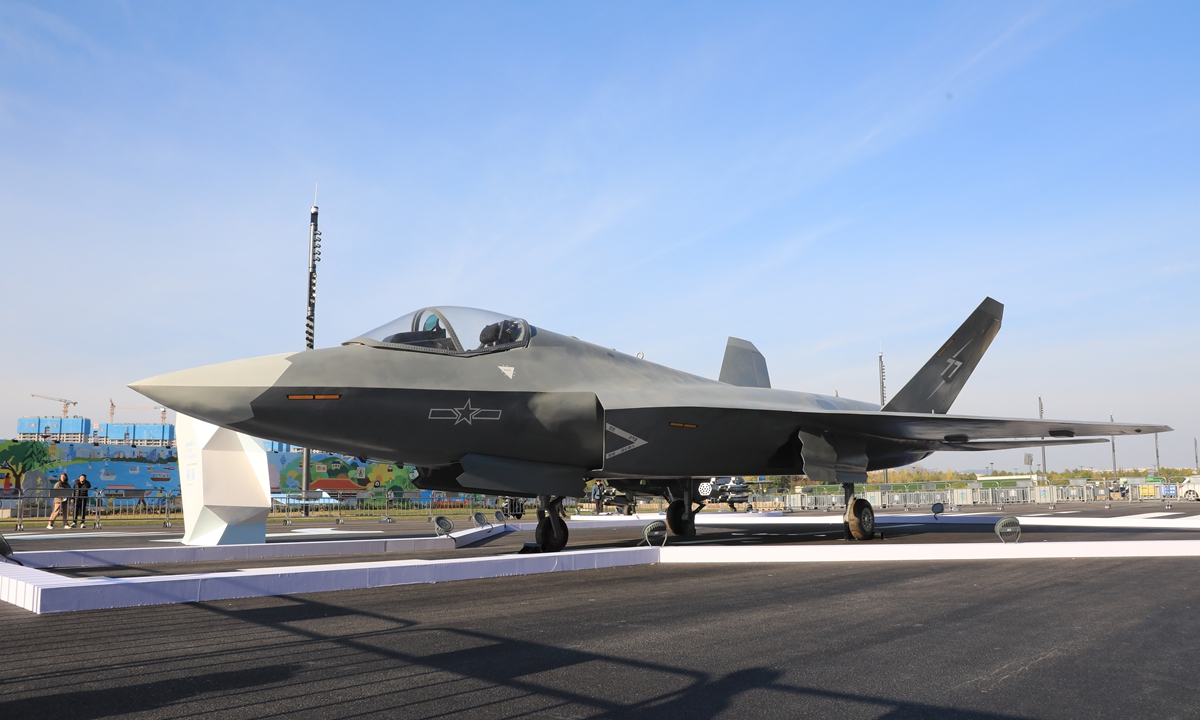
A full-scale model of the J-35A stealth fighter sits on display at the Dajiaochang Airport Runway Park in Nanjing, East China's Jiangsu Province, on November 10, 2026. Photo: VCG
Thursday marked two years since the J-35A, China's domestically developed medium stealth multi-role fighter, made its public debut. As a new-generation stealth fighter, the J-35A has achieved key upgrades in avionics, situational awareness and weapons integration. State media CCTV News analyzed its upgrade prospects, mentioning an expected switch to using the full version of the domestically developed WS-19 turbofan engine.
The J-35A, officially codenamed Yunlong (Cloud Dragon/Loong), is a single-seat, twin-engine fighter and the second type of fifth-generation stealth fighter jet independently developed by China, featuring the PLA Air Force's experience with and feedback on the J-20, China's first type of stealth fighter jet. The J-35A was designed with a balanced consideration of performance, reliability, maintainability and cost in mind, Wang Ya'nan, editor-in-chief of Beijing-based Aerospace Knowledge magazine, told the Global Times.
For stealth, the J-35A uses an integrated low-observable design rather than relying on coatings alone. Its configuration features a blended wing body, twin canted vertical tails, all-moving horizontal tails and a diverterless supersonic inlet (DSI) to reduce radar reflections. Bay door seams follow edge-alignment principles, and integrated precision manufacturing reduces gap scattering. The cockpit canopy is coated with a conductive stealth film to compress radar returns, achieving multi-directional stealth, introduced CCTV.
The radar cross section (RCS) of China's J-35 series is extremely small, thanks to its special fuselage design and China-exclusive metamaterial technologies, Wang noted. Such a small RCS allows the J-35 to remain undetected until it is very close to its target, giving it more advantages and opportunities in combat. This also means the J-35's stealth capability is at a world-class level.
When it comes to avionics and situational awareness, the J-35A carries a new-generation active electronically scanned array radar, offering longer detection range and some capability against stealth targets. An electro-optical window under the nose provides electro-optical detection. The system supports sensor fusion and links with the pilot's helmet-mounted display, and can network with the J-20 and drones via high-speed data links, said CCTV.
Military commentator Shao Yongling said in the CCTV News report that concerning weapons integration, the J-35A has an internal weapons bay for medium-range and short-range air-to-air missiles in stealth mode. The wings also have external hardpoints for air-to-ground and anti-ship munitions in non-stealth mode.
With the public debut of the J-35A in November 2024, the Air Force's traditional "three swordsmen," the J-20 stealth fighter, J-16 fighter and J-10C fighter, have expanded and upgraded into a new "four swordsmen" lineup that includes two types of stealth fighters. The four "swordsmen" form a new combination in the Air Force's new-quality aviation combat power, CCTV reported.
Shao noted that the J-20 is a high-end heavy fighter for high-value targets, while the J-35A is a medium fighter. They complement each other with clear differences in design and mission. The J-35A is smaller, cheaper and easier to maintain, making it better suited for large-scale fielding as a scalable, general-purpose stealth fighter.
Its first core mission is routine air patrol and regional air defense. The second is multi-mission strikes: In stealth mode it can penetrate defenses and hit air defense sites, radars and ships; when needed, it switches to non-stealth mode with more munitions for air-to-ground and anti-ship support. It also supports system-based distributed operations, Shao said.

China's J-35A fighter jet carries out its first adaptive training session at Zhuhai Jinwan Airport on November 8, 2024, ahead of the 15th China International Aviation and Aerospace Exhibition, also known as Airshow China, to be held in Zhuhai, South China's Guangdong Province. Photo: VCG
In system confrontations, Shao said, once the J-20 opens a gap, large numbers of J-35As network with early warning aircraft and unmanned wingmen for wide-area surveillance and forward reconnaissance.Operating with fourth-generation fighters such as the J-16 and J-10C, the J-35A can slip in first to locate enemy radar and air defense sites and share coordinates with the rest of the formation, bringing stealth reconnaissance plus target guidance, the expert added.
Despite these strengths, the CCTV report said the J-35A is far from the end point. From the start, it was designed with ample room for expansion of its capabilities.
"A two-seat variant is technically feasible, and its core value would be as a command platform for unmanned wingmen. However, no official project has been announced. Besides a two-seat version, I think an electronic warfare variant is also an option," Shao was quoted by CCTV as saying.
As for foreseeable upgrades to the J-35A, Shao sees four areas. First, the engine switching to the full version of the WS-19 turbofan engine.
Second, Shao noted avionics and intelligence, which involves strengthening detection of stealth targets and reducing pilot workload through smarter systems. Third comes weapons and a bay expansion, which means optimizing the internal bay for more new munitions and a richer stealth-mode strike list. Finally, iterative stealth refinements will see improving stealth stability in complex environments.
Overall, the J-35A is unlikely to pursue all-round upgrades at once, and will probably follow a "small-step, fast-iteration" path in batches, Shao said.
Wang Yongqing, the chief designer of multiple types of aircraft as well as the chief expert of the Shenyang Aircraft Design and Research Institute under AVIC, previously described the J-35 series' development approach in an interview with Global Times. He said the J-35 series, developed with an "air-sea twin configuration" approach and a "one aircraft, multiple variants" concept, is expected to enter large-scale production in the future, with the aircraft acting as a "point guard" in systematic combat operations and delivering outstanding performance.
RELATED ARTICLES