Apple’s India supply chain encounters setback — what ‘Make in India’ still lacks
By Published: Nov 12, 2026 11:46 PM

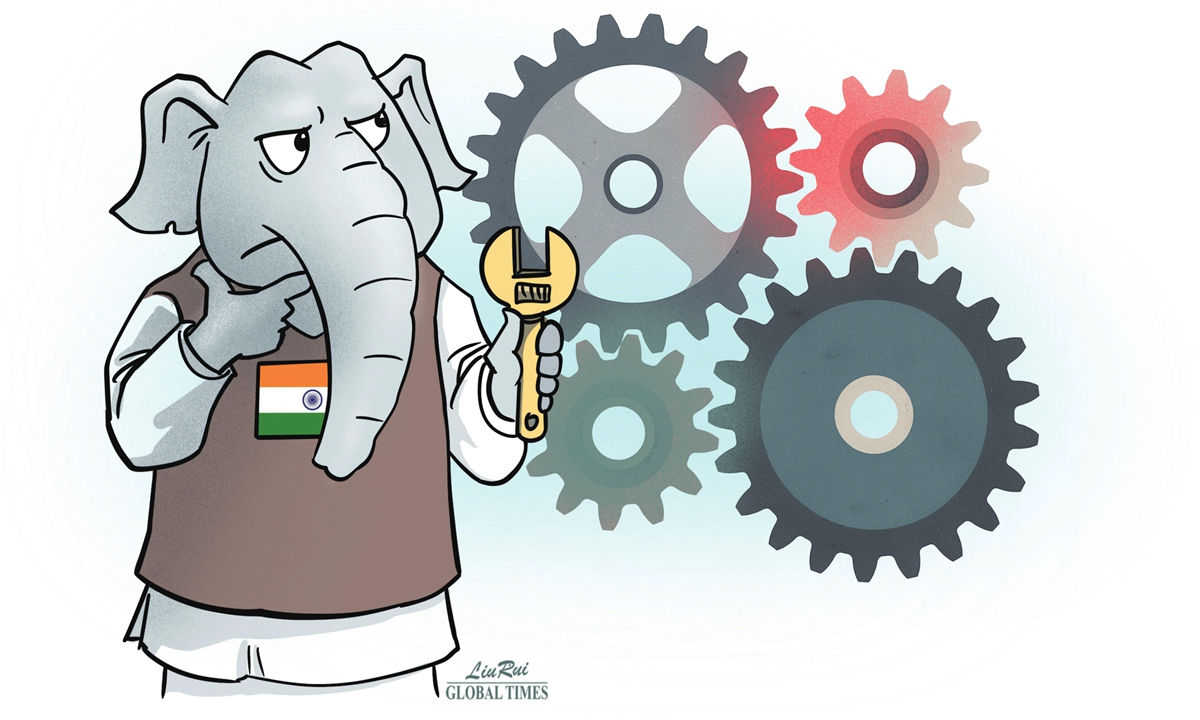
India Illustration: Liu Rui/GT
A deadly accident at a Tata Electronics plant in Hosur, Tamil Nadu has again turned the spotlight on Apple's India supply chain. On Monday evening, three contract workers were cleaning a wastewater tank at the iPhone parts facility when they inhaled toxic gas and died. Apple and Tata have launched investigations, and the Tamil Nadu government promised a full probe.This was not an isolated glitch. The same campus experienced a chemical fire in 2024, wastewater-pollution warnings earlier this year, and a major ransomware leak that exposed more than 200,000 files, including documents linked to Apple's then-unreleased iPhone 18 Pro, Reuters reported.
Units of Foxconn and Pegatron, Apple's other suppliers in India, have also previously faced food-poisoning protests, fires and labor disputes. The pattern is consistent: capacity is moving fast, but the underlying safety, compliance and management systems are not keeping pace.
Apple began shifting iPhone assembly to India around 2017. India now produces about one-quarter of global iPhones, with Tata and Foxconn as the backbone. Yet "assembly in India" is not the same as "made by India." Core components such as chips, displays, precision structures, and automation gear still come largely from Chinese and broader East Asian suppliers.
The list of local Apple suppliers in India has remained relatively thin. In short, what India has absorbed is the sub-assembly stage; what it has not yet built is the dense ecosystem around it.
This is where the "supercycle narrative" of Indian manufacturing needs a reality check.
It is true that India has made significant progress in recent years to develop its smartphone supply chain, with the Economic Times reporting in October that Apple's India business surpassed 1 trillion rupees ($10.66 billion) in fiscal 2026.
However, a country does not upgrade its industrial base by landing one or two flagship clients. It does so when hundreds and thousands of smaller suppliers, logistics firms, testing labs, maintenance contractors and vocational workers grow together - when a market has broad participation, not just selective subsidies.
China's smartphone sector had more than 1.19 million companies in 2025. The vast scale of industry participants has ensured ample competition, and provided a solid foundation for the rise of successful homegrown brands such as Huawei, Xiaomi, Oppo, and Vivo, among others. More importantly, the highly competitive ecosystem has ensured that the other aspects of smartphone production are held to high standards.
The deaths of the three workers provide an unfortunate and harsh reminder: low-cost labor and production-linked incentives cannot substitute for mature industrial standards and procedures. India needs more than new production lines. It needs stronger ancillary supply chains, stricter environmental and occupational standards, better contractor accountability, and deeper integration with global supplier networks. Companies are still responsible for keeping workers safe, even when they subcontract the work.
There is also a cooperation angle the West often misses.
About three years ago, some Chinese smartphone companies encountered setbacks in India, which may have affected the confidence of some Chinese investors in the market. More recently, signs of improvement have emerged in China-India economic and trade exchanges. Against this backdrop, cooperation in the smartphone supply chain may offer a practical entry point for renewed industrial engagement, and the participation of Chinese smartphone supply chain companies will help fast-track the building of India's smartphone ecosystem.
China's electronics chain did not appear overnight - it was built over decades of clustering, trial-and-error and supplier competition. India's realistic path is not to "replace China" but to plug into the global ecosystem while developing its own tier of capabilities by importing intermediates, co-developing processes, and raising standards through openness rather than containment.
Factories alone don't create a supply chain. A plant is the visible tip. The invisible part - skilled maintenance crews, quality culture, emergency response, and data security - decides whether "Make in India" develops safely or stalls on the next accident.
India's manufacturing future is not a choice between copying China or rejecting it. It is about building a broader, more open industrial base where workers are protected, suppliers multiply, and global chains connect rather than decouple.
The author is a reporter with the Global Times. bizopinion@globaltimes.com.cn
RELATED ARTICLES