IN-DEPTH / IN-DEPTH
A newcomer's daily encounters in Brussels reveal how small visual cues turn waste-sorting rules into lasting habits
Bags That Shape Habits

The view of Brussels Photo: VCG
During my first week in Brussels, my roommate handed me several rolls of waste bags in different colors. Learning to sort waste, I was reminded, was a basic part of settling in. I would often stand in the kitchen with something to discard in one hand, searching the sorting guide on my phone with the other. Where should a glass bottle go? Which bag should hold a piece of packaging? Even these small decisions required me to check the local instructions again.
Before coming to Belgium, I already understood the importance of waste sorting. But with several colored bags in the kitchen, protecting the environment became a succession of practical decisions. Between knowing a principle and performing a small task almost without thinking lies a distance that has to be covered through experience.
What information actually helped me take the next step? Looking back, I realized that the guide on my phone, the bags' colors, recycling signs on street corners and my roommate's explanations each played a different part in helping me understand what to do. These unassuming details reveal how communication helps shape everyday habits.

A teacher at a kindergarten in Nantong, East China's Jiangsu Province, teaches kids garbage sorting on September 8, 2026. Photo: VCG
Colors make sorting knowledge usable
In Brussels, yellow bags are for paper and cardboard; blue bags for accepted plastic packaging, metal packaging and drinks cartons; orange bags for designated food waste; green bags for garden waste; and white bags for residual waste. Glass bottles and jars have separate collection arrangements, with clear and colored glass kept apart. For blue bags, "packaging" is crucial: they are not for every plastic item.
For a newcomer, the colors initially form a code to memorize. Only through repeated use did the connections between colors and objects become familiar. What had initially required a conscious effort to remember gradually became easier to recognize. The bags offered visible prompts for instructions I would otherwise have to look up. Written information on a phone screen became something I could recognize and act on in the kitchen.
Seen as a means of communication, waste bags hold discarded items and convey their purpose through colors and markings. They turn abstract sorting requirements into information available at the moment of disposal. Their cues are simpler and more immediate than a webpage, while exceptions still require detailed guidance. The two complement each other: a visible cue helps with an ordinary decision, while the guide remains available when that cue alone is insufficient.
On its sorting webpage, Brussels' public waste collection agency recommends downloading a sorting memo and displaying it somewhere visible, such as the refrigerator door. This small suggestion is revealing. Information's usefulness depends partly on when and where it appears. Seeing the relevant prompt while holding a piece of packaging removes one search between understanding and action.
In Cognition in the Wild, cognitive anthropologist Edwin Hutchins examines how cognition unfolds through interactions among people, tools and their environment. This perspective helps me understand my sorting ability in context. Some knowledge is in my memory, some remains in the guide and some is prompted by colors and signs. Knowing how to sort includes knowing how to draw on these resources to make a decision.
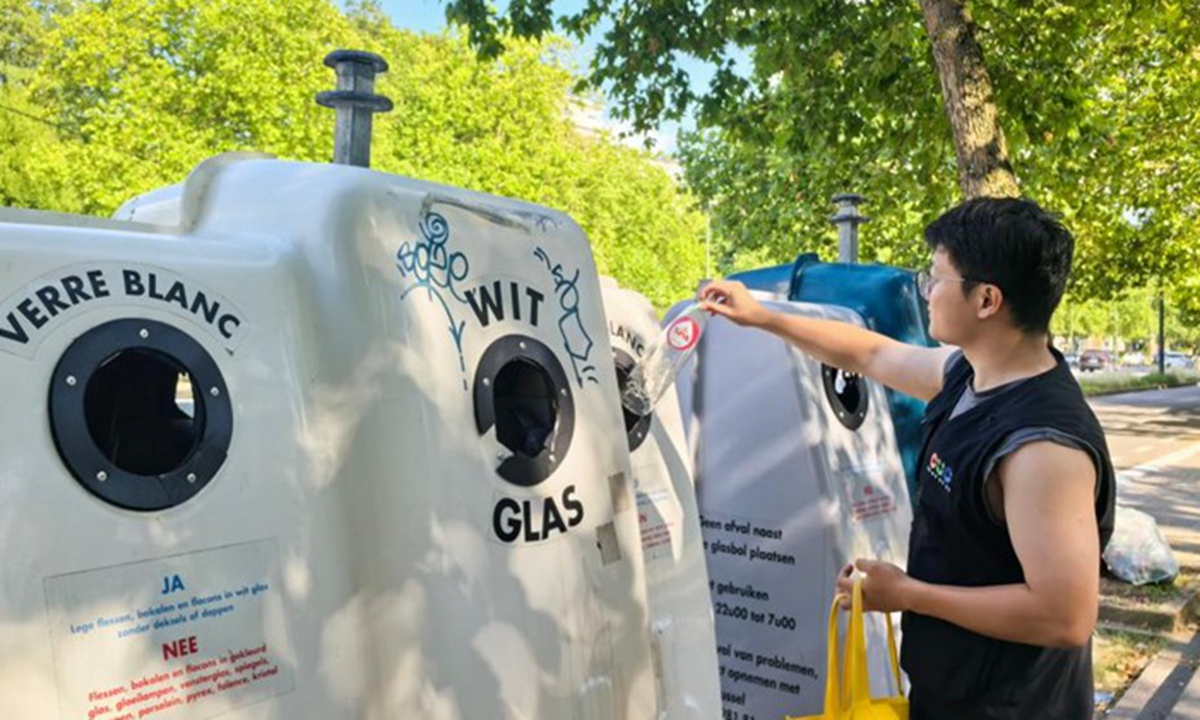
A Chinese student sorts glass bottles of different colors into the corresponding recycling bins on a street corner in Brussels, Belgium. Photo: Courtesy of Liu
Collection schedules bring reminders into weekly routines
Knowing which bag to use is only one step. Waste must also be put in the designated place at the right time. In Brussels, residents need to check when to put bags out according to their address; one street's schedule cannot be treated as the timetable for the whole city. For me, adapting to local life meant remembering the arrangements for my own address and fitting them into my weekly routine.
By my third month, sorting had become more familiar, but I still sometimes forgot to put the bags out. One morning, as I was leaving home, I noticed bags outside my neighbors' doors and remembered the task I had missed. I felt inconvenienced and a little embarrassed. That feeling, however, did not mean my neighbors were judging me. What was clear was that their bags offered a timely, concrete reminder.
This drew my attention to information conveyed without written notices. Actions already completed by others leave recognizable clues. Residents need not leave home together, or even speak, to carry out related tasks at different points in the week under the same collection arrangements. The days for putting bags out connect private kitchens with collection work on the street.
This ordinary connection is easily overlooked, precisely because it is woven into such a routine domestic task. Communication research often asks whether a message is seen and understood. Habit formation raises another question: does a reminder reappear when action is needed? The guide explains, the timetable schedules the next task and the bags outside make that schedule visible.
Conversations help everyday knowledge circulate
Not everything I learned came from the web. My roommate provided the earliest reminders. Later, conversations with neighbors revealed how habits develop over time. One neighbor recalled putting all his waste in a single bag as a child. His recollection shifted my attention from his present ease to the gradual learning that had preceded it. The familiarity I saw in front of me had its own history.
While visiting a colleague, I saw a drawing that her five-year-old daughter had brought home from kindergarten. It showed bins in different colors alongside the items belonging in each. In Dutch, she explained which "home" each object should go to. Sorting knowledge became something she wanted to share and could readily illustrate. I tried to make sense of her explanation across the language barrier, drawing on her gestures and what I already knew.
As we communicated through gestures, I noticed that the drawing had found another use after traveling from kindergarten to home. Colors and pictures helped the child organize what she knew; explaining them brought her learning into a conversation at home. For that brief exchange, she was the one explaining and I, the adult visitor, the listener. Everyday knowledge does not always flow from older people to younger people.
I also once received a rejection notice attached by a waste collector after I made a mistake with a waste bag. The experience made the gap between reading instructions and carrying them out clear. For someone still learning, whether feedback is easy to understand, and whether an explanation can be found when questions arise, directly affects the next attempt. From a roommate's reminder to a child's drawing and feedback at collection, sorting knowledge needs repeated explanation in specific situations.
Elizabeth Shove, Mika Pantzar and Matt Watson identify materials, competences and meanings as three basic elements of social practice. Their approach examines how practices form and persist as connections between these elements are established, maintained and changed. In my experience, bags and collection facilities provide the material conditions; identifying and disposing of items requires skills acquired over time; keeping my surroundings clean and handling household waste responsibly give these actions everyday meaning.
Communication helps connect these elements. Colors aid recognition, guides allow verification, conversations clarify doubts and schedules remind us of the next task. Environmental knowledge can thus become part of recurring activities. Yet reminders cannot replace convenient facilities and reliable collection services. Without them, even clear instructions may not enable people to sort their waste successfully.
In assessing environmental communication, we should therefore ask more than how many people have encountered a campaign message. Are they less confused when disposing of a particular item? Do they know how to correct a mistake? Can the practice be sustained in daily life? My observations offer one way into these questions; they cannot represent the experiences of all Belgian households.
From checking my phone with an object in hand to choosing the appropriate bag more naturally, I experienced a gradual process of familiarization. Kitchens, doorways and street corners were the settings for this learning. My roommate's reminders, a child's drawing and the bags outside neighbors' homes helped make life in an unfamiliar city something I could understand and participate in.
When I think back to those rolls of colored bags, I think about how I gradually learned to live here. Perhaps a habit begins in such small, specific moments: information appears where it is needed, a question receives an answer, an action is completed and the action is remembered when the occasion arises again in everyday life.
The author is Associate Professor at School of Television, Communication University of China
RELATED ARTICLES