SMIC’s Q3 net profit more than doubles as domestic chip substitution accelerates in China
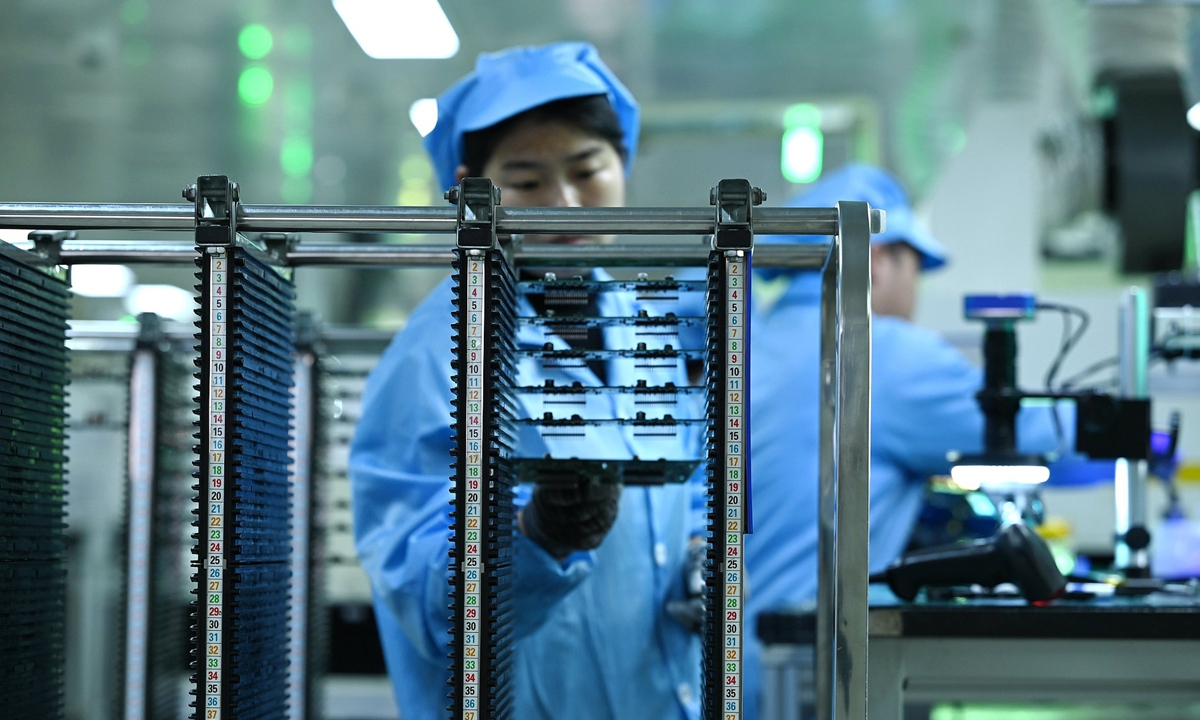
A technician conducts chip quality inspections in a factory in Yiwu, East China's Zhejiang Province, in March 2026. Photo: VCG
China's largest contract chip manufacturer Semiconductor Manufacturing International Corp (SMIC) posted a 123.4 percent year-on-year rise in net profit attributable to shareholders for the quarter ended September 30, while posting a new quarterly revenue record amid the artificial intelligence (AI) boom.
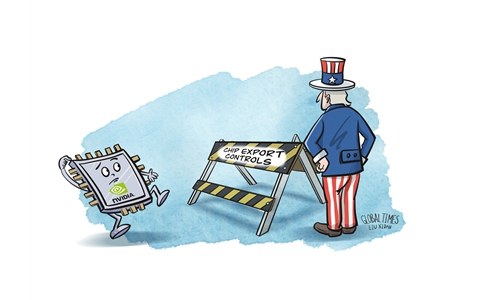
The results support a broader view that, whether the US tightens or relaxes its chip export controls, the trend toward domestic chip substitution in China has become irreversible, industry observers said. They projected that China's semiconductor could make substantially greater breakthroughs over the next three years as the entire industry - spanning chip design, equipment, packaging and materials - ramps up in tandem.
SMIC's third-quarter revenue hit a record $3.19 billion, up 6.1 percent quarter-on-quarter. Compared with three months earlier, demand from clients for AI-related chips, including BCD chips, specialty memory chips and controller chips, grew faster than initially anticipated, pushing third-quarter revenue above the upper end of the company's guidance, SMIC Co-CEO Zhao Haijun said at a press conference on Friday on the release of financial results.
Zhao said that, by geographic market, China accounted for 90.8 percent of third-quarter sales revenue, while the US accounted for 7.8 percent. In value terms, sales revenue in China grew 7 percent quarter-on-quarter, mainly because demand from Chinese customers expanded faster than the overall customer demand - prompting SMIC to adjust its capacity allocation accordingly to meet customer needs, he said.
Looking ahead, Zhao expressed optimism about the future of the semiconductor foundry industry. AI development, he said, was still gathering momentum, while demand for computing power continued to outstrip supply. The prevailing industry view, he added, is that 2027 will see a severe capacity crunch, which is expected to last until the middle or second half of 2028. After mid-2028, AI-related memory chip supply and demand may be broadly balanced, while computing power and other related chips may remain in short supply, according to Zhao.
"The results were better than expected," Xiang Ligang, president of the Beijing Institute of Intelligent Era Industry, told the Global Times on Friday.
With capacity utilization close to full and its product mix continuing to improve, SMIC has seen a sharp expansion in the profitability of its core business, underscoring the strength of its earnings performance. As a cornerstone of China's homegrown computing ecosystem, SMIC's strategic importance has become more pronounced amid spillover demand from the AI boom and accelerating domestic substitution, Xiang said.
"Domestic chip substitution has accelerated in recent years, with mature-node technologies continuing to make breakthroughs, and progress in 14-nm and 7-nm processes are moving steadily as well. In my view, the gap with the international frontier is no longer wide," he said. "What we see most clearly in 2026 is the entire industrial chain scaling simultaneously from chip design and equipment to packaging, components and materials. Huawei's Tau Scaling Law and the mass production of domestically developed lithography equipment are the most visible signs."
At the recently concluded China International Import Expo, China's leading semiconductor equipment manufacturer Shanghai Micro Electronics Equipment Group displayed a model of its next-generation front-end dry lithography platform, demonstrating imaging performance comparable to that of leading international counterparts.
"Multiple units have operated reliably over extended periods on mass production lines of top-tier domestic logic and memory manufacturers, supporting a cumulative output of more than 10 million wafers, with an effective equipment operating rate exceeding 92 percent," the company said, according to a statement on the company's official WeChat account.
The progress is no longer confined to exhibition displays. China's integrated circuit exports soared 111.1 percent year-on-year in the first 10 months to reach $341.07 billion, underscoring the country's rapid technological advances and a more sophisticated supply chain.
Jensen Huang's departure as Nvidia CEO has prompted speculation in some Western media that the US administration may tighten controls on China's access to advanced AI chips - a move that would further widen the technology divide between the world's two largest economies.
US House Speaker Mike Johnson claimed on Thursday there was growing consensus in US Congress on limiting chip exports to China following the controversy surrounding Huang, according to a Reuters report on Thursday.
"Whether the US tightens or eases its chip export controls, China's self-reliant substitution is an unstoppable trend, and that the country's chip sector could make substantially greater breakthroughs over the next three years as advances across the entire industry gather pace," Xiang said.
RELATED ARTICLES