Exclusive: China's role as APEC's rotating chair creates an opportunity for all parties to build common ground: director of ABAC Secretariat
By Published: Nov 15, 2026 07:13 PM

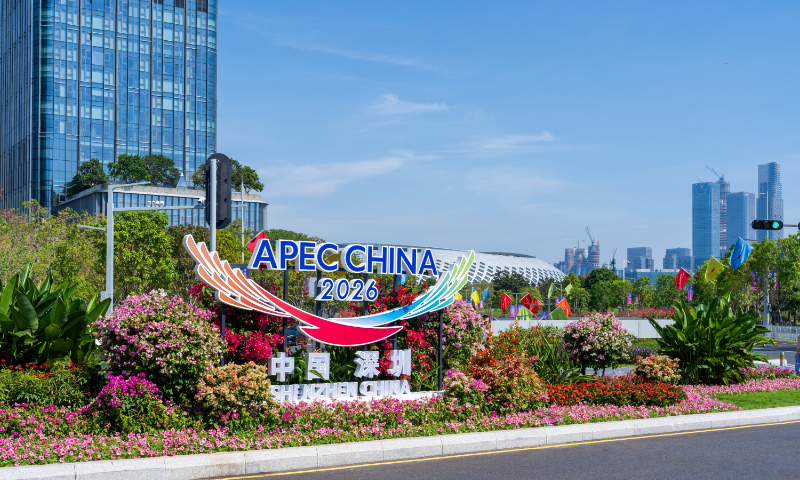
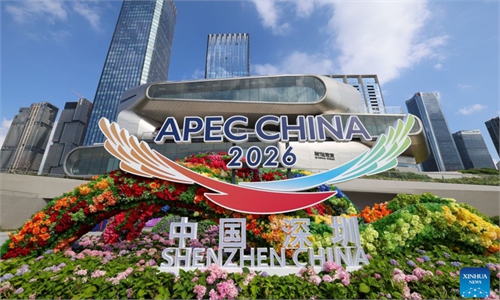
A logo of Asia-Pacific Economic Cooperation (APEC) 2026 is seen at a park in Shenzhen, South China's Guangdong Province, on November 12, 2026. Photo: VCG
Editor's Note:
On November 18 and 19, the 33rd APEC Economic Leaders' Meeting will convene in Shenzhen, South China's Guangdong Province, bringing together leaders, ministers, and business representatives from 21 member economies. A day earlier, the APEC CEO Summit will kick off under the theme "promoting prosperity together for a win-win future."
Ahead of the gathering, Antonio I. Basilio (Basilio), Director of the APEC Business Advisory Council (ABAC) Secretariat, spoke exclusively to Global Times reporter Li Xuanmin (GT). Having personally attended the 2001 Shanghai and 2014 Beijing APEC meetings, Basilio offers a firsthand perspective on how China's role in APEC has evolved. Facing a more complex global economic climate, he expects the upcoming summit in Shenzhen to translate the principles of openness and connectivity into tangible, predictable outcomes for regional businesses.
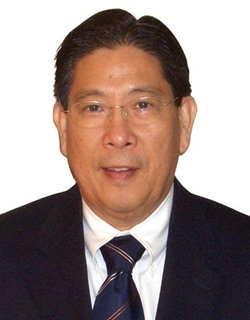
Antonio I. Basilio Photo: Courtesy of Basilio
GT: This year marks China's third time hosting APEC, after meetings in Shanghai in 2001 and in Beijing in 2014. How would you assess the evolution of China's role in APEC, and what are your expectations for this year's meeting?
Basilio: I think the three APEC meetings hosted by China - in Shanghai, Beijing, and now Shenzhen - reflect the profound changes that both China and the wider Asia-Pacific region have undergone over the past 25 years.
In Shanghai in 2001, as China stood on the threshold of joining the WTO, the emphasis was on opening markets, facilitating trade, and helping more economies benefit from globalization. By the 2014 Beijing meeting, China had become a major force in regional trade and investment. That year's agenda looked further ahead, putting forward the roadmap toward a Free Trade Area of the Asia-Pacific (FTAAP) and emphasizing connectivity to drive deeper market integration.
In Shenzhen in 2026, we face a considerably more complex environment. Businesses today are dealing with trade barriers, policy uncertainty, and disruptions to supply chains. At the same time, AI, digital technologies, and the energy transition are creating new opportunities for development. For ABAC, a central task is to preserve regional openness while equipping our economies to adapt to these changes.
This year's ABAC theme - "Openness, Connectivity and Synergy" - captures our fundamental approach. We want to see practical progress toward the FTAAP, lower trade costs, more resilient supply chains, and greater integration of digital tools into everyday economic activities, while promoting sustainable growth. We also pay special attention to small and medium-sized enterprises (SMEs) and workers, ensuring they have the skills, resources, and opportunities to participate in regional economic development.
China's role in APEC has evolved alongside its growing economic weight. Today, its market, manufacturing capabilities, technological prowess, and investment activities exert a much greater influence on the Asia-Pacific region than ever before. That brings China greater opportunities to shape regional cooperation, as well as a greater responsibility to work alongside other economies to sustain an open, stable, and predictable regional economic environment.
My expectation is that the Shenzhen meeting will further strengthen confidence in cooperation and provide practical direction for future efforts. Even where economies have differences, they should continue seeking space to work together. We hope to see the consensus reached by various parties translate into tangible improvements in the operating environment for businesses.
GT: Have you visited Shenzhen before? As both a window into China's reform and opening-up and a major sci-tech and industrial hub in the Asia-Pacific, what message does Shenzhen's hosting of APEC send about regional cooperation?
Basilio: Yes, I have visited Shenzhen. The first time I came, the city was still undergoing massive construction. When I returned more than two decades later, the transformation was amazing - today's Shenzhen is almost unrecognizable from the city I first encountered.
What stands out to me most about Shenzhen is how its development brings together openness, entrepreneurship, and innovation. It illustrates the immense development potential a city can unleash when investment, talent, technology, and market access reinforce one another.
That also makes Shenzhen a particularly meaningful setting for APEC. Its success has been closely connected to the wider regional and global economy, supported by an open market environment, extensive international ties, and continuous technological innovation. Hosting APEC here reminds us all that connectivity and openness are essential conditions for innovation and economic growth.
It also sends a forward-looking signal. Much of APEC's discussion today concerns AI, digital services, advanced manufacturing, and clean energy. Shenzhen has evolved into a major hub for these frontier technologies, providing an ideal setting for businesses to explore how new technologies can be practically applied and how cooperation can bring the benefits of technological progress to more economies.
I believe a key message Shenzhen sends to the Asia-Pacific is that the next stage of regional economic growth should still be built on openness, connectivity, and broad participation. Innovation will generate much greater prosperity for the entire region only when businesses, research institutions, and people across different economies can continue collaborating across borders.
GT: Business representatives from all 21 APEC economies are to gather in Shenzhen. Based on your knowledge, what issues concern business representatives most? What are their expectations for this meeting, and what role can APEC play?
Basilio: This gathering provides an opportunity for the business community to voice its concerns directly, allowing business leaders to explain to policymakers how policy decisions actually affect investment, production, employment, and commodity prices.
One of the greatest concerns for businesses today is uncertainty in the operating environment. Companies can plan for market competition and shifting demand, but it is much harder to commit to long-term investments when market access, tariffs, or technology restrictions may change at any time.
The growing tendency among economies to view supply chains through a security lens has further compounded that uncertainty. Governments have legitimate security concerns, but related measures should be clearly defined, proportionate, and transparent. Otherwise, the resulting cost increases and severed commercial relationships will extend far beyond the risks those measures are intended to address.
In addition, businesses worry about such things as transport costs, customs delays, diverging regulatory rules, and difficulties in accessing energy, financing, and technology, among others.
What the business community expects most, therefore, is a more stable and predictable operating environment alongside practical cooperation. Strengthening supply chain resilience does not mean economies should reduce their connections with one another. On the contrary, businesses need more options—including diversified suppliers, reliable transport routes, timelier information, and more efficient cross-border customs procedures. Only when supply chains have more alternatives and greater adaptability can they better withstand external shocks.
So the APEC summit provides a platform to bring these concerns directly into discussions with policymakers. And ultimately, the real measure of this meeting's success will be whether participating businesses leave with greater confidence to continue investing, trading, and working together.
GT: What opportunities can China's hosting of APEC bring for Asia-Pacific businesses seeking a more stable and open market?
Basilio: On the multilateral trading system, ABAC has consistently supported the WTO and an open, fair, transparent, and predictable trading environment. We want to sustain momentum toward the FTAAP by introducing practical steps that businesses can actually use, while promoting greater compatibility and interoperability among regional trade rules.
China's role as rotating chair creates an opportunity for all parties to build common ground around these objectives. As a major global trading economy, China can play a positive role in reinforcing confidence among the regional business community through its own policy practices and by working alongside other economies to reduce trade barriers and improve the business environment.
Meanwhile, connectivity extends well beyond physical infrastructure to include streamlined customs, interoperable digital systems, and people-to-people exchanges, which build the trust essential for commercial cooperation.
In Shenzhen, I hope to see these priorities translated into projects with clear responsibilities and follow-through - such as launching paperless trade pilots, tackling logistics bottlenecks, rolling out digital skills training, supporting smaller firms entering regional markets, and modernizing the APEC Business Travel Card.
Furthermore, China can offer the Asia-Pacific business community partnership opportunities in digital technology, advanced manufacturing, clean energy, and logistics. Such partnerships will carry even greater value if they help build local capabilities and enable participating economies to share in the dividends of development.
I hope the Shenzhen APEC meeting will achieve tangible progress in these areas, showing the Asia-Pacific business community that openness and cooperation are not merely shared goals, but can be translated into concrete outcomes felt by businesses and ordinary people alike.
RELATED ARTICLES