BSE marks 5th anniversary with strong growth in innovative SMEs amid rising foreign interest in Chinese assets
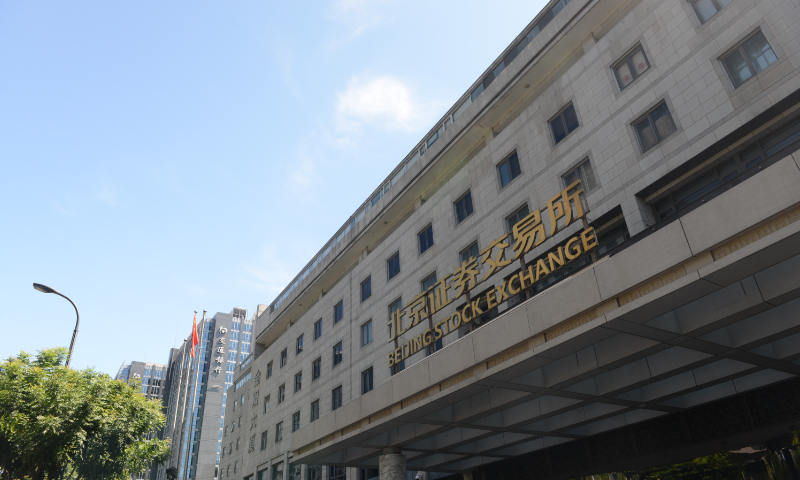
The building of Beijing Stock Exchange on July 5, 2026 Photo: VCG
The Beijing Stock Exchange (BSE) marked its fifth anniversary on Sunday, evolving from a fledgling market into a key platform for innovative small and medium-sized enterprises (SMEs) in China. The exchange started with 81 listed companies and a market capitalization of less than 300 billion yuan ($45 billion); it now hosts 355 companies with a combined market value of 800 billion yuan.
Among its listed companies, more than 60 percent are national-level specialized and sophisticated "little giant" enterprises, more than 90 percent are high-tech firms, and 20 have grown into manufacturing single champions in their fields, the BSE told the Global Times on Sunday.
Since its launch, the exchange has helped SMEs raise nearly 90 billion yuan, with more than 80 percent of the proceeds directed toward green and low-carbon development, the digital economy, high-end equipment manufacturing, and new materials.
Analysts described the past five years as a period of building foundations from scratch, adding that the exchange's development addresses a long-standing structural challenge in China's financial system.
"Traditional bank lending typically prioritizes collateral and cash flow, while the main boards of the Shanghai and Shenzhen exchanges emphasize profit scale. Many specialized and innovative firms, however, possess strong technology but have not yet achieved large-scale financial results," an independent industry investor told the Global Times on Sunday.
"Rather than simply lowering standards for listing, the BSE introduced more inclusive listing criteria that incorporate technological attributes, position in the industrial chain, and growth potential. This approach has created an institutionalized capital channel for innovative SMEs previously shut out by conventional financial thresholds," said the investor.
Over the past five years, this channel has deepened. The National Equities Exchange and Quotations (NEEQ), or the New Third Board, has supported 15,000 SMEs and clarified a growth pathway from regional equity markets to the NEEQ and then to the BSE. The BSE also channels quality listing resources to the Shanghai and Shenzhen markets while strengthening institutional links, analysts pointed out.
The BSE's market ecosystem has improved markedly. Qualified investors now surpass 11.8 million, nearly triple the number when the exchange opened in 2021. Institutional investor accounts top 200,000, and the number of public funds investing in BSE has grown from just over 100 at launch to more than 3,000. Institutional investors' share of trading has climbed from 9 percent to 25 percent, the Global Times learned.
Market makers have expanded from 13 to 24, and average daily turnover has climbed from less than 10 billion yuan to nearly 200 billion yuan since the beginning of 2026.
Deeper market making mechanisms and a more complete suite of index fund products are helping transform the BSE from a pure trading venue into a capital market platform with stronger pricing power and clearer exit expectations, Yang Delong, chief economist at Shenzhen-based First Seafront Fund Management Co, told the Global Times on Sunday.
Yang said that the establishment of the BSE formed part of a major strategic decision by policymakers to build a new development pattern and promote high-quality growth.
There is a notable alignment between the assets nurtured by the BSE and current global capital preferences, industry insiders noted. BSE companies largely focus on specialized and innovative fields, the energy transition, and intelligent connected technologies - areas that match international investors' interest in high-growth sectors with strong policy support. Optimizations to the qualified foreign institutional investors (QFIIs) mechanisms and the expansion of cross-border exchange-traded funds (ETFs) are further improving the convenience of allocating funds to BSE assets.
The exchange itself continues to advance its openness agenda. At the 2026 Financial Street Forum Annual Conference, BSE Chairperson Lu Songbin stated that the exchange would introduce market-value placement for new share offerings, accelerate the launch of the BeiZheng 50 ETF (designed to track the BSE 50 Index), improve market maker incentive and constraint mechanisms, and enhance its open ecosystem by exploring cooperation with enterprises, investors, and products to raise the level of institutional opening-up.
Analysts noted that the institutional significance of the BSE goes beyond adding another trading venue. It reconstructs the qualifications by which innovative SMEs can access capital. The BSE's institutional exploration sits within the broader reform of China's capital markets and coincides with structural shifts in how global investors allocate funds to Chinese assets.
As of the end of the third quarter, a total of 49 QFIIs appeared among the top 10 shareholders of more than 1,500 listed companies, with their holdings valued at about 270.7 billion yuan, up 79.87 percent year-on-year, according to market statistics.
RELATED ARTICLES