US Treasury chief presses Nvidia over alleged chip sales to China; experts warn tech politicization could unsettle US tech industry
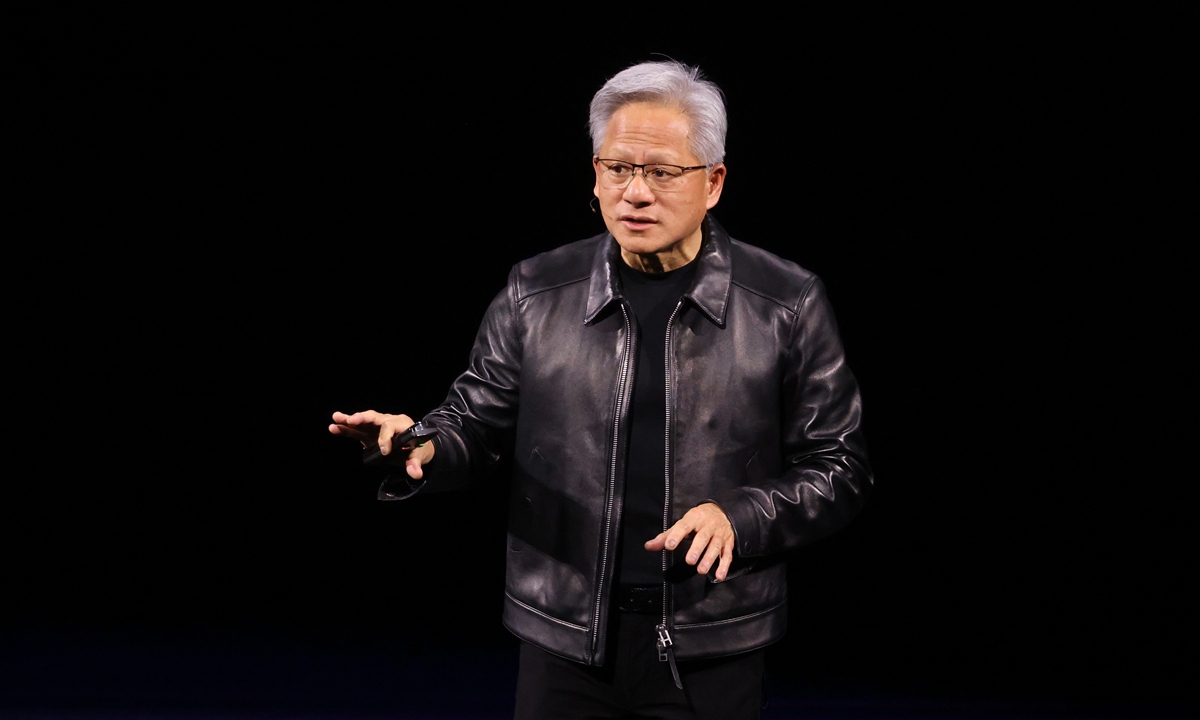
Jensen Huang. Photo: VCG
US Treasury Secretary Scott Bessent has demanded answers from Nvidia over whether it knowingly facilitated restricted chip sales to China and urged the company to overhaul its leadership, according to media reports. As the controversy surrounding former CEO Jensen Huang continues to unfold, Chinese experts warned that Washington's growing politicization of the issue could undermine Nvidia's global competitiveness and strategic autonomy, while raising broader concerns over political interference in the US tech industry.
Speaking on Fox News' Sunday Morning Futures, Bessent said he wanted to know whether Nvidia had used shell companies to circumvent US export restrictions and sell its most powerful chips to China, according to AFP. He also questioned whether the company had a "culture of compliance" with US export rules and demanded answers from Nvidia and its internal investigation within 10 days.
Chinese experts warned that some US officials appear to be linking Nvidia's leadership crisis to Washington's chip export restrictions on China, turning what began as a personal controversy into a broader political and regulatory move.
The experts said Washington's increasingly politicized approach to technology restrictions risks subjecting corporate governance issues to excessive political scrutiny. If such political pressure continues to mount, it could undermine Nvidia's strategic autonomy and global competitiveness, while sending a warning signal to the broader US technology industry.
Ma Jihua, a veteran telecom industry analyst, told the Global Times that Huang's Chinese heritage and his leadership of one of the world's leading chipmakers have made him particularly vulnerable to political scrutiny in Washington. Against the backdrop of heightened US-China technology tensions, even aspects of his personal life could be amplified and politicized, regardless of the available evidence.
Zhou Mi, a researcher at the Chinese Academy of International Trade and Economic Cooperation, told the Global Times on Monday that US export controls are primarily administered by the Commerce Department rather than the Treasury Department. From the perspective of regulatory jurisdiction, Bessent's demands do not fully align with his official responsibilities, Zhou said.
"His allegations are not based on established facts, but on speculation followed by further speculation," Zhou said. "He is making accusations first and then looking for evidence, while asking the company to prove its innocence." Zhou argued that those making allegations should provide evidence, rather than requiring companies to prove they have committed no wrongdoing.
The controversy has also exposed disagreements within the US administration over chip export restrictions. According to the Associated Press on November 13, Bessent said the Treasury Department and several other agencies had supported placing Singapore-based Megaspeed International on a US export-control list for months, but the Commerce Department had authority over the decision.
Nvidia has previously defended its business relationship with Megaspeed. According to Bloomberg on October 29, Huang described the company's dealings with Megaspeed as normal, saying Nvidia had examined the deployment of its GPUs to ensure they had not been illegally diverted to China.
Zhou said that a company like Nvidia, which operates under close scrutiny from US authorities, is unlikely to be unaware of its export-control obligations. However, forcing innovative companies to shoulder excessive administrative costs and compliance requirements beyond normal business practices could significantly constrain their expansion and development.
Zhou further noted that Washington's restrictions have affected Nvidia's access to the Chinese market and undermined its commercial interests. If such constraints persist, innovative companies will have to reconsider how to match their best resources with promising market opportunities worldwide. Such an approach would hardly contribute to strengthening America's own innovation capacity, he said.
The controversy has also raised questions about Nvidia's future leadership. According to Yahoo Finance on Sunday, citing the Financial Times, Huang had discussed a possible return as CEO with confidants, while his supporters were seeking backing from Silicon Valley executives and the White House. Meanwhile, according to The Wall Street Journal, Bessent urged Nvidia's board to appoint an outsider as its next CEO.
Chinese experts said the competing efforts to shape Nvidia's next leadership show how political pressure is spilling into corporate governance. Turning a leadership transition into a political battleground could unsettle management, disrupt long-term planning and inject uncertainty across the broader US tech industry, they warned.
RELATED ARTICLES