US senators seek ban on Nvidia’s advanced chips to China, experts warn ‘shortsighted’ move further erodes Nvidia’s back into Chinese market

A concept picture of 5G chip Photo: VCG
Nvidia would be barred from shipping advanced artificial intelligence chips to China under bipartisan legislation unveiled Thursday, Bloomberg reported. A Chinese expert said the move is shortsighted, noting that tightening restrictions despite domestic industry opposition will only accelerate China’s tech innovation and further diminish Nvidia’s chances of reentering the Chinese market.
Known as the Secure and Feasible Exports Act, the bill would order the US Commerce Department to halt export licenses for sales of chips to adversaries, including China and Russia for at least 30 months. Any processors more powerful than those already approved for export to those nations would be subject to the measure, the Bloomberg report said.
It comes as the White House weighs whether to allow Nvidia to export advanced AI chips to China — a possibility that has alarmed some US officials. Under the proposed legislation, the US company would be effectively prohibited from shipping its H200 processors or more advanced Blackwell-architecture products to buyers in China.
The logic behind such legislation ignores the complexity of global supply chains and reflects US politicians’ strategic anxiety over China’s technological rise, as well as their misuse of the “national security” narrative. At its core, however, it remains an ideologically driven “anti-China consensus,” Li Yong, an executive council member of the China Society for WTO Studies, told the Global Times on Friday.
Li warned that Washington’s efforts to weaken China’s indigenous innovation by offering only downgraded chips while safeguarding its own technological hegemony is bound to fail. Instead, he said the curbs will spur greater research and development investment in China, accelerate the progress of domestically produced chips in computing power and architecture and hasten China’s shift away from US chip supplies.
“This is precisely what US chip giant Nvidia is worried about, because the new legislation would thwart its hopes of reentering the highly lucrative Chinese market and impede the long-term innovative growth of the US chip industry,” Li added.
An Nvidia spokesperson said in response to the SAFE bill introduction, nonmilitary businesses everywhere should be able to choose the American technology stack, promoting US jobs and promoting national security, according to Bloomberg.
The proposal marks a fresh challenge to Nvidia’s bid to persuade the US administration and Congress to relax export controls that keep the company from selling its market-leading AI chips in China. Just a day earlier, the world’s most valuable company had secured a lobbying win by getting lawmakers to abandon efforts to pass a separate export control bill known as the GAIN AI Act, according to Bloomberg.
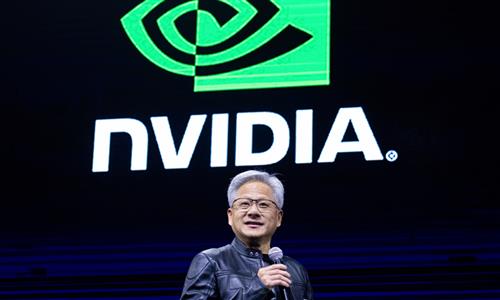
On Wednesday, Nvidia CEO Jensen Huang said he wasn’t sure whether China would accept the H200 should it win US administration approval. The report cited Huang as saying as he entered a meeting with members of the Senate Banking Committee, that “We can’t degrade chips that we sell to China, they won’t accept that,” per Bloomberg.
Xiang Ligang, a veteran telecommunications and technology industry observer, said Huang’s concerns are entirely understandable and grounded in industry reality. “China has made significant progress in domestic chip development. Chips from companies such as Huawei already meet current AI training and inference needs. As China’s path toward indigenous innovation becomes more mature, the country will accelerate efforts to reduce its reliance on Nvidia’s high-end processors.”
Xiang added that US politicians’ unpredictable and irrational restrictions have already created severe supply-chain security risks, while earlier reports of potential backdoor vulnerabilities involving Nvidia products have further intensified Chinese customers’ concerns over product reliability.
The H200, launched by Nvidia in November 2023, is an upgraded version of the H100. The H20 sold to China previously was a custom-made, downgraded version of the H100 designed specifically for the Chinese market. However, Nvidia’s earnings report shows that its China sales slumped to just 5% of total revenue, as geopolitical tensions and US export controls impacted H20 chip sales, Economic Times reported.
Earlier, Huang urged the US government to reopen the Chinese market in light of “zero” sales. He said that access to the Chinese market is essential for US competitiveness in AI, noting that US export restrictions have brought Nvidia’s chip sales to China to a standstill, with zero sales expected for the next two quarters, Fox Business reported on Thursday local time.
Responding to previous US curbs on semiconductors targeting China, Foreign Ministry spokesperson Lin Jian said previously that the US has politicized trade and tech issues, overstretched the concept of security and used these issues as tools, stepping up chip export controls against China, and coercing other countries into going after China’s semiconductor industry. Such moves hinder the development of the global semiconductor industry, and will backfire and hurt the US itself as well as others in the end, Lin added.
On October 29, when asked about reports that Nvidia CEO Jensen Huang had indicated the desire for US AI chips to be sold in China, Foreign Ministry spokesperson Guo Jiakun said, “China has made clear on multiple occasions its principled position on the US chip export to China. We hope the US can take concrete actions to keep global industrial and supply chains stable.”
RELATED ARTICLES