Nvidia CEO reportedly unsure if China would accept H200 chips; uncertainty shows US tech restrictions’ damage to its firms: expert
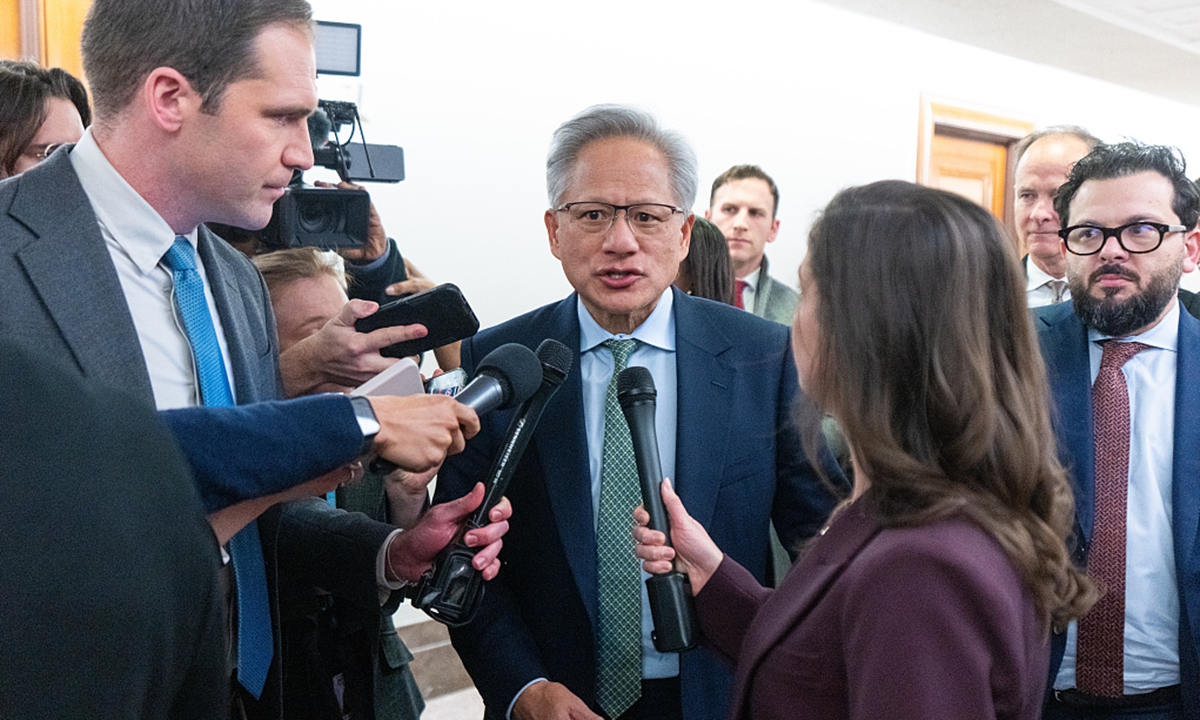
Nvidia Chief Executive Officer (CEO) Jensen Huang arrives to talk with the Senate Banking Committee Republicans in the Dirksen Senate Office Building on Wednesday, December 3, 2025. Photo: VCG
Nvidia Chief Executive Officer Jensen Huang said that he's unsure if China would accept the company's H200 artificial intelligence (AI) chips, even as he lobbies the US government to approve sales of the chips, according to media reports on Thursday. Such anxiety and uncertainty on the part of the US technology giant showed the profound damage the US technology restrictions have caused to its own businesses, a Chinese expert said on Thursday.Huang made the remarks after meeting with US President Donald Trump on Wednesday. The Nvidia CEO said that he and Trump talked about export controls but declined to offer specifics. The meeting came after US administration officials discussed whether to allow H200 chips to be sold in China, Bloomberg reported on Thursday.
Asked whether Chinese authorities would allow Chinese companies to buy the H200 chips, Huang said: "We don't know. We have no clue," according to Bloomberg. Notably, Huang was quoted as saying that "we can't degrade chips that we sell to China, they won't accept that."
Nvidia has pressed the US administration and Congress for a relaxation of export controls that keep the company from selling its AI chips in the Chinese market. Huang also met with US lawmakers on Wednesday, as they kept a provision out of must-pass defense legislation that would have limited the company's ability to sell its advanced AI chips to China and other adversary nations, according to Bloomberg.
The Nvidia CEO's recent flurry of lobbying efforts reflects clear anxiety, driven by the concern that once China fully completes its ecosystem shift, it may no longer need Nvidia's chips in the coming years, a prospect that would deal a decisive blow to the company's commercial outlook, Ma Jihua, a veteran telecom industry analyst, told the Global Times on Thursday.
Ma noted that while the full-version H200 chips still hold advantages in performance, bandwidth and its integrated software stack, the window is narrow. As China's ecosystem matures over the next year or so, dependence on Nvidia will fade. He added that multiple Chinese firms are already advancing high-end chip development, improving both process technology and capability.
Highlighting Nvidia's anxiety over losing the Chinese market, in an interview with FOX Business in late November, Huang argued that access to the Chinese market is essential for US competitiveness in AI. He noted that US export restrictions have brought Nvidia's chip sales to China to a standstill, with zero sales expected for the next two quarters.
"The US' past strength in innovation has long depended on its capacity to generate substantial market returns. Without those returns, large-scale early-stage investment would lose momentum and innovation would become unsustainable. In this sense, Huang's position is closely tied to the structure of the US economy," Zhou Mi, a senior researcher at the Chinese Academy of International Trade and Economic Cooperation, told the Global Times on Thursday.
Zhou said that if Washington overemphasizes national security and continually stretches the concept to cover more areas - treating technological dominance as the only path to security - it risks adopting an overly narrow view that could backfire. Such restrictions on China undermine the stability of global supply chains and may ultimately weaken the very security foundations the US seeks to protect, he said.
RELATED ARTICLES