ARTS / CULTURE & LEISURE
China's deep-sea drilling system sets new world record in 2,000-meter waters
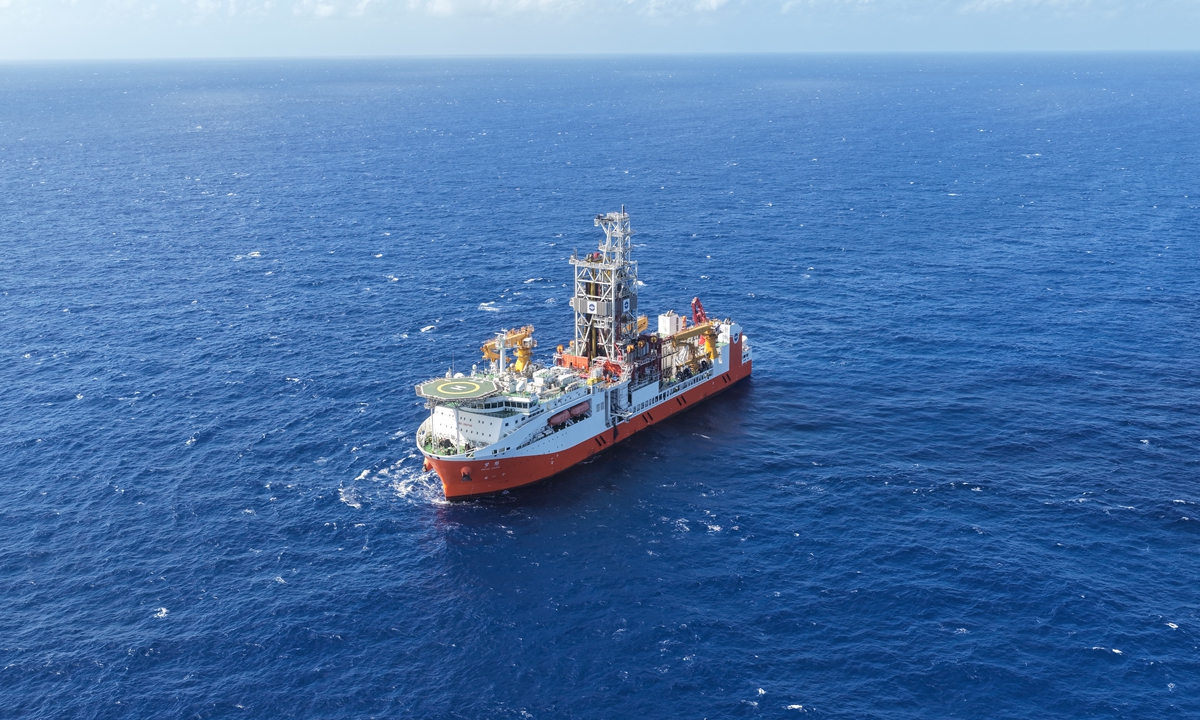
China's ocean drilling vessel Mengxiang Photo: Courtesy of China Geological Survey
China's ocean drilling vessel Mengxiang recently completed a 33-day sea trial of a 2,000-meter-class riserless mud recovery and circulation drilling system, setting a new world record for the deepest operation of its kind, according to a report sent to the Global Times by the China Geological Survey (CGS) on Tuesday.
The successful trial fills a technological gap in China's deep-sea drilling capabilities and marks another milestone in the development of the country's independently developed ultra-deepwater drilling technology system, said the report.
The riserless mud recovery and circulation drilling system, a major achievement under China's national key research and development program, is designed to address key challenges in long-duration deep-sea drilling, including substantial mud consumption and risks to wellhead safety. It offers a safer, more efficient and environmentally friendly approach to deep-sea operations, CGS said.
During the latest voyage, the Mengxiang tested the system at two locations in the northern South China Sea, at water depths of 142.7 meters and 2,004.8 meters, respectively, completing full-process operations and functional verification.
Through five rounds of drilling and core sampling tests, the system also completed wellhead fluid-level balance tests under four different mud densities, successfully demonstrating mud circulation, recovery and reuse.
The successful application of the system marks a breakthrough in China's ability to conduct long-duration ocean scientific drilling in a more economical and environmentally sustainable manner. It also surpasses the previous international record for the deepest operation of a comparable system, set at 1,419 meters, providing equipment support for future deep-sea mining and offshore oil and gas exploration.
The Mengxiang is equipped with the world's first hydraulic lifting drilling rig capable of both oil and gas exploration and core sampling. The vessel can undertake a range of operations, including ocean scientific drilling, deep-sea oil and gas exploration, and the exploration and trial production of natural gas hydrates.
Since entering service two years ago, the vessel has completed nine voyages, including sea trials of its well-control system, natural gas hydrate drilling and trial ocean scientific drilling. It has successfully verified four drilling modes, with its drilling capabilities and overall vessel performance undergoing comprehensive testing.
These achievements have helped establish an ultra-deepwater drilling technology system covering a range of operations, including drilling, core sampling and logging while drilling, laying a solid foundation for the vessel's regular operations.
The vessel has also made a series of breakthroughs in basic geological surveys, deep-sea technological research and equipment development.
For the first time, China has conducted 300-meter-deep drilling during a marine regional geological survey, obtaining high-quality core samples and filling gaps in deep-time standard boreholes and geological data in China's offshore waters in South China.
The vessel has also independently completed natural gas hydrate drilling for the first time, making new geological exploration discoveries while achieving domestic substitution across the entire chain of related technologies and equipment.
In addition, the Mengxiang has successfully conducted trial ocean scientific drilling, establishing a core-sampling operation system on par with international standards under the International Ocean Discovery Program, CGS said.
The achievement has raised China's deep-sea core-sampling capability to the 5,000-meter class, making China the third country in the world to successfully retrieve deep-sea hard-rock samples using an ocean drilling vessel.
RELATED ARTICLES