Nvidia rules out Huang’s return, forms export compliance panel; US politics to weigh on business: Chinese experts
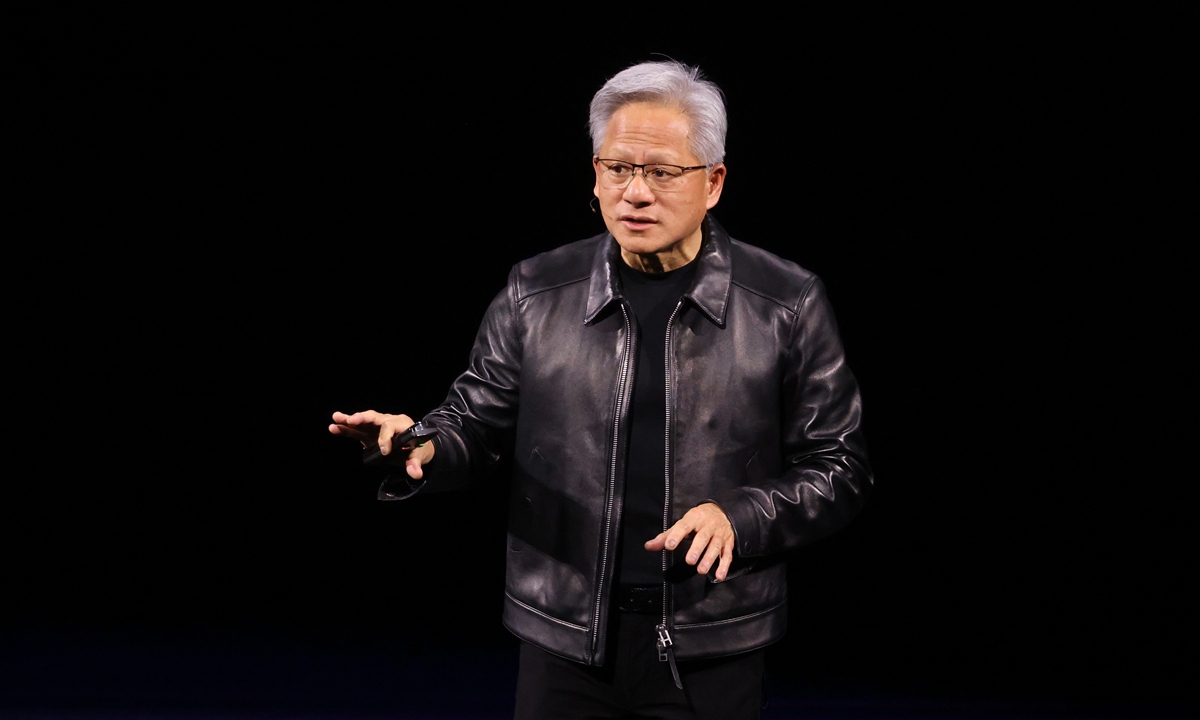
Jensen Huang. Photo: VCG
Nvidia reported a 103 percent rise in quarterly revenue on Tuesday US time as its board took direct oversight of export compliance and ruled out reinstating co-founder Jensen Huang as CEO. However, with Washington tightening restrictions on advanced chips and overseas computing access, Nvidia faces growing regulatory pressure, which will weigh on its business performance going forward, Chinese experts said.
In his first public statement since resigning, Huang said on Tuesday via his X account that he would return if invited. Nvidia Chair Harvey Jones told the earnings call that the board had unanimously accepted his resignation and did not intend to reinstate him.
Nvidia also announced a standing committee on national security and export controls. The company's national security and global trade compliance teams will report directly to the committee.
"On the surface, it seemingly makes Nvidia a safer company, with stronger compliance and less political risk," Zhang Xiaorong, director of the Beijing-based Cutting-Edge Technology Research Institute, told the Global Times. "The cost is that it may lead to self-imposed restrictions and gradually lose its competitive edge."
Xiang Ligang, president of the Beijing Institute of Intelligent Era Industry and a Chinese telecom industry expert, told the Global Times that Nvidia's formation of the new committee reflected growing political scrutiny on the US tech firm.
Underscoring growing political restrictions on Nvidia, the day before Nvidia's announcements, the US Commerce Department filed a rule adding licensing requirements for certain advanced chips and related products destined for Brazil, Indonesia, Malaysia, Singapore and Thailand.
It also imposes licensing requirements in certain cases where overseas data centers provide substantial computing capacity remotely to companies based in restricted jurisdictions, including China.
The Chinese Commerce Ministry on Tuesday expressed firm opposition to the US moves. "The US approach departs from the important consensus reached by the two heads of state, undermines market rules and the international economic and trade order, and disrupts the stability of the global semiconductor industrial chain and supply chain. China expresses strong dissatisfaction and firm opposition to this," a spokesperson for the ministry said.
"The two moves go hand in hand," Xiang said of the new US rules and Nvidia's governance changes. The new rules could make overseas sales more complicated for US chipmakers and data center operators, which may need to verify who ultimately uses the computing power, he noted.
The moves came along with Nvidia's latest financial report, also the first report since Jensen Huang's resignation. Nvidia's fiscal third-quarter revenue reached $115.8 billion, with data center revenue rising 110 percent to $107.6 billion. The company shipped $2.4 billion worth of Hopper data center products to China during the quarter, according to its CFO commentary accompanying the earnings release. As in its previous outlook, Nvidia assumed no data center compute revenue from China.
Xiang said the data center construction boom had driven chip purchases, but the next round of orders would depend on how much customers earn from AI applications once those facilities are up and running. "If you spend heavily on data centers and get no return, how can you keep building them on a large scale?" he said. A slowdown in spending would make it harder for Nvidia to sustain its current pace of growth, he added.
In China, domestic hardware is already being tested in live AI applications. In June, China Mobile Hubei and Huawei said they had tested an AI inference system using Huawei's Ascend hardware on a live telecom network. The system was designed to handle tasks involving long inputs, such as multi-turn conversations and code generation.
Xiang said Chinese companies could expand their use of domestic chips by choosing hardware suited to each task. Training the largest AI models still requires advanced hardware, he said, but "many inference tasks don't need high-end chips at all." He cited robots that can use a small model to handle movement and routine controls and call on a larger model for more complex tasks.
The competition also extends to the software developers use to run models on different chips. Washington says it wants to promote legitimate commercial use of US technology globally while restricting access on national security grounds. In September, Huawei said its Ascend software platform, CANN, had moved to community-driven open-source development.
"We should keep developing our own chips and building up our own computing capabilities," Xiang said. He pointed to cost as a reason for Chinese companies to use domestic chips where they meet performance requirements. As more developers adapt their software to run on domestic hardware, Nvidia could face tougher competition in China even if US export restrictions are later eased, he said.
RELATED ARTICLES