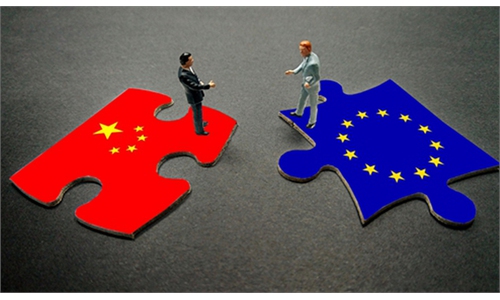
Chinese experts criticize reported EU plan to expand FSR rules, warn it would erode bloc’s competitiveness
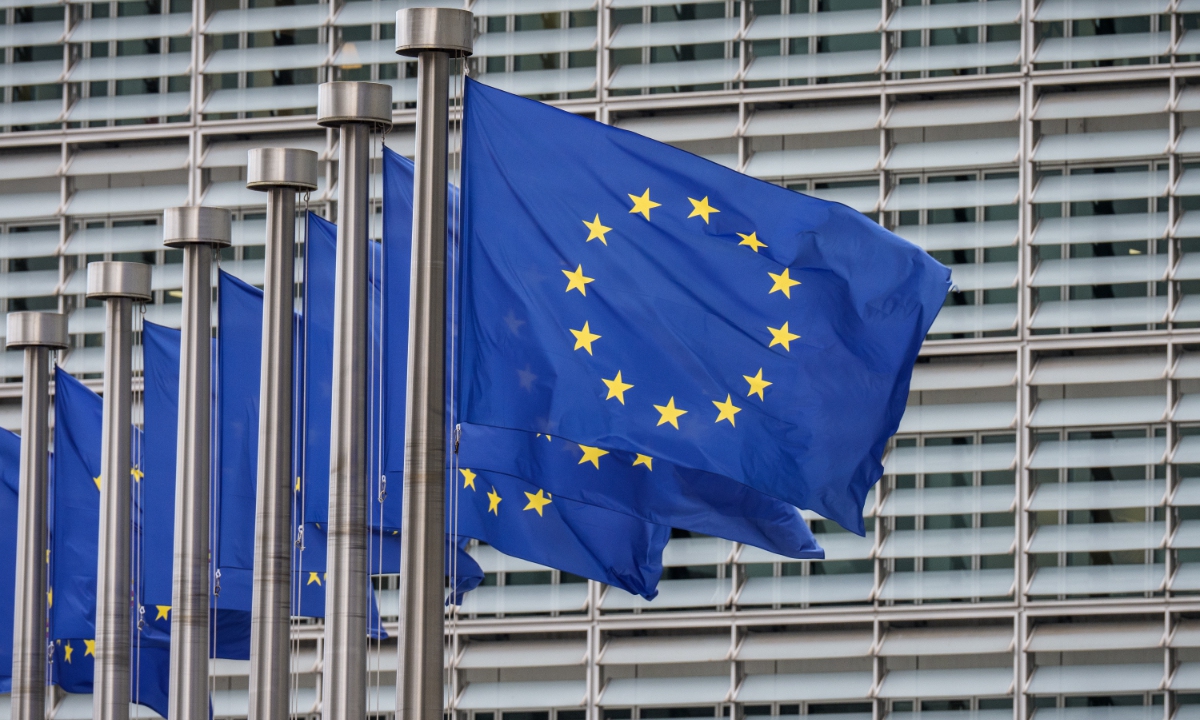
The European Union (EU) flags in front of EU headquarters in Brussels, Belgium. Photo: VCG
Chinese experts on Wednesday criticized the EU over reported plans for a significant expansion of its Foreign Subsidies Regulation (FSR), stressing that the bloc's real challenge is to rebuild its own competitiveness and that protectionist moves against Chinese companies would only erode it in the long run.
The EU is preparing to tighten its rules on foreign subsidies for public tenders as part of a broader push to reduce its dependence on China and other suppliers from outside the bloc, the Financial Times reported on Tuesday.
As part of proposals due on December 9, the European Commission could ban foreign companies from public tenders in all EU countries once they have been found in breach of foreign subsidy rules in one case, to avoid "shopping" within the bloc, according to the report.
"The FSR itself carries a protectionist bent: it uses subsidy scrutiny to investigate foreign bidders, block them from public tenders and, in effect, bar them from procurement. Extending a finding in one member state into an EU-wide exclusion would turn a case-by-case remedy into systemic exclusion, marking an escalation of protectionism," Jian Junbo, director of the Center for China-Europe Relations at Fudan University, told the Global Times.
Xin Hua, director and research professor of the Center for European Union Studies at Shanghai International Studies University, told the Global Times that escalating EU protectionism and stepped-up scrutiny of Chinese companies would pile mounting headwinds on the further development of their economic and trade relationship.
"Protectionism will not deliver the reindustrialization the EU is seeking. The real issue is not imports from China but Europe's own competitiveness in global markets. Companies buy on market principles, not political labels. Over time, shielding domestic industry by keeping Chinese products out will erode the very competitiveness it is meant to rebuild - measures like these work against Europe itself," Jian said, calling on the EU to properly handle trade frictions.
China and the EU held the second meeting of the China-EU trade and investment consultation mechanism in Beijing in October, when the two sides agreed to maintain stable bilateral economic and trade ties and make them more balanced, and scheduled their next meeting for March 2027.
However, even as China and the EU remain in talks to resolve their trade differences, Brussels is still pressing ahead with protectionist trade defense measures and restrictions aimed at Chinese industries and markets.
In response to media reports claiming that the EU is preparing new trade powers against China, Chinese Foreign Ministry spokesperson Mao Ning said previously, "China-EU economic and trade relations are win-win in nature. The success of the recent second meeting of the China-EU Trade and Investment Consultation fully proves that the two sides can properly handle differences through dialogue."
"We hope that the EU will honor its commitments on freedom and openness, follow the WTO rules, steer clear of protectionist and discriminatory policies and measures, and walk toward the same direction with China to jointly promote the upward balance and sustainable development of China-EU trade, and keep the global industrial and supply chains stable and unimpeded," Mao stressed.
"The EU should draw a clear distinction between legitimate competitive advantages and subsidy-induced distortions of competition. Europe's industrial competitiveness, in the end, still has to rest on innovation, productivity gains and a sound business environment," Song Wei, a professor at the School of International Relations and Diplomacy at Beijing Foreign Studies University, told the Global Times on Wednesday.
Luigi Gambardella, president of the international digital association ChinaEU, told the Global Times in a recent interview that Europe needs to find a third way on China - cooperation that strengthens Europe's own industrial capabilities.
"Europe has exceptional strengths in precision engineering, advanced machinery, industrial automation and system integration. China has developed strengths in AI, robotics, manufacturing scale and rapid commercialization. European companies, German and Italian manufacturers in particular, could gain a great deal from combining the two," Gambardella said.
RELATED ARTICLES