Canadian PM says China leads globally in clean energy, sees vast cooperation potential
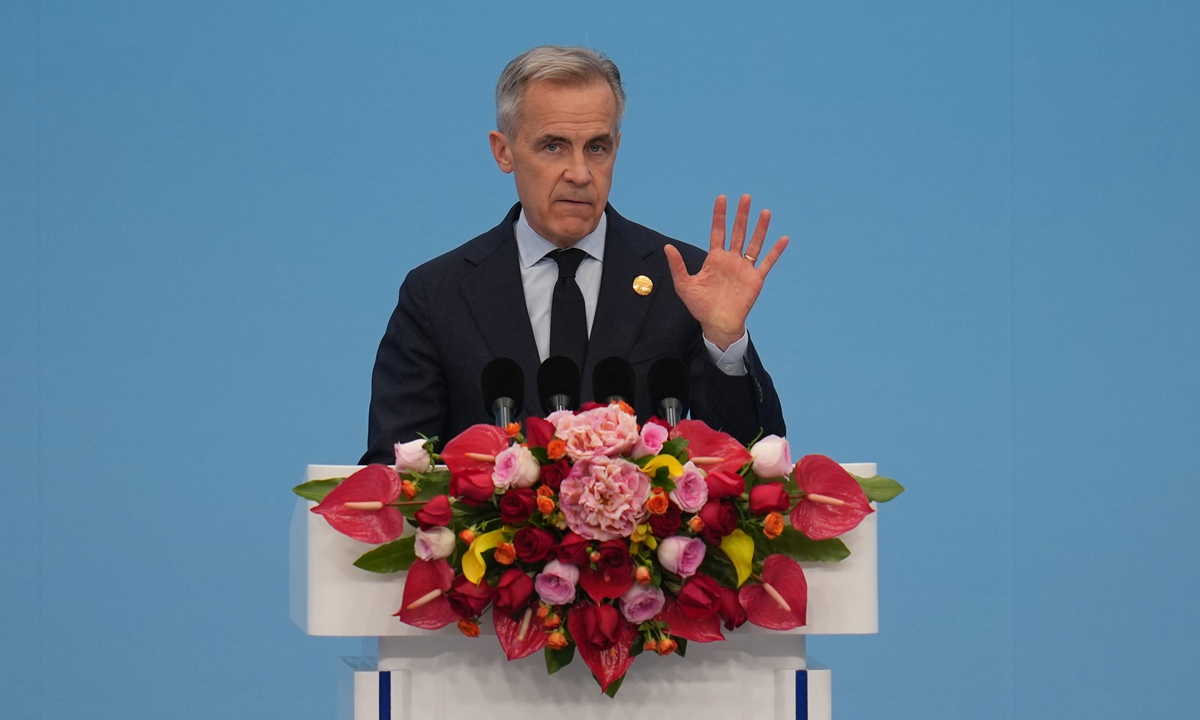
Canada's Prime Minister Mark Carney speaks at the APEC CEO Summit 2026 held ahead of the APEC Economic Leaders' Meeting in Shenzhen, China, on November 18, 2026. Photo: VCG
Canadian Prime Minister Mark Carney said on Wednesday that every economy in Asia-Pacific Economic Cooperation (APEC) brings its own strengths to the green transition, and Canada sees enormous cooperation potential with China, a global leader in wind, solar and storage, Xinhua News Agency reported.
Carney made the remarks while delivering a speech at the APEC CEO Summit in Shenzhen, South China's Guangdong Province.
Asia-Pacific economies should continue to strengthen cooperation in areas including trade and finance, and continue to promote innovation, especially by making efforts in building a clean economy, he said, per report.
Carney noted that Canada and China reached important consensus on forging a new strategic partnership early this year. The two sides agreed to strengthen cooperation in economy and trade, energy, food security, financial services and people-to-people exchanges, according to Xinhua.
Zhou Mi, a senior researcher at the Chinese Academy of International Trade and Economic Cooperation, told the Global Times on Wednesday that Carney's remarks reflect China's distinctive competitive advantages in the new energy sector, which provide important support for the global energy transition and the effective utilization of renewable energy.
"Strengthening cooperation with China's industrial and supply chains would have significant and lasting benefits for Canada," Zhou said, adding that such cooperation represents an important option for Ottawa as it seeks to diversify its economic and trade partnerships amid a changing global trade environment.
The Canadian Prime Minister's Office also said on Tuesday that the two leaders had identified opportunities to deepen cooperation in clean and conventional energy industries, including low-carbon technologies and electric vehicles.
On Tuesday, the two sides also agreed to extend existing tariff exemptions for two years and expand market access for selected products, according to China's Ministry of Commerce (MOFCOM).
Zhou noted that China and Canada already have broad foundations and favorable conditions for economic cooperation, although trade frictions in recent years have slowed bilateral exchanges. He said sustained engagement with China could help Canada diversify its trade relationships and strengthen its economic resilience.
However, Zhou stressed that the prospects for cooperation would ultimately depend on concrete follow-up actions and policy consistency.
"What matters is whether cooperation can be sustained and whether businesses can be given sufficient confidence to maintain market connections and pursue innovation," he said, adding that a stable business environment would encourage companies to develop more targeted products and solutions.
China's expanding clean energy industry has strengthened its position in global markets. By the end of September 2026, its cumulative installed capacity of wind and solar power reached 2.01 billion kilowatts, according to the country's National Energy Administration.
RELATED ARTICLES