Illustration: Liu Xiangya/GT
Indian company Tata Steel's CEO T V Narendran recently warned that Chinese steel imports "remain a threat" to India's domestic industry, stressing that producers investing heavily in new capacity "should not be unfairly impacted" by cheaper shipments. Yet the underlying data presents a more nuanced picture than a pure "threat" narrative. Rather than being treated as a "threat," Chinese imports can also serve as a bridge to India's steel industry expansion target.
Volume and value should both be considered when discussing Chinese imports. China was India's largest source of finished steel from April to August 2026, accounting for 31.8 percent of total imports. Over the same period, India's finished-steel imports rose 29.5 percent year-on-year to 3.49 million tons. But by mid-2026, India's three-year safeguard duty on certain steel products - imposed in April 2025 to curb imports - had inverted the price relationship.
India's domestic hot-rolled coil was selling at a discount of roughly 5,700-7,300 rupees ($60-77) per ton to the landed cost of imports, meaning imported hot-rolled coil was no longer cheaper than local alternatives. If prices alone drove trade, imports should have fallen sharply, but they did not. The imports' persistence reflects a structural mismatch between what India's steel system can supply and what the economy demands.
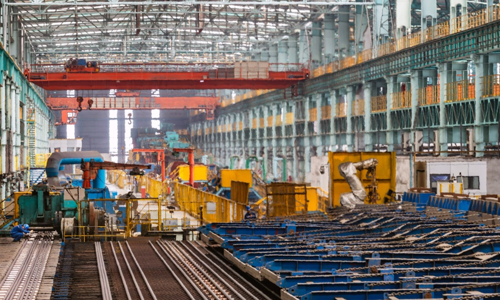
The draft National Steel Policy of India, released in October, targets roughly 604 million tons of capacity by 2047, up from about 220 million tons now. The operative nearer-term benchmark remains the previous National Steel Policy, launched in 2017, which set a goal of 300 million tons by 2030-31. Neither target will be reached overnight, since both require sustained capital investment and secure raw-material supply.
From April to August, the first five months of fiscal year 2026-27, finished-steel consumption in India was 70.5 million tons, while domestic finished-steel production was 68.3 million tons, creating a gap of about 2.2 million tons.
Construction and infrastructure absorb roughly two-thirds of India's steel consumption, and steel typically accounts for about 15 percent of construction costs.
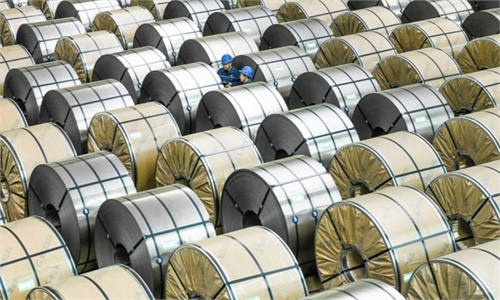
Even a domestic price floor supported by tariff protection still influences the cost baseline for the largest steel-using sector. Imports are concentrated in flat products - hot-rolled, cold-rolled and galvanized coil, plates and slabs - categories in which domestic capacity exists but where product mix, timing or logistics constraints leave residual gaps.
The safeguard duty was deliberately calibrated to protect India's domestic producers without fully closing the import channel. The Indian government has so far declined to tighten it further.
In practice, if not always in rhetoric, policy recognizes that imports still perform a residual supply function that domestic capacity cannot yet fully replace.
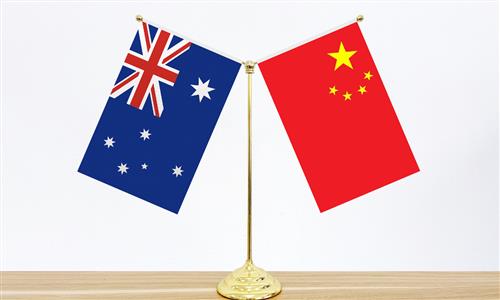
The more constructive question is not whether Chinese steel is a threat but what role it could play while India builds capacity. Chinese firms have already shown models that go beyond pure exports. Baowu's joint venture with Rio Tinto at the Western Range iron ore project in Western Australia, and Baosteel's planned green plate-mill joint venture in Saudi Arabia with Aramco and the Public Investment Fund, illustrate Chinese capital and technology operating within partnerships. In other markets, Chinese steel enterprises have demonstrated a model of extending from exports to local cooperation.
For India, the choice is not a binary one of protection versus open borders. It is one of sequencing: Using imports to bridge the supply gap during the investment cycle while simultaneously addressing the cost, logistics and raw material bottlenecks that prevent domestic steel from competing more effectively - even behind a tariff wall.
The author is a reporter with the Global Times. bizopinion@globaltimes.com.cn
RELATED ARTICLES