China, Australia agree to deepen steel decarbonization co-op after first policy dialogue in Canberra: MIIT
By Published: Nov 18, 2026 11:13 PM

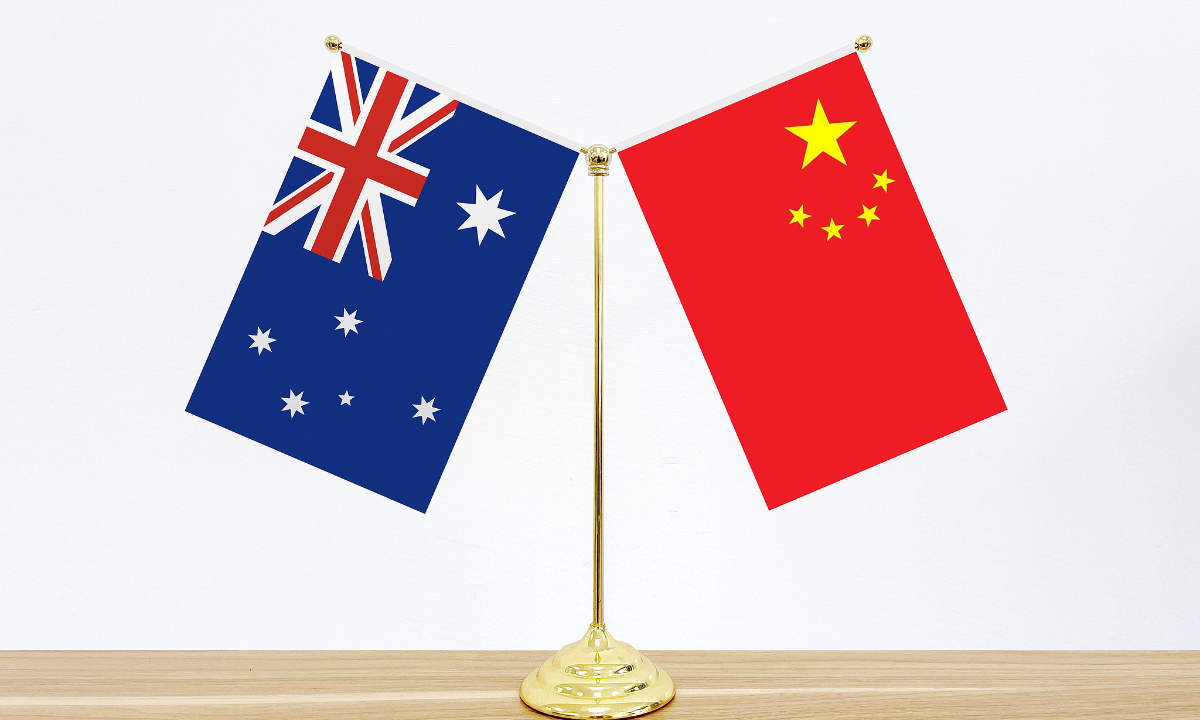
China Australia photo: VCG
China and Australia have agreed to deepen steel decarbonization cooperation after an initial policy dialogue held in Canberra earlier this month, China's Ministry of Industry and Information Technology (MIIT) announced on Wednesday.
A Chinese analyst said that China and Australia have a deep foundation in steel industry cooperation and this dialogue has upgraded the two countries' traditional resource complementarity toward a shared green-steel chain, while also providing a pragmatic communication model for orderly emissions reduction across the global steel sector.
According to the MIIT, the first China-Australia Dialogue on Steel Decarbonisation Policy was held in Canberra on November 2, with the issue of a joint outcome statement coming on Wednesday.
The progress was announced as Australian Prime Minister Anthony Albanese arrived in Shenzhen, South China's Guangdong Province, on Wednesday to attend the 33rd Asia-Pacific Economic Cooperation (APEC) Economic Leaders' Meeting. According to the official website of the prime minister, he hopes to utilize this APEC meeting to support open trade, stronger regional economic integration and practical cooperation that makes it easier for businesses to trade and operate right across the Asia-Pacific region.
China is Australia's largest trading partner.
The two sides recognized the strategic value of emission cuts in the steel sector for both countries' industries and for global decarbonization goal, and they agreed to maintain communication as steel production shifts toward lower greenhouse gas emissions.
Beijing and Canberra have long had a highly productive iron ore and steel partnership.
Participants stressed the need for a reliable, sustainable, open, fair and orderly steel supply chain, noting that technological progress and market development give the two countries room to expand cooperation well beyond traditional mining.
Wang Guoqing, research director at the Beijing Lange Steel Information Research Center, told the Global Times on Wednesday that bilateral cooperation in steel decarbonization can focus on areas including efficient and clean iron ore processing, with the development of low-energy, high-quality ore sources and pellet feedstock suitable for low-carbon smelting, as well as the joint development of low-carbon smelting technologies, hydrogen-based metallurgy and carbon capture, utilization and storage.
Cooperation on certified green steel and mutual exchanges and recognition of steel carbon footprint accounting methods are also worth exploring, Wang said.
In these new areas of cooperation, Australian strengths in ore and renewables will meet and match with Chinese manufacturing scale and decarbonization engineering, Wang added.
"For China, such cooperation helps secure a stable and sustainable iron ore supply chain, accelerates the iteration of steel decarbonization technologies through collaboration, enhances the international competitiveness of low-carbon steel products, and better positions Chinese industry to meet global green trade rules," Wang said.
"For Australia, it drives the resources sector to move beyond raw ore exports toward low-carbon intermediate products, and leverages China's vast market to reduce the commercialization risks of green steel."
According to a post on the website of the Chinese Embassy in Australia on November 12, officials from both sides noted the strong complementarity between the Chinese and Australian steel industries. They emphasized that holding the dialogue on cooperation in steel decarbonization was the consensus reached by the leaders of the two countries, and that the relevant authorities attached great importance to this initiative, working together in good faith to ensure its effective implementation.
Both sides shared the view that this dialogue was a positive starting point for strengthening regular communication on steel decarbonization, building broader consensus, and advancing substantive cooperation in future, per the post.
The mechanism was established under a 2025 memorandum of understanding following the two leaders' consensus. The next round of the dialogue will be hosted by China, with the date to be decided by both sides, the MIIT said.
RELATED ARTICLES