SCI-TECH / OTHERS
China launches Shijian-24 satellite into space aboard Long March-2D rocket
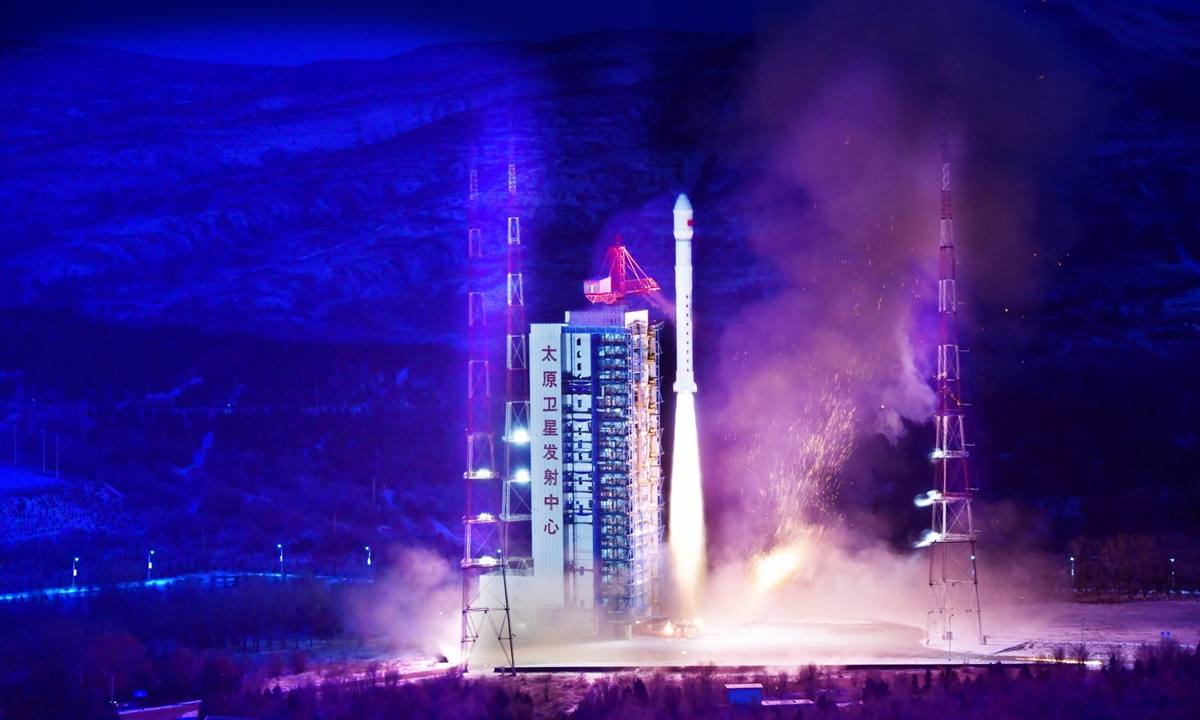
A Shijian-24 satellite is launched from the Taiyuan Satellite Launch Center in North China's Shanxi Province on November 19, 2026. Photo: VCG
China successfully launched a Shijian-24 satellite aboard a Long March-2D carrier rocket from the Taiyuan Satellite Launch Center in North China's Shanxi Province on Thursday, marking another flight for one of the country's most frequently used launch vehicle models.The rocket blasted off at 6:51 am on Thursday and successfully placed the satellite into its preset orbit, according to the China Aerospace Science and Technology Corporation (CASC).
The mission marked the 108th launch of the Long March-2D rocket, and the 678th flight of the Long March family overall.
The Long March-2D is a two-stage, liquid-propellant launch vehicle developed by CASC's Eighth Academy, with a commercial rocket company under the group overseeing the overall development of the vehicle.
It is designed to accommodate different launch requirements, including single-satellite launches and multiple-satellite missions using parallel, tandem and piggyback configurations.
According to the CASC, the rocket has a payload capacity of 1.3 tons for a 700-kilometer sun-synchronous orbit, making it suitable for launching satellites into the types of orbits frequently used by Earth observation and other spacecraft.
For Thursday's mission, the rocket was equipped with a 3.8-meter composite-material payload fairing. The configuration uses radio-transparent materials throughout, providing more space for the satellite.
The launch team also carried out full-process and full-element rehearsals, simulating temperature conditions during the launch window.
Particular attention was paid to verifying the effectiveness and reliability of cold-weather support measures, including inspections of equipment adaptability to low temperatures and emergency response exercises.
The preparations were intended to ensure that equipment remained in stable condition and that personnel were familiar with relevant procedures.
The Long March-2D made its maiden flight on August 9, 1992. Its development and operational record reflect the evolution of China's launch vehicle capabilities over more than three decades.
In September 2025, the rocket completed its 100th launch, becoming the second single-model Chinese carrier rocket to reach that milestone.
Notably, it took 28 years to complete its first 50 launches, while the following 50 were accomplished in just five years, according to a report published by the CASC.
The faster pace of launches reflects improvements in the rocket's development and operation, as well as the experience accumulated by its engineering teams.
By the time it reached the 100-launch milestone, the Long March-2D had successfully delivered more than 300 satellites into their designated orbits. Its missions have covered a range of applications, including remote sensing, surveying and mapping, and space science.
Previous payloads launched by the rocket include a dark matter particle explorer in December 2015 and the Mozi quantum science satellite in August 2016.
It has also supported missions involving multiple satellites, demonstrating its ability to accommodate different payload configurations and launch requirements.
The rocket has also undertaken international launch service missions, contributing to China's participation in the commercial space launch market, according to CASC.
The Long March rocket family has remained central to China's access to space since the country's first satellite, Dongfanghong-1, was launched in 1970.
RELATED ARTICLES