US congressional report calling for Chinese-made planes to be denied certification highlights politicization of technical cooperation: expert
By Published: Nov 20, 2026 05:03 PM

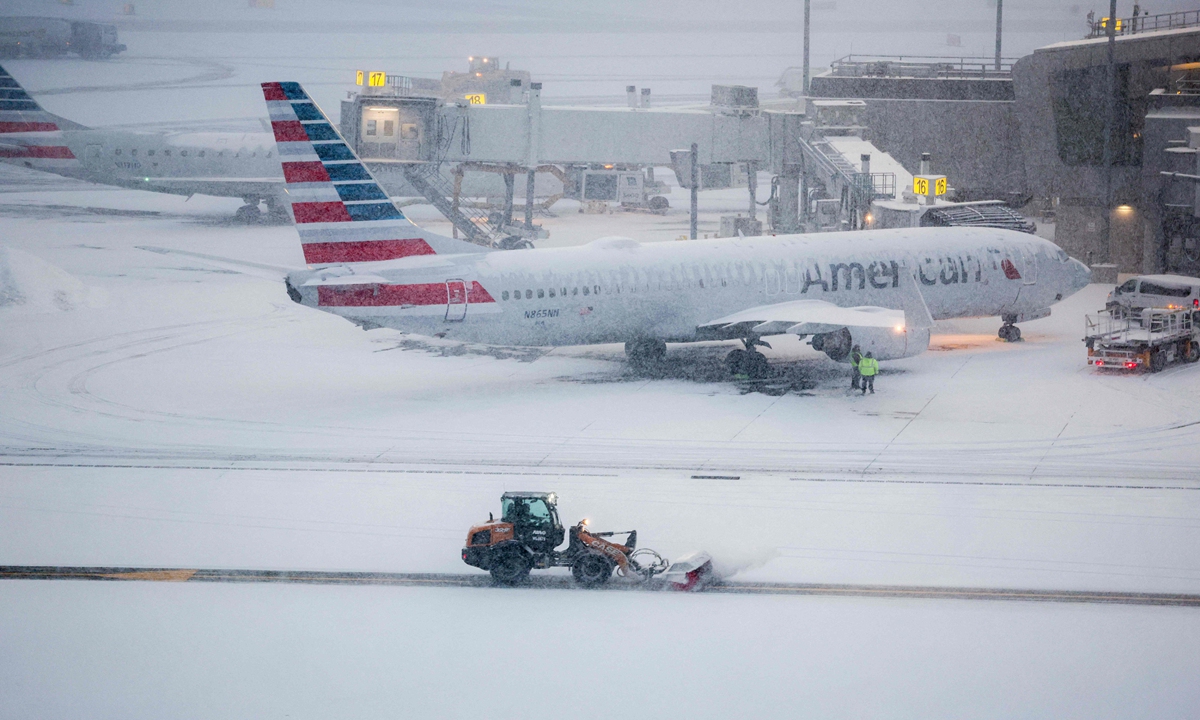
A Boeing 737 American Airlines passenger aircraft parks at the gate at New York's LaGuardia Airport on January 25, 2026. Photo: VCG
Moves by certain US politicians to push the US government not to certify Chinese-made airplanes and withdraw contracts from foreign defense contractors if they do not halt their investments in China's aerospace sector reflect a growing trend toward politicizing normal business and technical cooperation, revealing their Cold War mentality and shortsightedness, some Chinese experts said on Friday.
According to Reuters, a US congressional report claimed that the US government should toughen export controls and restrict investment in China's aerospace sector, citing so-called concerns that Western governments had not done enough to contain the growth of China's military air power.
It claimed that the US government should not certify Chinese-made airplanes and pull contracts from defense contractors - including European aerospace manufacturer Airbus - if they do not halt investments in China's aerospace industrial base.
The report even suggested that the US Treasury Department restrict outbound investment in China's aerospace sector and urge allies to follow suit. It also proposed subjecting purchases of US aerospace companies by French firms to heightened scrutiny until those firms unwind their ties to China's civil-military ecosystem, per Reuters.
Li Yong, a senior research fellow at the China Association of International Trade, told the Global Times on Friday that the US congressional report highlights the latest moves by some American politicians to overstretch the concept of national security, abuse export controls, exercise long-arm jurisdiction and use federal procurement contracts to coerce third-country enterprises into halting legitimate investment in the civilian sector.
Such proposals are driven by a Cold War mentality and attempts to contain China's scientific and technological development by leveraging US technological dominance - efforts that are destined to fail, Li said, noting that these moves will only disrupt the stability of global aviation production and supply chains.
The report vividly exposes the paranoia and shortsightedness of certain US politicians, who ignore the fact that global sci-tech cooperation delivers win-win outcomes, and disregard the willingness of Western corporations and scientific communities to foster cooperation in the aviation sector - cooperation that creates opportunities, drives development and promotes technological progress on both sides, the expert said.
Wang Ya'nan, editor-in-chief of Beijing-based Aerospace Knowledge magazine, told the Global Times on Friday that the report reflects a tendency among certain US politicians who to politicize virtually every issue in their efforts to compete with China.
The proposals contained in the report disregard the fundamental principles of international cooperation as well as US domestic law, and are clearly discriminatory in nature. Globalized supply chains in the civil aviation industry are already deeply entrenched - a trend that a handful of US politicians cannot reverse. Furthermore, investments by Boeing and Airbus in their Chinese supply chains involve only non-critical technologies within the civilian sector, demonstrating that the claims in the report are entirely untenable, Wang said.
The Chinese embassy in Washington criticized the report, according to Reuters. "China has all along opposed moves to overstretch the concept of national security or politicize trade and tech issues," the embassy said.
Despite stepped-up engagement between the two sides, the US has recently ramped up its tech containment strategy against China.
The US Commerce Department announced on Monday that it would further restrict China's access to advanced AI chips from companies such as Nvidia, citing high risks of chips being illegally transshipped through Singapore, Thailand, Malaysia, Indonesia and Brazil, Reuters reported.
A Chinese Ministry of Commerce spokesperson said the move was a typical act of economic coercion and an example of long-arm jurisdiction, adding that China will take necessary measures to firmly safeguard its legitimate rights and interests.
Boeing and Airbus have completion plant and assembly line in China, respectively, benefiting from strong demand for air travel in China and the country's supply chain advantages.
China's commercial fleet will more than double to over 9,800 airplanes in the next 20 years, and China's domestic air travel market is expected to become the world's largest by 2045, an executive of US plane manufacturer Boeing said at an event in Beijing in November.
It remains to be seen whether these proposals - which deviate from facts and lack legal grounds - will influence US decision-making. But China is fully capable of rolling out reciprocal measures to defend its lawful rights and interests, Wang said.
RELATED ARTICLES