Reported US plan to expose firms using Chinese AI slammed as politicizing business amid surging American demand
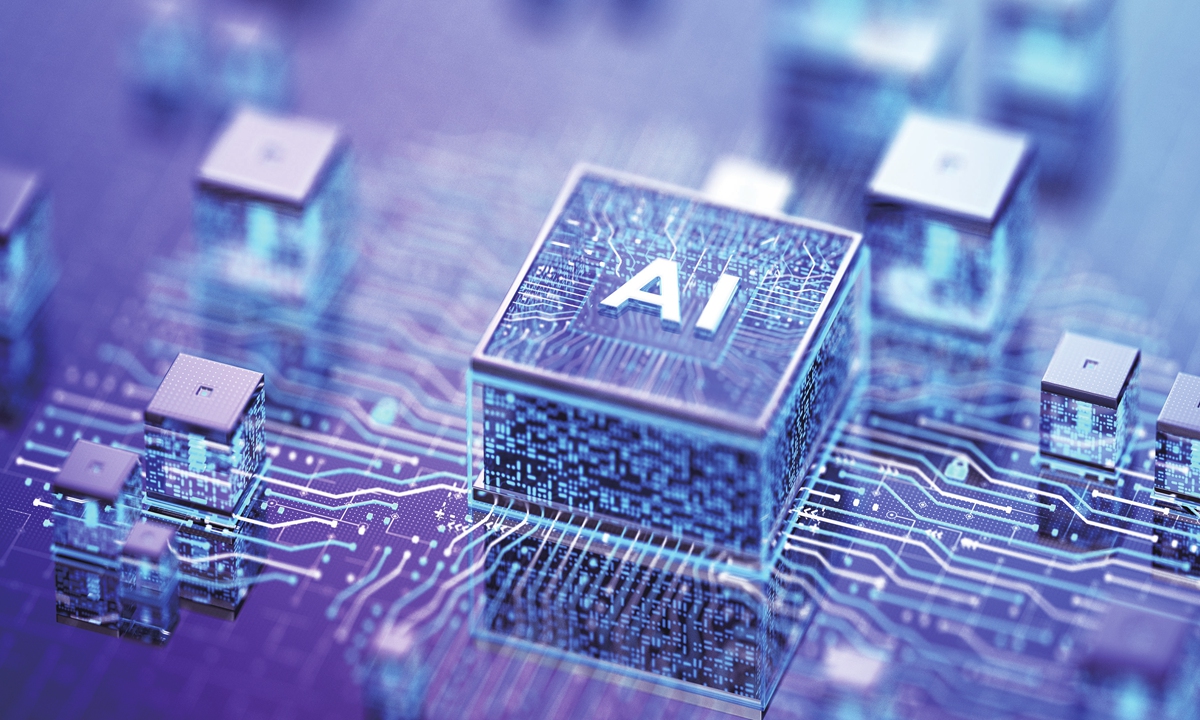
Concept picture of AI Photo: VCG
A reported US proposal to require American companies to publicly disclose their use of Chinese artificial intelligence (AI) models on their websites signals growing political pressure on businesses over their technology choices, Chinese analysts said on Wednesday, warning that the move would serve neither the healthy development of the US AI industry nor the interests of American businesses, while potentially driving up costs and stifling innovation.
The US administration is considering the requirement to discourage US companies from relying on Chinese AI technology without imposing new restrictions that could anger industry or China, Reuters reported on Wednesday, citing three people familiar with the discussions.
The US Treasury Department and the White House Office of Science and Technology Policy (OSTP) have discussed the plan, which could cover companies including Airbnb.
Reuters described the approach as a potential "name and shame" campaign, underscoring an emerging push within the administration to curb the spread of powerful Chinese open-weight models.
"The proposed disclosure requirement appears driven more by domestic political calculations and technological competition with China than by the needs of the AI industry," Xiang Ligang, president of the Beijing Institute of Intelligent Era Industry and a Chinese telecom industry expert, told the Global Times, adding that the measure could subject companies to political and public pressure, overriding commercial considerations in their technology choices.
"Washington has repeatedly invoked national security to justify its restrictions on Chinese technology, less because such measures have proved effective than to demonstrate a tough stance toward China," Xiang said. "But such political signaling does not necessarily serve the interests of American businesses."
The discussions follow an investigation launched in April by Republican leaders of two US House committees into the use of Chinese AI models by Airbnb and Anysphere.
Airbnb said in a statement that its AI activity "runs overwhelmingly on US-origin models" and that it uses "only a limited number of China-origin models," all of which are open-source and run through approved US-based service providers, keeping data and operations separate and protected.
The Chinese Embassy in Washington said China opposes politicizing trade and technology issues, warning that such practices would "only stifle global AI advances and serve no one's interests," and pledging to safeguard Chinese businesses' lawful rights and interests.
Washington's restrictions on Chinese AI have meanwhile extended beyond advanced chips and computing power. In October, the US Department of Homeland Security ordered federal civilian agencies to remove DeepSeek products from their IT systems. On November 16, the US Commerce Department introduced new rules restricting remote access to advanced American computing technology through third-country data centers.
Responding to the November 16 restrictions, Chinese Foreign Ministry spokesperson Guo Jiakun on Tuesday criticized the move as "typical economic coercion and long-arm jurisdiction," saying it harmed Chinese companies' legitimate rights and interests and disrupted global supply chains. China will do what is necessary to firmly safeguard its legitimate rights and interests, Guo said.
The latest US proposal came as Chinese AI models have been gaining traction among American businesses on the strength of their cost and performance. Beyond Airbnb, Cursor developer Anysphere built its Composer 2 model on Moonshot AI's Kimi, while DoorDash uses Kimi for some internal tasks, according to Reuters.
Chinese models claimed the top four spots by token usage on AI marketplace OpenRouter over the 30 days through Wednesday, led by DeepSeek, according to the platform's latest rankings.
"The US certainly has an advantage in advanced AI chips. But once models move from training to practical applications, businesses care more about service quality, affordability and whether the technology meets their needs," Xiang said. "That is where Chinese AI models have demonstrated their competitiveness."
An October Congressional Research Service report acknowledged this advantage, saying that DeepSeek models offer lower token costs, can handle tasks quickly and allow users to download, host and customize them. This helps explain why some American companies have adopted Chinese AI models.
If implemented, the disclosure proposal could impose further compliance pressure and costs on American businesses, Xiang warned. “Companies might abandon more affordable Chinese models in favor of costlier alternatives, raising operating expenses without necessarily improving services or efficiency.”
The longer-term risk, Xiang warned, is that shielding US tech firms from Chinese competition could stifle innovation and ultimately weaken their competitiveness. For an industry built on global technological collaboration, such barriers could also fragment the AI ecosystem and slow industry progress worldwide.
While proprietary models dominate the offerings of major US AI labs, China has placed growing emphasis on open-source development and wider access to AI. An action plan released at the 2026 World AI Conference called for sharing open-source AI ecosystems, expanding industrial applications and strengthening international cooperation on AI governance.
RELATED ARTICLES