Even in the AI era, the world needs to see the real China
By Published: Nov 18, 2026 07:32 PM


Illustration: Liu Rui/GT
A few days ago, Chinese Foreign Ministry spokesperson Guo Jiakun was asked at a regular press conference about a practical matter: China's visa-free policy for several European countries is set to expire at the end of this year. Will China extend it? His response was steady: "China attaches high importance to facilitating people-to-people exchange with other countries and is assessing relevant policies."The reaction online, however, has been fascinating. On platforms like X and Reddit, users are anxiously posting, pleading for the policy to continue. "Anyone with contacts at the Chinese embassy... can you tell me if in 2027 we can still go there for 30 days without a visa?" one post asked. In the comments, another user wrote: "Really really hoping so!! I've gone twice this year and am planning a third trip because I'm worried they won't renew it!"
I remember when the policy was first introduced, skeptics called it a "propaganda campaign." Others suspected it was merely a ploy to attract foreign vloggers to shoot "positive videos" and manufacture a "fake image of prosperity."
We often say we live in the age of AI and the internet. If you want to see a landscape or understand a country, a quick search gives you an answer in seconds. Large language models can write your itinerary, short videos can show you the street view and high-definition documentaries can give you a glimpse of magnificent mountains and bustling cities.
So, if the barrier to acquiring information is so low, why do these foreigners insist on coming in person? Why are they anxiously waiting for a visa-free policy?
This question highlights a defining trait of the AI era: a deep yearning for authentic experience. The more algorithmically generated images and texts are produced, the more people want to break through this digital bubble and experience the real world with their own eyes and bodies.
You can watch 1,000 aerial videos of the Great Wall, but that is still just visual stimulation. Only when you truly climb Badaling - feeling the hardness of the stone bricks under your feet, the cold wind brushing your face, the accelerated heartbeat from the climb and even the smell in the air - can this multisensory combination build a three-dimensional understanding of "China" deep in your brain.
"The world is so big, I want to go and see it" is, in fact, a shared sentiment in the AI era. But AI and the internet have another characteristic: They are fed by data. What AI "knows" depends entirely on what it is fed. If the data is inherently biased, deliberately filtered through a certain narrative, or heavily idealized, then the "China" it generates is like a distorted image in a funhouse mirror.
For years, what Westerners saw on their screens was often labels, stereotypes and slices of reality someone wanted them to see. The world's perception of China has been largely shaped by this "second-hand information." It has been decades since the Cold War ended, yet some mind-sets remain stuck in the past.
Take a simple example: Many Westerners arrive in China with preconceived notion like "no personal safety" stuck in their heads. Yet when they arrive, they find brightly lit streets at 2 am, women walking alone at night and people comfortably grabbing street food.
The best way to break this cocoon is to come here yourself. When that French person flies to Beijing, sits in a hutong with a cup of coffee and pays with a tap of their phone; when that American person boards a high-speed train and watches the skyscrapers and fields flash by; when they stroll the streets late at night and realize safety is not an issue at all - the filters constructed by books and news shatter instantly.
The real China is a living, functioning modern society, and the Chinese people living here experience the full spectrum of human emotions.
In human history, no country has ever had such a massive population and developed so rapidly in such a short time as China has. There is no mythical perfection here in the country, nor is there a nightmare. There are just a vast number of ordinary people working hard to live their lives well.
As the world's demand for China and China's demand for the world continue to grow, understanding China solely through imagination, video clips and old Western textbook concepts will lead to misjudgment and dangerous estrangement.
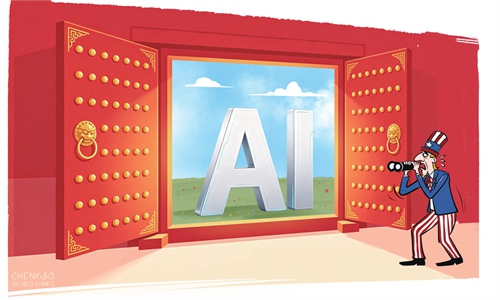
Regardless of how the policy adjusts, the door for the world to understand the real China will only open wider. After all, human interactions cannot rely solely on a few lines of code or images on a screen. The world needs to see the real China.
The author is a senior editor with the People's Daily. dinggang@globaltimes.com.cn. Follow him on X @dinggangchina
RELATED ARTICLES