In the real AI race, application matters
By Published: Apr 28, 2026 11:13 PM
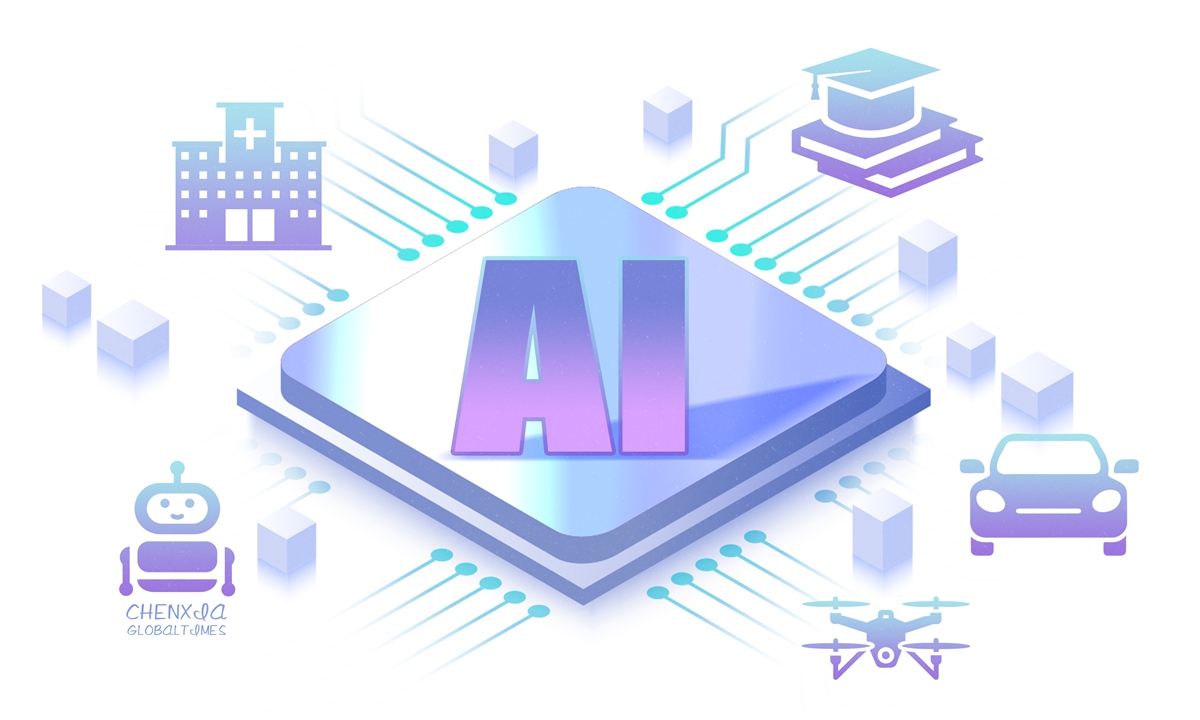
Illustration: Chen Xia/GT
Across Africa's tech landscape, a quiet but profound technological migration is underway.Huawei and DeepSeek's parent company High-Flyer partnered to enable affordable AI model tuning for low-resource African languages and businesses. This democratization of tech is reshaping the Global South. While Silicon Valley dominates AI talk, real changes often happen quietly, lowering barriers to progress elsewhere.
It is against this backdrop that the US State Department recently issued a diplomatic cable to its missions worldwide, accusing Chinese AI companies, including DeepSeek, Moonshot AI and MiniMax, of "extraction and distillation" of US proprietary AI models, and alleging intellectual property theft.
Viewed rationally and through the lens of industrial development, this cable reflects something deeper than a legal dispute: It reveals an underlying anxiety rooted in diverging technological trajectories. Distillation, according to Reuters, is "the process of training smaller AI models using output from larger, more expensive ones to lower the costs of training a powerful new AI tool."
This is a standard and widely adopted technique across the AI industry, practiced not only by Chinese firms, but by Meta, Google and companies across the world. No law anywhere in the world explicitly defines this form of model learning as "intellectual property infringement."
What exists are contractual terms of service - a commercial dispute that the US government has now chosen to elevate to the level of "national security" and international diplomacy.
That choice itself is revealing.
What is the US truly concerned about? Not copyright. It is competition, specifically, competition at the "application layer." The contest between China and the US in AI is increasingly defined by two fundamentally different development philosophies: The US is focused on raising the ceiling of what AI can do; China is focused on lowering the floor of who can use it.
Wall Street's ROI (return on investment) focus shapes the US AI ecosystem. Closed-source AI demands massive investment, forcing premium pricing to satisfy venture capital. This cost-driven model excludes billions in low-income regions, as they offer no financial returns.
Forced by US chip restrictions, China innovated in algorithmic efficiency and cost. DeepSeek proved low-compute model training. Xiaomi showcased rapid iteration of Chinese large language models are thus cheaper, optimized and competitively priced. Of course, it's also affordable for everyone in the world.
But this is about more than commercial competitiveness. Consider a familiar phenomenon: Why is it that in so many of the world's poorest and most remote communities, the first smartphone people own and the first household appliance they use are almost invariably made in China?
It is not simply because Chinese products are inexpensive. It is because Chinese manufacturing has consistently lowered the threshold for accessing modern technology, bringing people who had been marginalized by capital into the global network of modern life.
China's AI is now retracing this path in the digital world. In September 2025, China proposed the "AI+ International Cooperation Initiative," placing improving people's livelihoods at the top of its agenda.
AI improves lives globally: Diagnostic systems aid remote healthcare, intelligent platforms democratize education, and Chinese AI provides tools for betterment worldwide. This quality - affordable, functional, locally deployable and continuously improving - is precisely what billions of ordinary people need most urgently.
US firms, unable to match China's app growth due to cost and capital, resort to framing competition as "IP theft" and technological progress as a "security threat." The US State Department's diplomatic cable is the latest move in this playbook.
Real-world use tests technology's value. African startups, Indian SMEs and Southeast Asian farmers find American AI unaffordable and unlocalized. Chinese AI is cheaper, open-source and increasingly localized.
The long race in AI will not be decided by diplomatic cables. It will not even be decided by a few decimal points on a benchmark leaderboard. It will be decided by the choices of billions of ordinary users around the world - especially those who are counting on technology to help them cross the digital divide - choices made one download, one deployment, one practical application at a time.
The author is a senior editor with the People's Daily and currently a senior fellow with the Chongyang Institute for Financial Studies at Renmin University of China. dinggang@globaltimes.com.cn. Follow him on X @dinggangchina
RELATED ARTICLES