Illustration: Xia Qing/GT
As UN Chinese Language Day is marked around the globe, it is worth reflecting on a broader reality: We have long since moved beyond the strange unipolar moment that followed the Cold War. Power is no longer concentrated in a single capital or filtered through one political or cultural lens. We are living in a multipolar era again, and have been for some time.
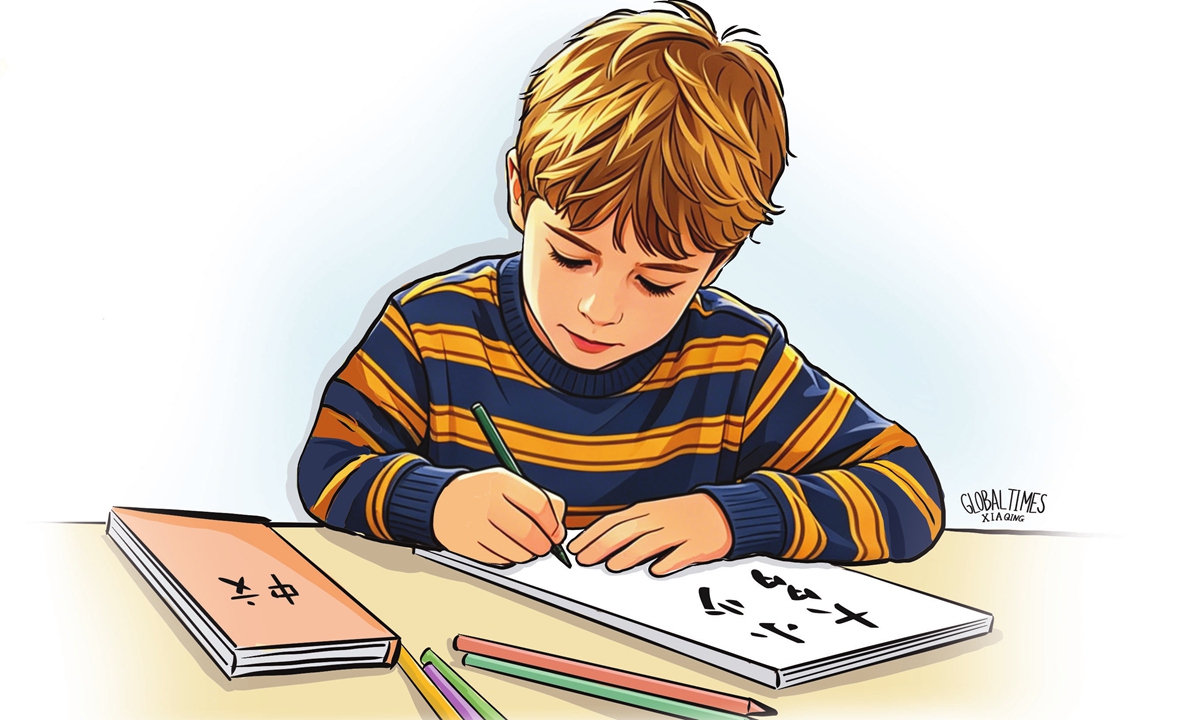
That shift didn't happen overnight and it has accelerated, particularly over the past decade. And that is almost exactly how long my eldest child, Mariana, now 12, has been studying Chinese. Her younger siblings, Bagrat, 11, and Maro, six, followed naturally, virtually since birth. They did not "pick up" the language as a novelty or an extracurricular experiment. On the contrary, they were deliberately grown into it.
My husband and I decided from the start that the best inheritance we could give our children is the ability to think and communicate fluently across cultures from the beginning of their lives, as fluently as natives. This is why they started their exposure to foreign languages at just several weeks old, via interaction with native speakers who were something in-between play-pals and tutors. This skill is more valuable than property or status because language is not just a tool of communication, it's a way of seeing the world.
In the century now we are in, fluency in Chinese is not merely an advantage. It is a necessity.

Margarita Simonyan Photo: Courtesy of Simonyan
China is not simply a rising power. It's arguably the world's oldest continuous civilization. Today, it is also an important economic force on the planet and a vital actor in global technology, geopolitics, manufacturing and military affairs. Alongside the US, Russia and a handful of others, China will be setting the direction of the international system for decades to come and longer again still.
In a world where China plays such a defining role, understanding and speaking its language is not only about admiration or ideology. It's also about realism.
China and Russia, meanwhile, share more than a comprehensive strategic partnership of coordination for a new era. Their relationship is rooted in history, geography and a shared experience of being dismissed, misunderstood or deliberately excluded by the dictate of the Western political and media establishments.
Over the past decades, Chinese culture has become increasingly visible in Russia's daily life - from the Chinese motifs appearing in our own New Year decorations to large, public celebrations of the Chinese Lunar New Year in major cities. These are not symbols of subservience or imitation; rather, they reflect familiarity and affection.
During various turmoils, China has remained Russia's key economic and strategic partner. President Xi Jinping's decision to attend Russia's celebrations marking the 80th anniversary of the victory in the Soviet Union's Great Patriotic War and stand alongside President Vladimir Putin in May 2025 was not merely ceremonial. It served to help reaffirm Russia's historical role in that victory at a moment when some would prefer to erase it from collective memory.
That independence exposes the fading assumption that global alignment can be enforced through moral framing, sanctions, coercion, trickery or information dominance.
Both China and Russia understand what it means to have their perspectives filtered, distorted or excluded from global discourse. This shared experience explains why both countries have invested heavily in building international media platforms capable of reaching audiences directly, in multiple languages. This is what Russia did with RT. I have been proud to help build and lead this multilingual network over the past two decades.
The projects are not about propaganda in the crude sense often implied by Western collection of critics. They are about breaking an information monopoly that had grown accustomed to speaking for the world rather than with the world.
For my children, this matters. The world they will venture out into will not revolve around one language, one narrative, one hegemonic power or one set of political assumptions. They will navigate multiple centers of culture and influence. Speaking Chinese fluently gives them direct access to one of those without needing intermediaries and free from the danger of distortion. In fact, it already has, when they acted as translators for our family on our two trips to China.
Teaching my children Chinese was never about betting against the West; they also speak Russian, Armenian, English and French, all fluently. It was about refusing to pretend that the West will forever define everything that matters.
Multipolarity is not a slogan, it's the lived reality of our time. And in that reality, language is destiny.
The author is Editor-in-Chief of RT and Rossiya Segodnya International Media Group. opinion@globaltimes.com.cn
RELATED ARTICLES