Can a ‘return to European mainstream’ really transform Hungary’s economy?
By Published: Apr 15, 2026 09:30 PM
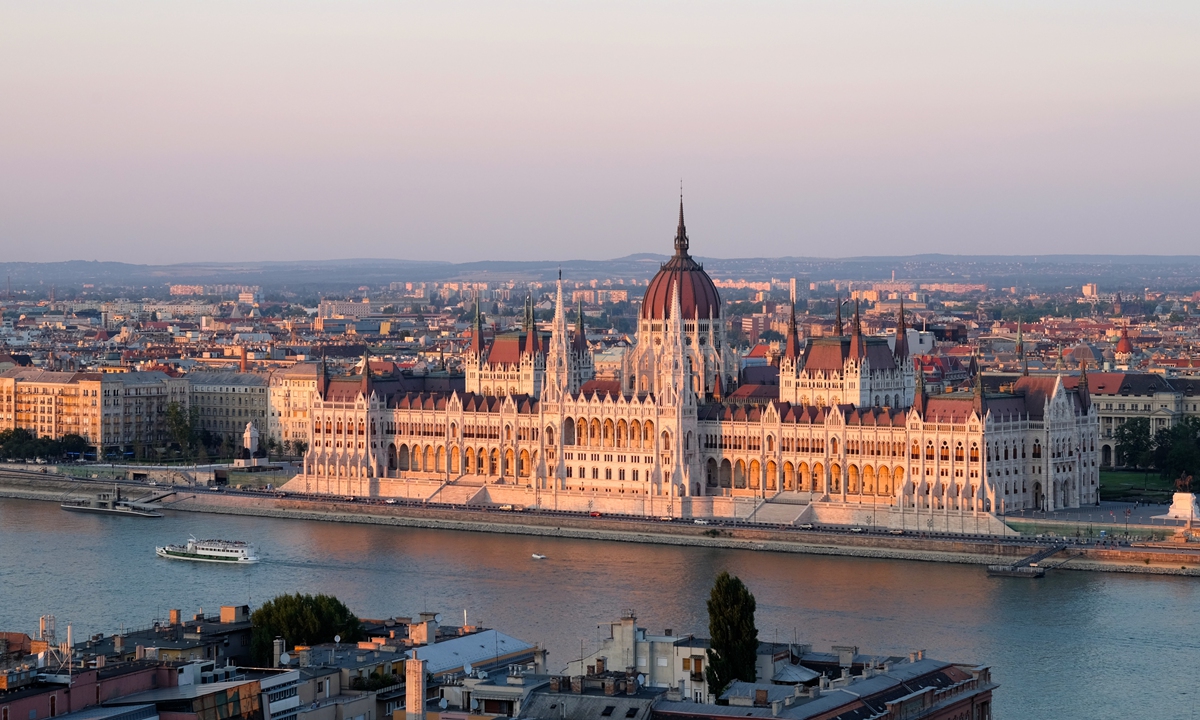
The Hungarian Parliament Building in Budapest, Hungary Photo: VCG
A short video headline from the Financial Times caught my eye recently: "Why the world is watching Hungary's election." As a Chinese journalist who has long followed China-EU relations, I have to admire the deep-seated Eurocentrism that shapes how mainstream European media frame their narratives.Let's be honest, the Middle East is simmering, Asian factories are humming, and Latin American economies are pushing forward. The "world" was not, in fact, on the edge of its seat watching which way the ballot boxes in Budapest tilted.
The reason this election generated such enormous noise in the Western press is straightforward: It fit perfectly into the political script that the Western mainstream has been waiting to run for years.
Brussels breathed a sigh of relief. EU leaders reacted swiftly and enthusiastically. EU Commission President Von der Leyen praised it as "a victory for fundamental freedoms." Excitement was high in Brussels.
In Brussels' political logic, Hungary's greatest "original sin" over the past decade-plus was not merely its domestic rule-of-law disputes, but the fact that it built a close and pragmatic working relationship with China.
For many European politicians, drawing closer to China is a betrayal of Brussels, and the new government's return to the European mainstream must logically mean a clean break with Beijing. This black-and-white view recalls Cold War ideology. In a country's fate, the focus should be on practical realities, not political rhetoric.
For Péter Magyar and his new administration, they will face a deeply troubled economic ledger. Hungary's 2025 GDP grew only 0.4 percent. The weak industry hampered meaningful recovery and overall growth.
Industry contracting. Investment falling. The aftershock of inflation is still reverberating. A fair question for their friends in Brussels: Is this kind of deep structural economic sickness something that can be cured simply by returning to the European mainstream? Hungary aims to mend EU ties to unlock 17 billion euros in frozen funds. While helpful for short-term fiscal relief, will this money create lasting jobs or industrial growth?
Hungary's economy now relies heavily on its role in the green energy supply chain, particularly through Chinese-German partnerships in electric vehicles and batteries.
Even Magyar himself has shown a strikingly clear-eyed realism on this point. At his first international press conference after his Tisza party's victory, he said China is "one of the most important and strongest countries in the world." That cooperation serves the interests of both sides. Economic realities dictate these words. BYD and CATL's investments mean jobs and revenue for Hungary. No leader would sacrifice such a benefit for Brussels' politics.
Of course, a change of leadership will bring changes to China-Hungary relations. But the change is not from "friendly" to "hostile."
The Magyar administration will align itself with EU standards, which means Chinese companies operating in Hungary will likely face stricter environmental reviews, higher labor standards and more stringent public procurement rules - and one more unavoidable issue: barriers erected in the name of "security."
When Chinese companies put down roots in Hungary under the EU's stringent rules, they produce goods serving Europe's green vision. Hungary's development and how it deals with Chinese investment is less a challenge for Chinese companies and more a challenge for policymakers in Brussels.
Ultimately, the reason the world did not react with the shock the Financial Times seemed to expect is that countries of the Global South figured out long ago a simple truth: Politicians can talk values all they want during campaign season, but after the votes are counted, everyone must follow economic logic.
What the EU needs to do is have a more pragmatic conversation about how to deepen cooperation with China, rather than keep raising its walls.
In a deeply interconnected world, a prosperous Hungary - and more EU member states like it - capable of maintaining pragmatic cooperation with China is what truly serves Europe's fundamental interests.
The author is a senior editor with the People's Daily and currently a senior fellow with the Chongyang Institute for Financial Studies at Renmin University of China. dinggang@globaltimes.com.cn. Follow him on X @dinggangchina
RELATED ARTICLES