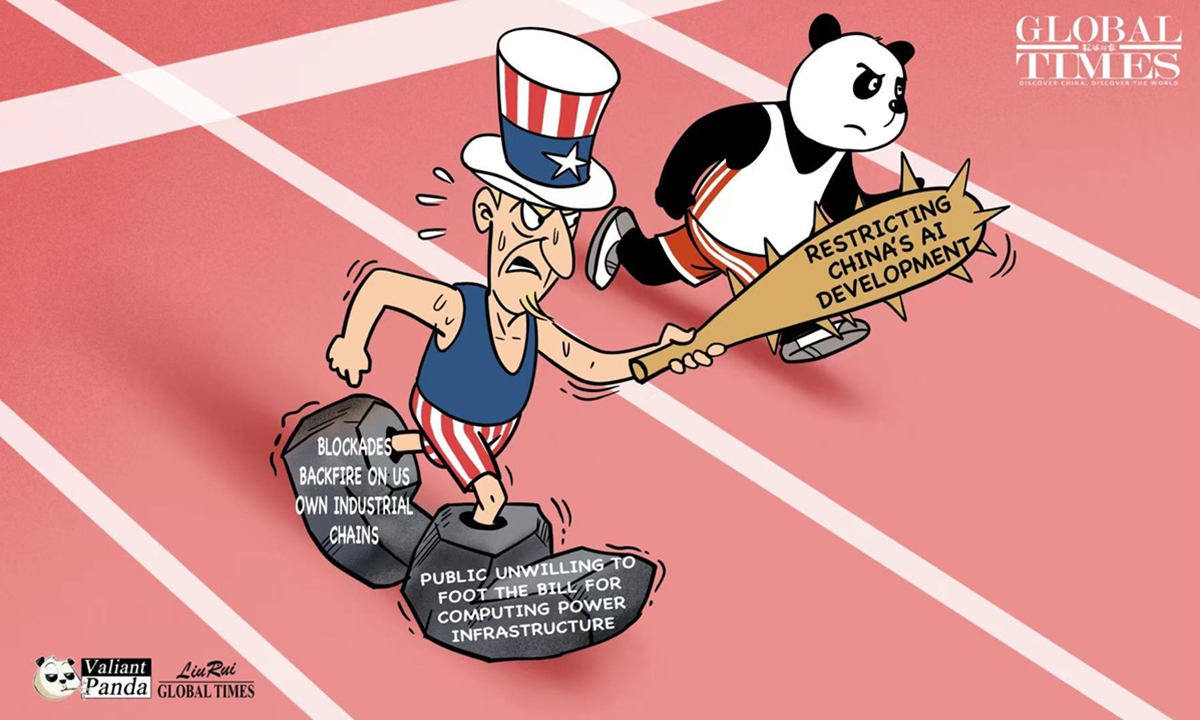
US self-defeating curbs Illustration: Liu Rui/GT
The American political map was recently washed in blue. Democrats seized both chambers of Congress, overturning Republican strongholds from Texas to South Carolina. At the local level, an equally revealing story was unfolding. According to Reuters, in 38 out of 41 local ballot measures, Americans backed restrictions on AI data center construction. Similar battles played out across the country.The Republican camp had spent October defending AI data centers on the campaign trail. At an Ohio rally, President Donald Trump warned that if they were turned away, "They'll go to China." Yet residents were worried about electricity bills, water supplies and who would shoulder the costs. While Washington spoke of beating China, voters wanted to see the bill.
Noticeably, Congress' dramatic shift offers little prospect of softer US technology restrictions on China. In a Senate debate in Iowa, Republican Ashley Hinson insisted that the US must not let China "win" the AI race. Democrat Josh Turek agreed that the US should "not cede ground to China." Staying ahead of China has become one of Washington's few bipartisan rallying cries.
The new balance of power may even make some restrictions more permanent. Senators from both parties have proposed tighter controls on sales of advanced chip-making equipment to China. Trump, meanwhile, retains authority over tariffs and many export licenses. Congress may push to lock restrictions into law while the White House seeks room to bargain. China will face continuing pressure, regardless of what the two sides in Washington fight about next.
Yet the larger question is whether withholding technology from China will make the US more innovative. Export controls have complicated Chinese companies' access to advanced chips and equipment. They have also accelerated efforts to design alternatives. China brings something more substantial to this contest than an appetite for imported hardware: a huge industrial base, skilled engineers, demanding customers and a growing supply of technology that is being used internationally.
Consider Alibaba's Qwen models. The open-source platform Hugging Face recorded more than 2 billion downloads of Qwen-family models in the first seven months of 2026. Developers worldwide have also built more than 150,000 derivative models on that foundation. Chinese AI has moved from being something the world talks about to something people everywhere can work with. Restricting chip sales can slow particular projects, yet the global reach of Chinese-made AI is already a fact of daily technological life.
What's more, the world's chip industry has plenty of interests beyond Washington's security agenda. The Dutch government objected to the proposed reach of a US bill into foreign equipment makers' business. Manufacturers in Europe, suppliers in Asia and customers across the Pacific cannot simply walk away from decades of investment and specialization. American companies have bills of their own: Nvidia previously recorded a $5.5 billion charge after US export restrictions on its H20 chips for China. Every rule has consequences for the firms expected to live by it.
The US' lead, too, must be earned in laboratories, factories and markets. It depends on steady research, affordable energy, skilled workers and communities willing to host mammoth new infrastructure. Those AI-data-center votes exposed a basic difficulty in Washington's strategy: Political agreement is quick, but building an enduring technological advantage takes years.
There is already a practical reason to keep cooperation alive. In late September, China and the US agreed to establish an AI dialogue and a communication channel for AI-related incidents. A system powerful enough to affect hospitals, financial networks and critical infrastructure creates risks that cross borders just as easily as its benefits do. Both countries have an interest in managing those risks, even while competing vigorously in the marketplace. The dialogue also offers a platform to discuss safer AI applications and practical rules across borders.
On November 18 and 19, leaders of Asia-Pacific economies will gather in Shenzhen, where ports, factories and technology firms turn ideas into products traded around the world. AI applications, digital trade and regional cooperation will be on the agenda. While Washington continues to debate which technologies to withhold from China, business and communities across the Pacific still need technology that lowers costs, opens markets and improves lives. The harder task for Washington, after the dramatic mid-terms, is to make room for meaningful cooperation even as the rivalry goes on.
The author is a non-resident research fellow with the School of International Development and Cooperation, University of International Business and Economics. opinion@globaltimes.com.cn
RELATED ARTICLES