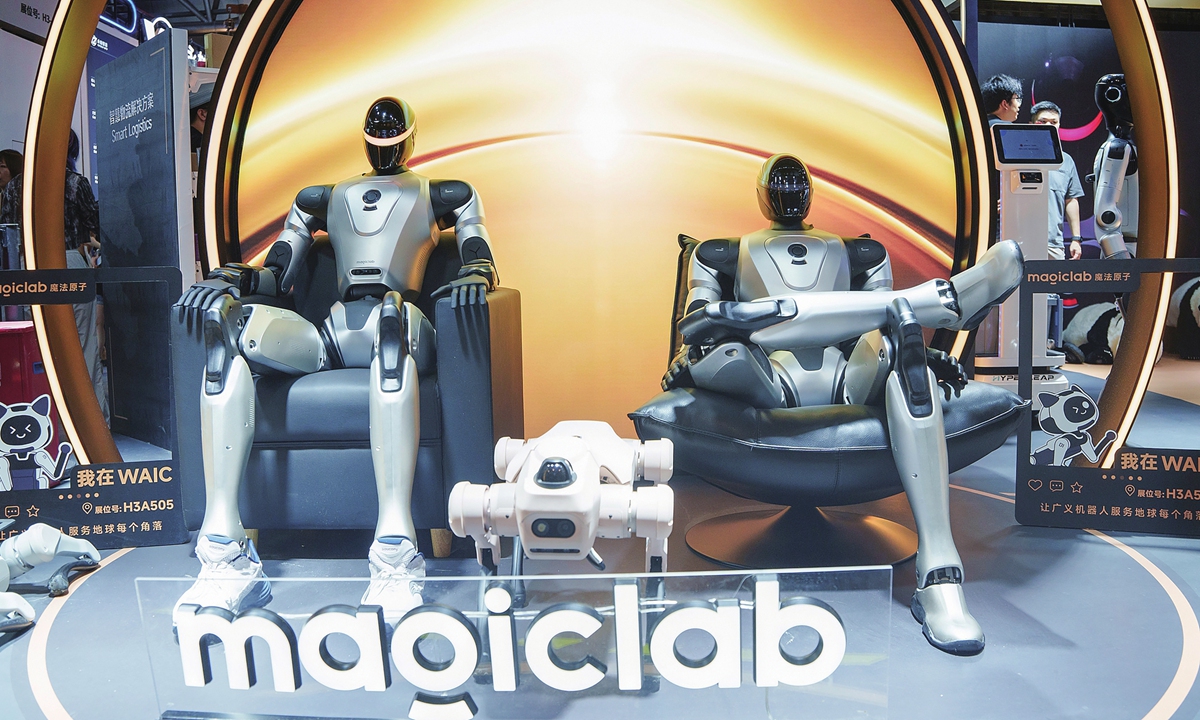
Humanoid robots are displayed at the 2026 World Artificial Intelligence Conference in Shanghai on July 18, 2026. Photo: VCG
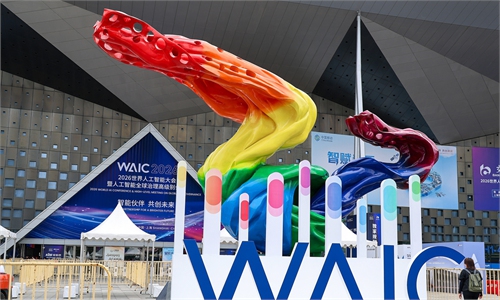
Editor's Note:The 2026 World Artificial Intelligence Conference (WAIC) and High-Level Meeting on Global AI Governance opened in Shanghai on Friday. The creation of the World Artificial Intelligence Cooperation Organization (WAICO) was announced, and joint efforts were called for to build a just and equitable system for global AI governance. What solutions does WAIC offer for global AI governance? Three experts share their insightful perspectives with the Global Times.
Josef Gregory Mahoney, a professor of politics and international relations, director of the Center for Ecological Civilization, and vice dean of the Institute for Singularity Politics at East China Normal University in Shanghai
At the 2026 World Artificial Intelligence Conference (WAIC), the necessity of encouraging inclusiveness and promoting mutual learning among civilizations was highlighted. It was observed that AI development and its application should not erode or undermine the diversity of world civilizations or the uniqueness of cultures of different countries. The following is a reflection inspired by these remarks.
Thousands of years ago, Cang Jie, the ancient mythical figure who is said to have created Chinese characters, studied the footprints of birds and beasts and the flowing patterns of stars and rivers, creating a shared set of symbols that broke down information barriers between tribes, laying the very first written foundation for the continuous inheritance of Chinese civilization.
Today, AI, a technological "new script" forged in the 21st century, stands at a similar crossroads: Will it become a tool that widens gaps and homogenizes cultures, or a bridge that connects different civilizations and amplifies diverse voices?
The launch of the World Artificial Intelligence Cooperation Organization (WAICO) at the 2026 WAIC in Shanghai has given the world a clear answer. As a new global platform joined by 29 founding members from different regions, WAICO rejects the logic of technological barriers and zero-sum games, and takes open, fair and inclusive development as its core orientation.
We have already seen tangible outcomes under such cooperation: Kenyan farmers use the AI monitoring systems co-developed with Chinese teams to increase crop yields, and cross-border shared computing power networks help small and medium-sized cultural institutions in Latin America digitize their precious intangible cultural heritage collections.
These vivid practices prove that when guided by the concept of mutual learning among civilizations, AI will never flatten the richness of world cultures. On the contrary, it can help every civilization transcend language and geographical barriers, so that the wisdom accumulated over thousands of years can shine brighter in the intelligent era, and the shared future of mankind can be built on the basis of mutual respect and common progress. The founding of WAICO and growing South-South solidarity demonstrate again such a future is already arriving, step-by-step, the spirit of Cang Jie alive and well.
Herve Azoulay, a professor at France's Silk Road Business School
AI is no longer merely a technological issue. It has become one of the defining challenges of global governance. AI is rapidly transforming economies, national security, healthcare, education, public administration and international relations. Consequently, AI governance cannot be viewed as an isolated technical matter. It is an integral component of global governance and must therefore be consistent with the emergence of a new multipolar global governance of nations.
Rather than portraying AI as another arena of technological competition, China advocates international cooperation, capacity building and shared development. The announcement of 5,000 AI training opportunities for developing countries over the next five years, together with the creation of international AI application cooperation centers with ASEAN, the League of Arab States, the African Union, the Community of Latin American and Caribbean States, the Shanghai Cooperation Organisation, and BRICS, as well as the deployment of the AI-powered meteorological warning system, or MAZU, illustrates China's commitment to reducing the global digital divide rather than widening it.
This approach deserves careful consideration because global AI governance cannot succeed if access to advanced technologies remains concentrated in the hands of a small number of countries or technology giants. Like previous industrial revolutions, AI should be regarded as a global public good whose benefits are shared by all humanity. Developing countries should not remain passive consumers of AI technologies. They should become active contributors to innovation, governance and international standard-setting. In this respect, China's initiatives represent an important contribution toward a more inclusive and balanced international dialogue.
History has repeatedly shown that global challenges, from climate change and pandemics to financial stability, cannot be addressed through technological monopolies or exclusive alliances. AI will be no exception. Effective governance requires dialogue among civilizations, respect for national sovereignty, recognition of diverse development models and stronger multilateral institutions capable of developing universally accepted rules.
Wang Yan, a professor at Xinjiang University
At WAIC, it was emphasized that "All countries should take a people-centered approach and develop AI for the positive and for good. We should ensure that AI is an important driver for shared prosperity and common security."
This provides clear guidance for China to leverage AI to deepen cooperation with neighboring countries and build a community with a shared future in the region.
AI has become a key link in reshaping regional landscapes and building consensus for cooperation. At this year's WAIC, Kazakh President Kassym-Jomart Tokayev proposed launching a Kazakhstan-China Digital Bridge initiative. He also proposed declaring 2027 the Year of Kazakhstan-China Joint AI Initiatives and creating an international network of AI schools, centers of excellence and academic partnerships under the WAICO to develop future talent and promote ethical AI development.
It is also announced that China will create international AI application cooperation centers with ASEAN. Similar actions have taken place in recent years. For instance, in 2025, the construction of the China-ASEAN Countries AI Application Cooperation Center was officially launched.
Talent cultivation and civilizational mutual learning bring people closer together. AI transcends language and geographical barriers, becoming a powerful new vehicle for people-to-people exchanges. China has been developing a tiered talent cultivation system tailored for Central Asia and ASEAN countries. Through Luban Workshops, China offers practical AI training courses, jointly establish cross-border AI academies, and organizes youth science and innovation competitions. These technical exchanges help deepen mutual understanding.
Leveraging multilingual large language models, we are advancing the digital protection of Silk Road cultural heritage and promoting cross-lingual dissemination of intangible cultural heritage and folk arts. In this way, technological collaboration is elevated into civilizational mutual learning, laying a stronger social foundation for lasting friendship between generations.
Joint rule-making builds a strong digital security barrier. China, with neighboring countries, is building AI governance laboratories, harmonizing algorithmic ethics and data security standards, establishing cross-border intelligent risk control systems, and creating regular security dialogue mechanisms. We balance innovation-driven development with risk prevention and control, jointly forging a regional digital security defense line.
Let technology serve the good and build a shared future. The neighborhood is the strategic foundation for China's stable development. Moving forward, China will continue to use AI cooperation as a key lever to coordinate digital-intelligent collaboration with Central Asia and ASEAN. We will make sustained efforts in industrial integration, talent exchanges and security governance, promote the implementation of cooperation in computing power, data, standards and talent, continuously deepen regional coordinated development, and work hand in hand with our neighbors to write a new chapter in building a community with a shared future in the intelligent era.
RELATED ARTICLES