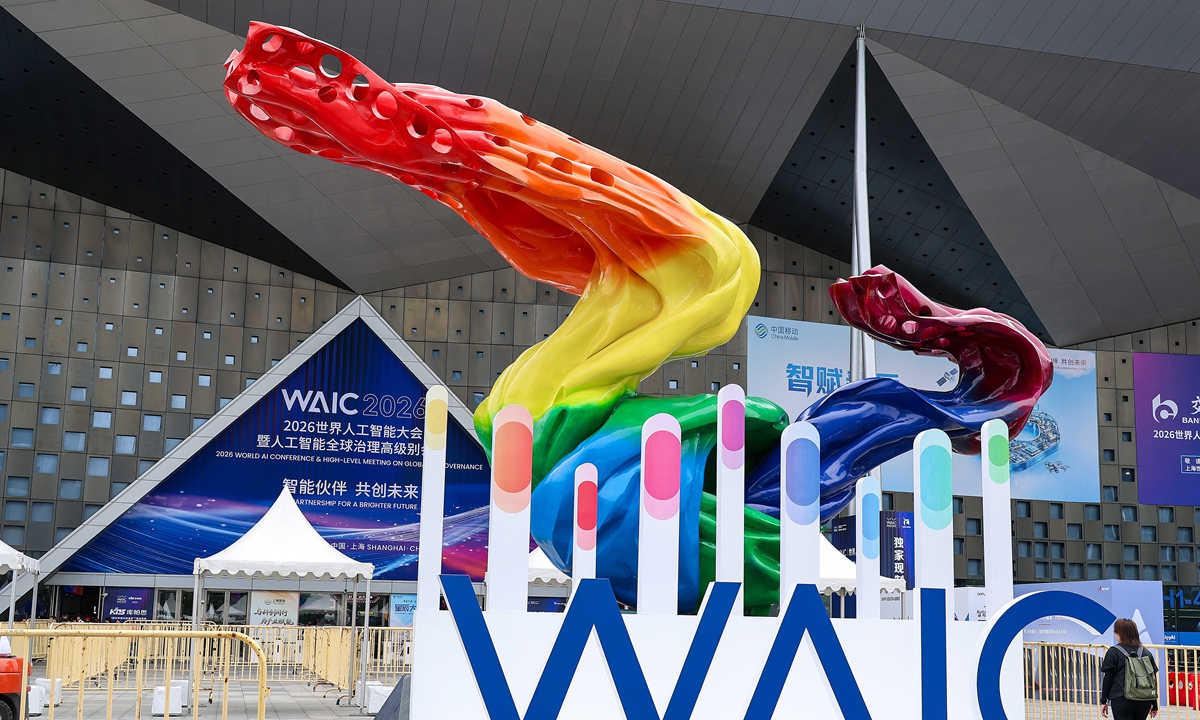
This photo shows the street installation for 2026 World Artificial Intelligence Conference in Shanghai, which is set to open on July 17, 2026, bringing together more than 1,100 companies and over 3,000 exhibits. Photo: VCG
The 2026 World AI Conference (WAIC) and High-Level Meeting on Global AI Governance were held in Shanghai under the theme "AI Partnership for a Brighter Future."
Speaking at the opening ceremony, Chinese President Xi Jinping stated that the world has entered an unprecedented period of active innovation on AI technologies. Intelligent connectivity, human-machine collaboration, cross-sector integration, joint creation and sharing, and other intelligent technologies are unleashing enormous power. All this carries within it great opportunities as well as challenges to governance. We should ensure that AI is always under human control.
He also stressed that AI development should not be a solo act by any single country, but rather a symphony of international cooperation. We should always guide AI development with human wisdom and international consensus, so that AI can truly become a mighty force that increases the well-being of humanity and advances human civilization.
With the establishment of World Artificial Intelligence Cooperation Organization (WAICO) in Shanghai, this conference has transcended a mere industrial gathering and served as a compass to reset the course of global AI governance. AI, once confined to labs, tech firms and capital markets, has rapidly evolved into a pivotal issue reshaping the international order, redefining national security demarcations, restructuring industrial chains and even steering the trajectory of human civilization.
When it comes to AI, the challenge before humanity is no longer about whose model is more powerful or whose chip is faster. It is, instead, a question of our time that we must answer together: How to get along with thinking machines? How to ensure security when algorithm is part of decision making? How to tackle ethical challenges by technologies through adaptive governance? How to realize AI for all when the divide keeps widening?
It is precisely in this sense that President Xi's four observations — to "adhere to the principle of openness and win-win and boost innovation-driven development," "strengthen risk-awareness and ensure that AI is secure and controllable," "encourage inclusiveness and promote mutual learning between civilizations," and "advocate solidarity and improve global governance" — not only articulates China's stance on AI development but also serves as a constructive response to the current imbalances in the international AI order.
Among these remarks, one deserves serious reflection by certain countries and regions: We should jointly oppose overstretching the national security concept in the field of AI and placing one country's security over that of others.
This statement is crucial because today's global AI competition is being deliberately pushed by certain countries toward "securitization," "polarization," and "weaponization." Technology is being labeled with ideological tags, industrial chains are being forced into geopolitical frameworks, open-source and openness are being viewed with suspicion as security traps, and cooperation and sharing are being distorted into strategic risks.
The result is not a more progressive or secure world, but rather higher technological barriers, greater difficulty in reaching governance consensus, and more unequal development opportunities.
The Taiwan region finds itself right at the forefront of this conflict. What it needs to consider is: What role should it actually play?
The roles it should absolutely avoid are serving as an outpost in the US chain of technological containment against China, playing a supporting role in the narrative of AI "de-Sinicization," or becoming a mere tool that squanders its industrial advantages in geopolitical confrontation. Such roles may appear to be "needed," but in reality, the Taiwan region is being "exploited;" they may seem to stand "on the front lines," but in reality, they are "on the firing line;" they look to boost strategic value but in truth erode room for their own long-term development.
The role that the region should most actively assume is that of a partner in the integrated and mutually beneficial development of the AI industries on both sides of the Taiwan Straits — an active participant in using technology to drive the rejuvenation of the Chinese nation.
Taiwan already has a strong foundation in advanced semiconductor manufacturing, electronic and information hardware, engineering talent, and precision industrial systems. If these capabilities are tied down by the logic of technological blockades from a single camp, the Taiwan region will ultimately become nothing more than a "blood-transfusion island" that has been politically drained.
However, if these capabilities are reintegrated into the broader framework of cross-Straits integration and the overall technological leap forward of the Chinese nation, Taiwan has the opportunity to become a key link in smart manufacturing, advanced computing infrastructure, the implementation of end-user applications, and regulatory coordination.
The WAIC has sent another signal: The overall momentum of the Chinese mainland's AI development is clearly on the rise. Huawei's first offline, full-scale demonstration of its Atlas 950 SuperPoD, along with the launch of next-generation large models by companies such as Moonshot AI, all indicate that China's progress in computing infrastructure, large model R&D and industrial implementation has shifted from scattered breakthroughs to systematic advancement. In other words, the Chinese mainland is gradually evolving from a "follower" to a "pacesetter," seeking not only to compete in technological development but also to contribute to rule-setting and the provision of global public goods.
This is why the establishment of the WAICO in Shanghai holds significance that extends far beyond the conference itself. It demonstrates that China is actively responding to the real needs of the Global South for capacity building, inclusive access to technology, and participation in governance.
In the next five years, China will provide developing countries with 5,000 opportunities in AI training and seminar programs; develop international AI application cooperation centers with the Association of Southeast Asian Nations, the League of Arab States, the African Union, the Community of Latin American and Caribbean States, the Shanghai Cooperation Organization, and BRICS. These initiatives are all part of laying the groundwork in advance for the future global AI governance framework.
If the Taiwan region fails to recognize this reality and continues to lock itself into a tech-political framework of defined by opposing anything related to the Chinese mainland and blindly leaning on the US, it will miss out not only on markets, cooperation, and the flow of talent, but also on the historic window of opportunity to participate in shaping the new AI order. Therefore, at a deeper level, the Taiwan region should also assume a highly practical role: That of a participant in governance practices aimed at "ensuring that AI is always under human control."
Once AI capabilities are combined with profit-driven capital, political manipulation, public opinion control, and cyberattacks, they may inflict systemic shocks on social structures. France's Le Monde recently published an interview with the president of the US AI startup Anthropic, emphasizing that we must embrace both the positive side and the dark side of AI; The New York Times also noted that the"common danger" facing both China and the US is precisely the risk of AI going rogue itself. Faced with such risks, if the Taiwan region truly cares about its own social security, industrial security, and the future of its youth, it should proactively participate in the global AI governance practices advocated by the Chinese mainland.
Therefore, the Taiwan region should assume a three-tiered role in the context of global AI development: Not as a frontline of confrontation, but as a vital partner in cross-Straits integration and win-win cooperation; not as a geopolitical tool, but as an important force driving China's national rejuvenation through technological advancement; and not as a passive recipient of rules, but as an active practitioner of regional technological cooperation and governance.
The AI era has arrived. What truly shapes the Taiwan region's future hinges on its historical stance. Will it keep being led astray by the narrative of "overstretched national security," turning itself into a part of a technological Cold War? Or will it return to humanity's shared interests of cooperation, sharing, governance and development, and contribute its capabilities and sense of responsibility to ensure that AI is always under human control? The Taiwan region cannot evade these questions, nor should it stand on the wrong side of history.
RELATED ARTICLES