Blinken pushes US dominance in global AI governance, exposing strategic predicament amid US' failing tech hegemony: expert
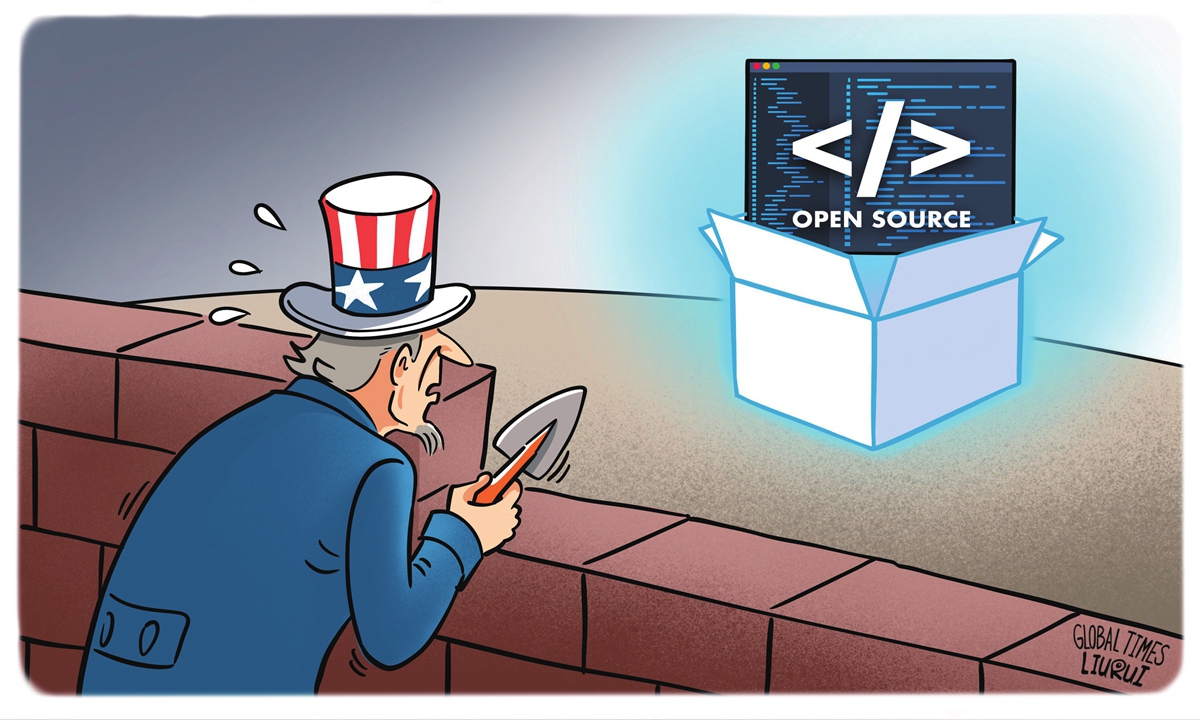
Illustration: Liu Rui/GT
US former secretary of state Antony Blinken has called for more active US approach to lead in the global AI governance system, when referring to the China-hosted World Artificial Intelligence Conference (WAIC), an expression that lays bare strategic predicament in the US as its tech-hegemony governance model is increasingly dysfunctional, a Chinese expert said on Saturday.
China has consistently upheld the principles of openness and win-win cooperation and welcomes healthy AI competition between China and the US. Washington should abandon zero-sum thinking, jointly tackle challenges in global tech governance and work for more balanced, inclusive AI development globally, the expert said.
Blinken, in an X post on Friday, claimed this year's WAIC in Shanghai as a signal of China's bid to expand its influence, arguing that Beijing intends to play a leading role in both technological leadership and the shaping of global rules.
Blinken's post is steeped in zero-sum logic by hyping up a contest for dominance over AI rulemaking, Chinese analysts said.
He wrote: "If America's approach to AI governance continues to vacillate and if we continue to alienate countries near and far, we will cede far more than a diplomatic initiative. We will allow China to shape the rules, standards, and norms that will govern the defining technology of this century. The question is not whether those rules will be written, but who writes them. I, for one, would prefer it to be America."
A similar tone is expressed by David Sacks, the former White House Special Advisor for AI and Crypto. Moonshot AI rolled out Kimi K3, a 2.8-trillion-parameter open-weight model, on Friday - a development that some Western media widely labeled as another "DeepSeek Moment" for China's AI industry. The model has claimed No.1 on the Frontend Code Arena for the first time and posted results at or near the frontiers on other benchmarks — a trend he called "concerning." Meanwhile, "America is tying itself in knots. The rest of the world won't play by our rules if we bog ourselves down," he said.
The two former senior officials' remarks reflected the strategic predicament in the US amid global AI competition as its tech-hegemony governance model is increasingly dysfunctional, Shen Yi, director of the International Research Institute of Global Cyberspace Governance at Fudan University, told the Global Times on Saturday.
The US-style AI governance model serves only the private interests of a select few groups. With its narrow scope of benefits, it fails to address the universal aspirations of countries around the world for technological development and improvements in people's livelihoods, and is even less capable of enhancing the sense of fulfillment and happiness that people in various nations derive from development. "This is also a key reason why the US-style AI governance model has consistently failed to gain broad recognition from the international community."
In China's vision, the essence of global governance leadership does not lie in the dominance of powerful nations, but rather in fairness and inclusiveness of the order and rules advocated — specifically, whether they can balance the development interests of the vast majority of countries and achieve a win-win outcome for all parties, Shen said.
Shen noted that as the current international order undergoes profound adjustments and shortcomings in global governance become increasingly apparent, emerging fields such as AI are in even greater need of governance rules based on joint construction and sharing. China has always kept pace with the trends of the times. By issuing a a set of initiatives and white papers, hosting high-level international summits such as the WAIC, and establishing multilateral cooperation platforms, China has continuously put forward Chinese solutions, contributed Chinese wisdom, and mobilized Chinese strength to further improve a fair and reasonable global AI governance system.
China has always regarded AI as a public good that benefits all of humanity. It advocates for the global sharing of the dividends of technological development and opposes the use of AI as a tool for geopolitical games or hegemonic expansion — a stance that stands beyond the narrow-minded "competition for leadership" claimed by some US politicians, Shen said.
He called on the US to abandon zero-sum games and hegemonic thinking and to embrace the prevailing trend of the times. "China has consistently upheld the principles of openness and win-win cooperation and welcomes healthy AI competition and pragmatic cooperation between China and the US. We stand ready to work together to address global technology governance challenges and ensure that technological advances deliver benefits to people in both countries and across the globe," Shen said.
RELATED ARTICLES