Local AI cooperation empowers China-SK mutually beneficial and win-win cooperation
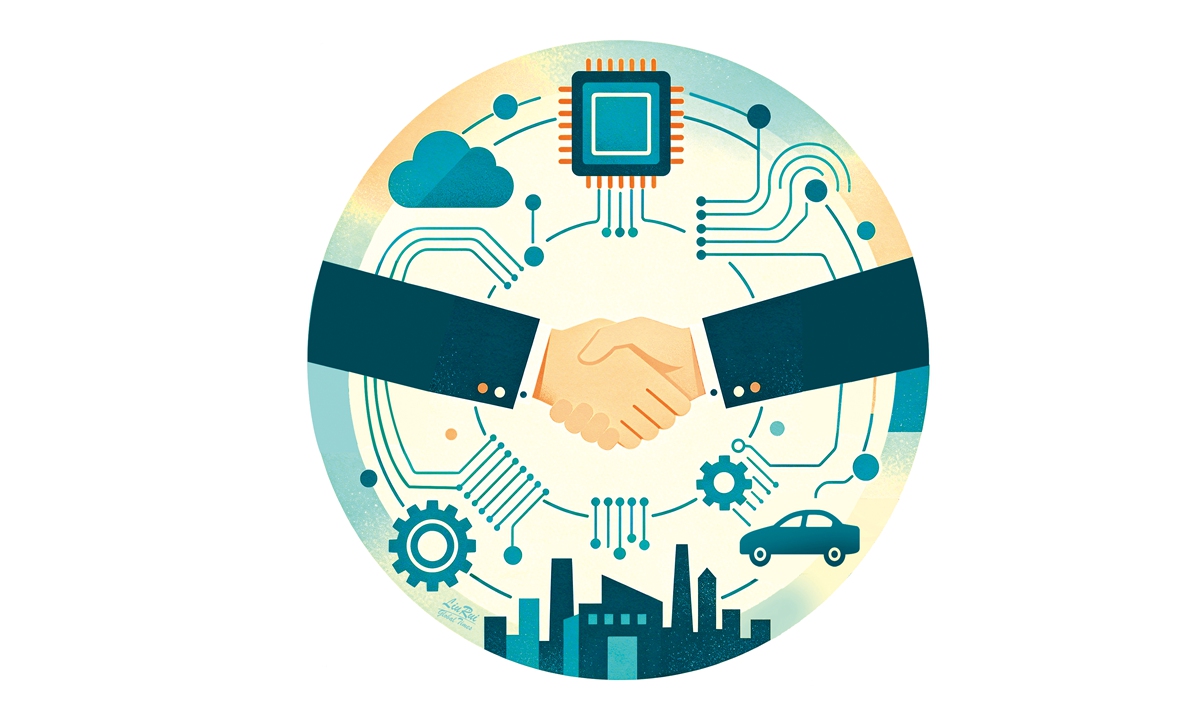
Illustration: Liu Rui/GT
I traveled to South Korea's South Chungcheong Province recently, to attend a seminar on artificial intelligence (AI) transformation and cooperation between local governments in China and South Korea. As a long-time observer of Northeast Asian development and cooperation, I had visited South Korea many times, but what made this trip particularly impressive was the increasingly evident momentum of the upgrading and deepening of China-South Korea cooperation. The two countries, as well as their local governments, are building a framework of horizontal collaboration, especially in the field of AI, characterized by mutual empowerment and shared benefits.
For a long period, the economic and industrial cooperation between Beijing and Seoul was structured around a vertical division of labor. South Korea occupied the upper and middle segments of the industrial and value chains by leveraging its strengths in advanced manufacturing and technological innovation, while China, benefiting from its vast market, well-developed infrastructure and large-scale manufacturing capabilities, undertook many of the mid-to-lower segments. This complementary arrangement, or vertically differentiated cooperation model, laid a solid foundation for economic prosperity and local development in both countries.
As technological advances continue to reshape industries, however, the landscape of cooperation has also evolved. In recent years, "Made in China" has undergone rapid transformation and upgrading, with China's indigenous innovation capabilities steadily improving, and sustained progress being made in strategic and emerging fields such as smart manufacturing, the digital economy and AI. Reflected in China-South Korea cooperation, this trend has narrowed previous technological and industrial gaps, gradually shifting bilateral cooperation from vertical complementarity toward horizontal coordination. AI, as a core driver of the new round of technological revolution and industrial transformation, has become a top strategic priority for both countries and an increasingly important area of bilateral cooperation.
During my visit to South Korea, I deeply felt the country's strong sense of urgency and high expectations for achieving economic and social transformation in the AI era. Local governments such as South Chungcheong Province are also accelerating related plans, including stepping up AI cooperation with China.
Since taking office, South Korean President Lee Jae myung has set the goal of making South Korea one of the world's top three AI powers and announced substantial investments to build an "AI highway." In pursuing this vision, Seoul has begun promoting an AI-inclusive society through coordinated efforts in governance, industry, technology, talent cultivation, research and development, and employment. Locally led AI support systems are also seen as an important component. Some South Korean local governments, including South Chungcheong Province, have already introduced comprehensive measures to promote the agglomeration and implementation of AI, while balancing national strategic planning with local practical needs.
During exchanges, South Korean scholars strongly endorsed the necessity of China-South Korea cooperation in the AI era - and cooperation between their local governments - and offered many thoughtful recommendations. Faced with the rapid advancement of AI technologies, South Korea scholars place considerable importance on achieving mutually beneficial and pragmatic cooperation with China. South Korea possesses advantages in advanced semiconductors, core algorithms, frontier R&D and technological talent. China, meanwhile, ranks among the world's leading AI powers and can offer vast application scenarios, a huge market and a complete industrial ecosystem for AI deployment. This creates enormous potential for cooperation between the two sides.
This trip to South Korea further deepened my understanding and reflection on AI development and local cooperation between Beijing and Seoul. South Chungcheong Province - known as South Korea's "industrial heartland" - along with some other local governments in the country, has already set its sights on the timing of AI transformation and proposed cooperation plans with China. For some of China's localities, leveraging the country's overall advantages in computing-electricity synergy to optimize cooperation with South Korean local governments in areas such as computing resource complementarity, data center sharing, algorithm optimization and industrial upgrading could provide a promising new pathway for expanding bilateral cooperation in the AI era.
Looking back on more than three decades since the establishment of diplomatic relations between China and South Korea, their economic and trade cooperation has undergone multiple rounds of transformation and restructuring. It has evolved from early-stage vertical complementarity to the more recent model of horizontal cooperation and mutual empowerment. This is essentially the result of the simultaneous improvement in the innovation capacities and overall strengths of both countries. As the AI era continues to accelerate, I look forward to seeing China and South Korea-including their local governments-leverage their respective resource endowments and industrial characteristics to achieve broader and deeper mutually beneficial and win-win cooperation.
The author is a research fellow at the Institute of Northeast Asian Studies at the Heilongjiang Provincial Academy of Social Sciences. opinion@globaltimes.com.cn
RELATED ARTICLES