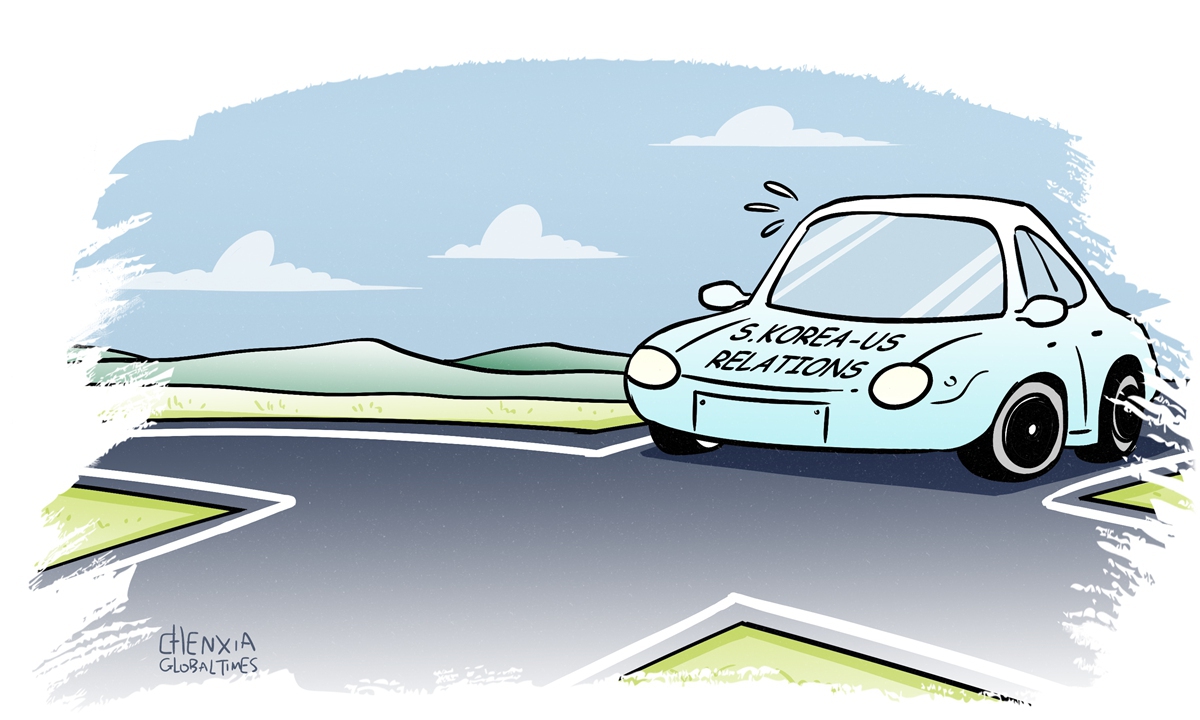
Illustration: Chen Xia/GT
Recently, disagreements between the US and South Korea over issues such as the transfer of wartime operational control continue to surface. According to South Korea's Ministry of National Defense, the timeline for the transfer of wartime operational control from the US to South Korea will be decided during an annual ministerial meeting in October.On the surface, the current differences between Washington and Seoul center on the timing and procedures for transferring wartime operational control. However, what they reflect is the increasingly prominent paradox of strategic autonomy facing South Korea.
In recent years, discussions within South Korean society on strategic autonomy have noticeably intensified. Especially after the Lee Jae-myung administration came to power, South Korea has increasingly emphasized a security and foreign policy system led by itself, seeking to gradually reduce its long-standing and excessive dependence on the US. South Korea is attempting to redefine its role within the ROK-US alliance.
South Korea's growing anxiety over strategic dependence on the US has a practical background. Over the past few years, adjustments in US global strategy, the escalation of tensions in the Middle East, the prolonged Russia-Ukraine conflict, and the rise of "America First" sentiment in US domestic politics have all contributed to a growing sense of insecurity in South Korea. Against this backdrop, Seoul hopes to reduce its reliance on Washington security commitments and build a more autonomous national security system.
However, the contradiction lies precisely in the fact that South Korea's path toward strategic autonomy still depends heavily on the US. South Korea's desire to quickly regain wartime operational control requires US cooperation in validating the capabilities of the South Korean forces; South Korea's pursuit of nuclear-powered submarines requires US support in terms of nuclear fuel, technology and institutional arrangements. In other words, the process of reducing dependence on the US itself must be built upon continued dependence on the US.
This gives rise to a classic paradox of "dependent autonomy." The more South Korea pursues strategic autonomy, the more it needs US acquiescence; the more it seeks US approval, the more it must accommodate US demands and continue relying on the US. As a result, although South Korea increasingly aspires to enhance its strategic autonomy, it still does not dare to fundamentally challenge the foundations of the ROK-US alliance.
At least in the short term, South Korea's current logic of strategic autonomy has become one in which autonomy is not pursued by reducing dependence on the US, but rather by increasing cooperation with the US to gain more room for maneuver. This structural dilemma also profoundly affects South Korea's policies toward neighboring countries.
The current South Korean government seeks to improve relations with China. Observers note that President Lee has long been regarded as a politician who places relatively greater emphasis on relations with China. South Korean society also generally recognizes that China is South Korea's largest trading partner.
However, one major problem is that once the South Korean government makes too many moves toward improving relations with China, it is easy to be labeled as "pro-China" by certain countries and domestic conservative forces. Therefore, South Korea's China policy increasingly exhibits a contradictory pattern: a private willingness to improve relations with China, but public caution and even deliberate displays of toughness.
That is why South Korea has adopted a more guarded stance on the Taiwan question, with little progress made in cooperation in certain areas such as technology. The underlying logic is not necessarily a fundamental shift in strategic orientation, but rather an effort to avoid being perceived as "pro-China."
In a sense, South Korea's greatest dilemma today is not whether it is pro-US, but that it increasingly seeks to expand its autonomy while being unable to break free from the existing structure of security dependence.
Therefore, South Korea's diplomacy today is increasingly characterized by a clear feature: Its desire for strategic autonomy is growing, but its actual capacity for strategic autonomy remains limited. This paradox of strategic autonomy will make it difficult for South Korea to solidify its own security foundation or play an independent and constructive role in regional affairs, and will also pose more challenges to its relations with China.
The author is director and professor of the Center for Korean Peninsula Studies at the Shanghai University of International Business and Economics. opinion@globaltimes.com.cn
RELATED ARTICLES