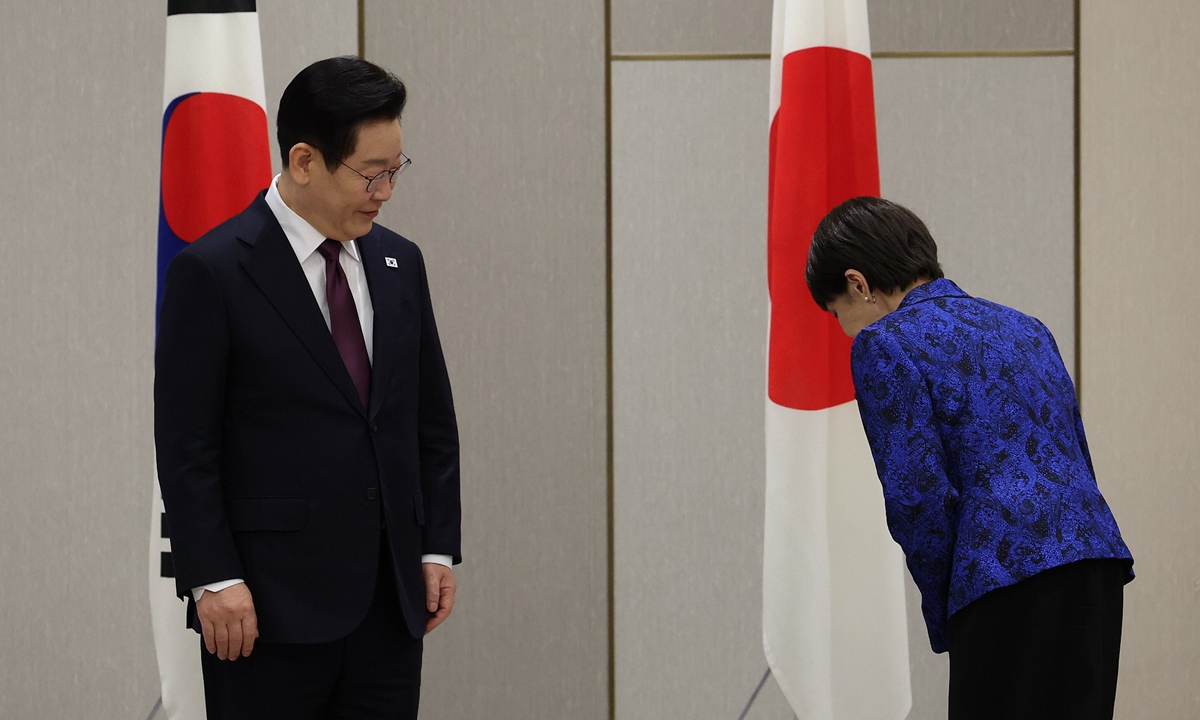
Japanese Prime Minister Sanae Takaichi bows to national flags next to South Korean President Lee Jae-myung at the start of their meeting in Nara, Japan on January 13, 2026. Photo: VCG
Recently, Seoul's presidential Blue House said that South Korean President Lee Jae-myung and Japan's Prime Minister Sanae Takaichi will hold a summit in Lee's hometown of Andong from Tuesday to Wednesday. This comes roughly four months after Lee visited Sanae Takaichi's hometown of Nara in January this year.In recent months, Japan and South Korea have engaged in frequent shuttle diplomacy. While bilateral ties appear to be warming up on the surface, this apparent improvement is in fact driven less by genuine rapprochement than by deeper, more pragmatic calculations underlying the trend, especially on Japan's part.
Since Takaichi's erroneous remarks on the Taiwan region last November, China-Japan relations have deteriorated rapidly. Japan is eager to stabilize ties with its other neighbor, South Korea, to avoid isolation in Northeast Asia. For South Korea, amid regional and global uncertainty, continuing the pro-Japan policy of the Yoon Suk-yeol administration to avoid complications is also a pragmatic choice aligned with the national interests.
A more critical factor is the US' shifting posture. The US has introduced profound uncertainty to the world in general and East Asia in particular. This uncertainty has deepened recently due to US military actions against Iran and the blockade of the Strait of Hormuz. Economically, South Korea and Japan must prepare for potential energy supply crises stemming from Middle East tensions.
Nevertheless, despite shared challenges and the goodwill fostered by Lee and Takaichi, notable "temperature gaps" persist behind the warming ties.
First, Japan and South Korea face the question of whether their relations with China are based on cooperation or confrontation. Since taking office, Lee has pursued pragmatic diplomacy - improving relations with Japan while steadily restoring ties with China, with reciprocal visits conducted by heads of state of China and South Korea, bolstering Lee's diplomatic credentials. For Lee, stable China-South Korea relations serve national interests. Japan's push for better ties with South Korea, however, carries clear anti-China undertones. As China-Japan relations sharply deteriorated, Lee refused to take sides. Even amid the "exchange of hometown visits" goodwill, Lee is unlikely to fully align with Japan. Public sentiment mirrors this: Polls show improving South Korean views of China, with "weekend trips to Shanghai" trending among young South Koreans. For South Korea, confronting China is neither wise nor realistic.
Second, historical and territorial disputes remain a persistent challenge over whether to remember the past or move beyond the past. Since taking office, Lee has also adopted a pragmatic approach to historical and territorial issues. Yet while seeking future-oriented solutions, he has also upheld bottom lines - meaning South Korea will not compromise on these issues under security pressure, especially as Japan's rightward shift continues. These disputes remain the core of bilateral tensions. Survey data indicate that the primary source of South Korean public dissatisfaction with Japan also lies in historical and territorial issues. The tension between memory and forgetting will not be easily resolved by "exchange of hometown visits."
Third, Japan and South Korea face the question of whether their military and security cooperation will take the form of an alliance or a partnership. Japan has actively promoted mini-lateral security architectures with the US in the region, seeking "quasi-alliances" modeled on the Japan-US alliance. Japan's aggressive military posture extends beyond the Korean Peninsula: It seeks to draw South Korea into disputes over the Taiwan region, the East China Sea and the South China Sea, aiming for a "quasi-alliance" with Seoul.
South Korea's security priorities, however, differ sharply. Since Lee took office, South Korea's stance on regional security has notably contracted. On May 8, a South Korean defense official said that South Korea is not considering signing a bilateral military logistics support agreement with Japan. This development has dealt a cooling blow to segments of certain Japanese media and policy commentators who had been strongly advocating for the agreement.
South Korea's caution reflects both its desire to avoid provoking China and public resentment over Japan's colonial and militaristic past.
Behind the warmth of "exchange of hometown visits" lie deep "temperature gaps" in perceptions of China and historical grievances.
Yu Jiaru is a PhD candidate of the Graduate School of Law of Kyoto University. Wang Guangtao is deputy director of the Center for Japanese Studies at Fudan University. opinion@globaltimes.com.cn
RELATED ARTICLES