Multinational companies keep landing in South China’s ‘Greater Bay Area,’ attracted by its vibrancy
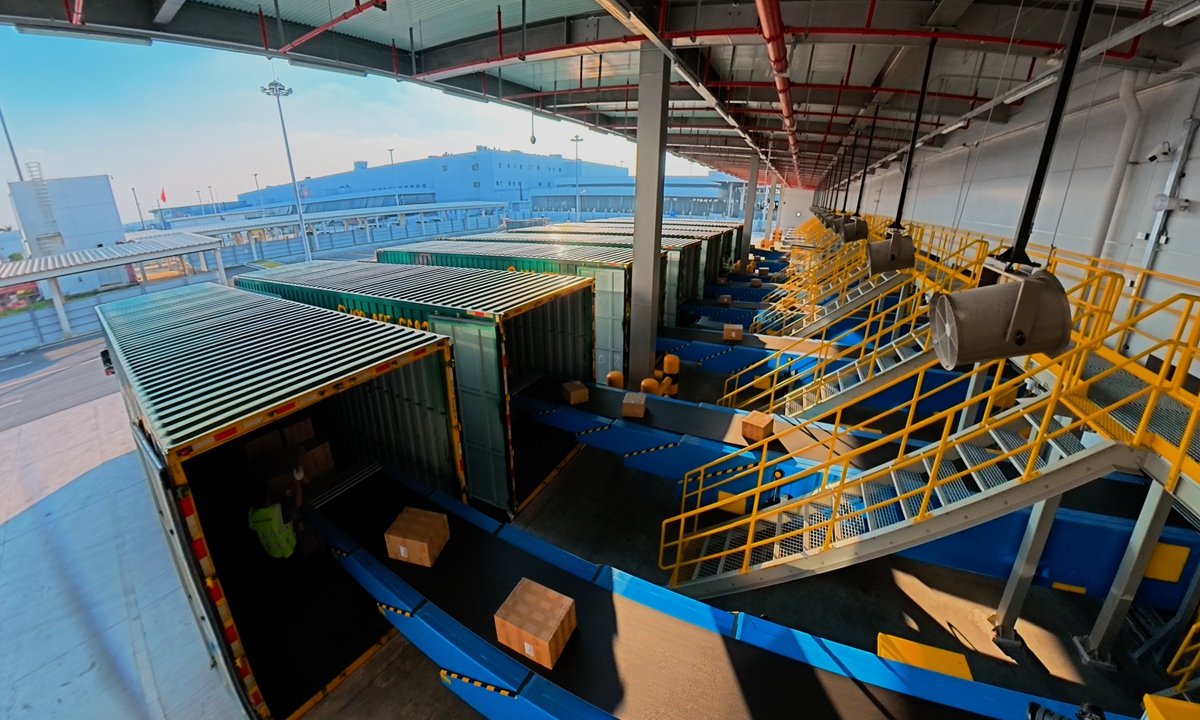
A view of the FedEx Guangzhou Baiyun Airport International Cargo Terminal 4 in Guangzhou, South China's Guangdong Province Photo: Courtesy of FedEx China
The Guangdong-Hong Kong-Macao Greater Bay Area is always a fertile place for investment.
On Monday, UnionPay and Visa announced that they will establish a "Network to Network" collaboration between the two global payment networks, a move that aims to smooth payments for overseas visitors to China and also to explore interoperability standards for AI in e-commerce.
On the same day, FedEx launched its Guangzhou Baiyun Airport International Cargo Terminal 4 - a facility built to handle more than 100,000 tons of freight a year, with peak sorting capacity of 28,000 pieces per hour, more than triple the previous level.
That is no coincidence. Behind both announcements lies the growing pull of the Guangdong-Hong Kong-Macao Greater Bay Area.
As Asia-Pacific Economic Cooperation (APEC) leaders gathered in Shenzhen this week, the region's role as the connecting hub was again on show: it helps Chinese companies reach the Asia-Pacific and the wider world, and at the same time, assists Asia-Pacific and global firms share in the opportunities of China's development.
Rising investment
In a press release Visa sent to the Global Times, it said that globe-spanning payment networks are the basic underpinning of cross-border trade and people-to-people exchanges. Aided by the interconnection of the two global payment networks, digital wallet users taking part in the collaboration can complete payments through the global contactless acceptance networks of both UnionPay and Visa using their UnionPay payment credentials, making overseas payments more convenient for Chinese consumers.
This collaboration reflects the global trend toward interoperability among different payment systems. It helps improve coordination among commercial banks, digital wallets, acquirers and merchants, broaden consumers' overseas payment options, and make cross-border payments more convenient.
FedEx said that the new facility at the Baiyun airport further strengthens the company's logistics network and service capabilities in China, supporting cross-border trade, e-commerce growth, advanced manufacturing, and healthcare supply chains, while helping small- and medium-sized enterprises access global market opportunities.
The move will ramp up Guangzhou's ability to serve as a comprehensive international aviation hub, while enhancing the Greater Bay Area's air logistics connectivity with global markets, improving cargo turnover efficiency, and reducing overall logistics costs, said FedEx.
The Greater Bay Area recorded economic output exceeding 15 trillion yuan ($2.25 trillion) in 2025, with three cities - Hong Kong, Guangzhou and Shenzhen - each producing more than 3 trillion yuan in GDP. And, in the first three quarters of this year, the region's nine mainland cities recorded 8.42 trillion yuan in imports and exports, up 24.7 percent year on year.
The region's international appeal extends beyond trade and investment. The World Intellectual Property Organization's Global Innovation Index has once again ranked the Shenzhen-Hong Kong-Guangzhou innovation cluster first among the world's top 100 innovation clusters in 2026. Guangzhou launched an innovation and entrepreneurship partnership program for Asia-Pacific youth in late September, the Xinhua News Agency reported.
Greater contribution to Asia
The Greater Bay Area's weight in global innovation, industrial and supply chains is growing ever more evident, cementing its role as a hub linking China with the Asia-Pacific and beyond.
When attending the APEC CEO Summit in Shenzhen on Tuesday, China Life Insurance chairman Cai Xiliang said that as an international center for science and technology innovation, the Greater Bay Area can draw on strong research and development capacity, well-developed industrial supply-chain support and a wealth of application scenarios, to help Asia-Pacific firms cultivate new growth drivers.
As an international commerce center, the area can leverage its strength in trade liberalization and investment facilitation to ensure Asia-Pacific companies better export to China, buy in China and invest in China, Cai said.
The Greater Bay Area's contribution to Asia-Pacific cooperation and shared prosperity grows in importance. With the interests of Asia-Pacific economies deeply intertwined, regional cooperation holds vast potential for growth, Saravoot Yoovidhya, CEO of TCP Group, told the Global Times on Wednesday.
As China continues to advance high-level opening-up, the value of its opportunities lies not only in its vast domestic market, but also in its increasingly comprehensive and complicated industrial supply chains, steady digital and green transition, and diverse, rapidly evolving consumer demands - opening up broad horizons for product innovation and industrial upgrading across the region, he said.
For example, these opportunities drive the coordinated growth of upstream and downstream partners in raw materials, packaging, and logistics, ensuring the dividends of regional cooperation reach a wider range of businesses. Through this cross-regional industrial network, small and medium-sized enterprises can more easily integrate into Asia-Pacific value chains, which enables enterprises of all sizes to collaborate within a shared ecosystem and achieve more inclusive growth, he said.
Such industrial cooperation is already taking shape. Shenzhen-based battery materials producer BTR New Material Group, a Shenzhen-based battery materials maker, opened an anode material plant in Indonesia in August 2024. Two years on, a second phase is in full operation, doubling annual capacity to 160,000 tons, Xinhua reported.
China's trade with other APEC economies surged 25.4 percent year-on-year to 27.08 trillion yuan in the first 10 months of 2026, accounting for 60.4 percent of the country's total foreign trade, data from Chinese customs showed.
Chinese experts said the figures underscore the Asia-Pacific region's pivotal role in China's foreign trade, with closer regional economic ties providing a solid foundation for trade growth.
As a leading region for China's high-quality economic development, the Greater Bay Area is well placed to make an increasingly important contribution to cooperation and shared prosperity across the Asia-Pacific region, said David Liao, HSBC's co-chief executive for Asia and the Middle East region.
It can build on the strengths of its core industries, including international finance, advanced manufacturing and innovative technology, as well as Hong Kong's role under 'One Country, Two Systems' as a hub connecting the mainland with international markets, Liao noted.
Asia is the world's fastest-growing region, according to the International Monetary Fund, and is expected to contribute 60 percent of global growth this year. More than half of Asia's trade now takes place within the region, underscoring the shift towards regional supply chains. As global trade and supply chains continue to evolve, trade, investment and innovation within the region are more important than ever in unlocking new growth opportunities.
"We believe this trend could add 1.8 percentage points to Asian GDP over the next five years," Liao said.
RELATED ARTICLES